
Commons Ontology Library
OMG GraphArch rendering of the Commons 1.3 formal specification
Specification PDF- Copyright © 2024-2025, Adaptive Analytics, Inc.
- Copyright © 2022-2025, agnos.ai U.K. Ltd.
- Copyright © 2024-2025, Airbus Group
- Copyright © 2024-2025, Boeing
- Copyright © 2024-2025, Dassault Systèmes
- Copyright © 2024-2025, DEKonsult
- Copyright © 2022-2026, EDM Council, Inc. d/b/a EDM Association
- Copyright © 2024-2025, 88Solutions
- Copyright © 2022-2025, Federated Knowledge, LLC
- Copyright © 2024-2025, GfSE e.V.
- Copyright © 2024-2025, Mayo Clinic
- Copyright © 2022-2025, OntoAge
- Copyright © 2024-2025, Ontogenesis Solutions, LLC
- Copyright © 2023-2025, Pistoia Alliance
- Copyright © 2024-2025, ProSTEP iViP Association
- Copyright © 2024-2025, Raytheon Technologies
- Copyright © 2022, QuoteWell, Inc.
- Copyright © 2024-2025, Sparx Systems Pty Ltd
- Copyright © 2022-2025, Stardog Union
- Copyright © 2022-2025, Thematix Partners LLC
- Copyright © 2022-2025, University of North Florida
- Copyright © 2022-2025, Working Ontologist
- Copyright © 2022-2026, Object Management Group, Inc.
USE OF SPECIFICATION – TERMS, CONDITIONS & NOTICES
The material in this document details an Object Management Group specification in accordance with the terms, conditions and notices set forth below. This document does not represent a commitment to implement any portion of this specification in any company's products. The information contained in this document is subject to change without notice.
LICENSES
The companies listed above have granted to the Object Management Group, Inc. (OMG) a nonexclusive, royalty-free, paid up, worldwide license to copy and distribute this document and to modify this document and distribute copies of the modified version. Each of the copyright holders listed above has agreed that no person shall be deemed to have infringed the copyright in the included material of any such copyright holder by reason of having used the specification set forth herein or having conformed any computer software to the specification.
Subject to all of the terms and conditions below, the owners of the copyright in this specification hereby grant you a fully-paid up, non-exclusive, nontransferable, perpetual, worldwide license (without the right to sublicense), to use this specification to create and distribute software and special purpose specifications that are based upon this specification, and to use, copy, and distribute this specification as provided under the Copyright Act; provided that: (1) both the copyright notice identified above and this permission notice appear on any copies of this specification; (2) the use of the specifications is for informational purposes and will not be copied or posted on any network computer or broadcast in any media and will not be otherwise resold or transferred for commercial purposes; and (3) no modifications are made to this specification. This limited permission automatically terminates without notice if you breach any of these terms or conditions. Upon termination, you will destroy immediately any copies of the specifications in your possession or control.
PATENTS
The attention of adopters is directed to the possibility that compliance with or adoption of OMG specifications may require use of an invention covered by patent rights. OMG shall not be responsible for identifying patents for which a license may be required by any OMG specification, or for conducting legal inquiries into the legal validity or scope of those patents that are brought to its attention. OMG specifications are prospective and advisory only. Prospective users are responsible for protecting themselves against liability for infringement of patents.
GENERAL USE RESTRICTIONS
Any unauthorized use of this specification may violate copyright laws, trademark laws, and communications regulations and statutes. This document contains information which is protected by copyright. All Rights Reserved. No part of this work covered by copyright herein may be reproduced or used in any form or by any means--graphic, electronic, or mechanical, including photocopying, recording, taping, or information storage and retrieval systems--without permission of the copyright owner.
DISCLAIMER OF WARRANTY
WHILE THIS PUBLICATION IS BELIEVED TO BE ACCURATE, IT IS PROVIDED "AS IS" AND MAY CONTAIN ERRORS OR MISPRINTS. THE OBJECT MANAGEMENT GROUP AND THE COMPANIES LISTED ABOVE MAKE NO WARRANTY OF ANY KIND, EXPRESS OR IMPLIED, WITH REGARD TO THIS PUBLICATION, INCLUDING BUT NOT LIMITED TO ANY WARRANTY OF TITLE OR OWNERSHIP, IMPLIED WARRANTY OF MERCHANTABILITY OR WARRANTY OF FITNESS FOR A PARTICULAR PURPOSE OR USE. IN NO EVENT SHALL THE OBJECT MANAGEMENT GROUP OR ANY OF THE COMPANIES LISTED ABOVE BE LIABLE FOR ERRORS CONTAINED HEREIN OR FOR DIRECT, INDIRECT, INCIDENTAL, SPECIAL, CONSEQUENTIAL, RELIANCE OR COVER DAMAGES, INCLUDING LOSS OF PROFITS, REVENUE, DATA OR USE, INCURRED BY ANY USER OR ANY THIRD PARTY IN CONNECTION WITH THE FURNISHING, PERFORMANCE, OR USE OF THIS MATERIAL, EVEN IF ADVISED OF THE POSSIBILITY OF SUCH DAMAGES.
The entire risk as to the quality and performance of software developed using this specification is borne by you. This disclaimer of warranty constitutes an essential part of the license granted to you to use this specification.
RESTRICTED RIGHTS LEGEND
Use, duplication or disclosure by the U.S. Government is subject to the restrictions set forth in subparagraph (c) (1) (ii) of The Rights in Technical Data and Computer Software Clause at DFARS 252.227-7013 or in subparagraph (c)(1) and (2) of the Commercial Computer Software - Restricted Rights clauses at 48 C.F.R. 52.227-19 or as specified in 48 C.F.R. 227-7202-2 of the DoD F.A.R. Supplement and its successors, or as specified in 48 C.F.R. 12.212 of the Federal Acquisition Regulations and its successors, as applicable. The specification copyright owners are as indicated above and may be contacted through the Object Management Group, 9C Medway Road, PMB 274, Milford, MA 01757, U.S.A.
TRADEMARKS
CORBA®, CORBA logos®, FIBO®, Financial Industry Business Ontology®, FINANCIAL INSTRUMENT GLOBAL IDENTIFIER®, IIOP®, IMM®, Model Driven Architecture®, MDA®, Object Management Group®, OMG®, OMG Logo®, SoaML®, SOAML®, SysML®, UAF®, Unified Modeling Language®, UML®, UML Cube Logo®, VSIPL®, and XMI® are registered trademarks of the Object Management Group, Inc.
For a complete list of trademarks, see: https://www.omg.org/legal/tm_list.htm. All other products or company names mentioned are used for identification purposes only, and may be trademarks of their respective owners.
COMPLIANCE
The copyright holders listed above acknowledge that the Object Management Group (acting itself or through its designees) is and shall at all times be the sole entity that may authorize developers, suppliers and sellers of computer software to use certification marks, trademarks or other special designations to indicate compliance with these materials.
Software developed under the terms of this license may claim compliance or conformance with this specification if and only if the software compliance is of a nature fully matching the applicable compliance points as stated in the specification. Software developed only partially matching the applicable compliance points may claim only that the software was based on this specification but may not claim compliance or conformance with this specification. In the event that testing suites are implemented or approved by Object Management Group, Inc., software developed using this specification may claim compliance or conformance with the specification only if the software satisfactorily completes the testing suites.
OMG’s Issue Reporting Procedure
All OMG specifications are subject to continuous review and improvement. As part of this process, we encourage readers to report any ambiguities, inconsistencies, or inaccuracies they may find by completing the Issue Reporting Form listed on the main web page https://www.omg.org, under Specifications, Report a Bug/Issue (https://issues.omg.org/issues/create-new-issue).
1. Library overview§
1.1 OMG Commons Ontology Library§
Explore the 24 ontologies in this library. Select an ontology to read its vocabulary reference.
Preface§
OMG§
Founded in 1989, the Object Management Group, Inc. (OMG) is an open membership, not-for-profit computer industry standards consortium that produces and maintains computer industry specifications for interoperable, portable, and reusable enterprise applications in distributed, heterogeneous environments. Membership includes Information Technology vendors, end users, government agencies, and academia.
OMG member companies write, adopt, and maintain its specifications following a mature, open process. OMG’s specifications implement the Model Driven Architecture® (MDA®), maximizing ROI through a full-lifecycle approach to enterprise integration that covers multiple operating systems, programming languages, middleware and networking infrastructures, and software development environments. OMG’s specifications include: UML® (Unified Modeling Language®); CORBA® (Common Object Request Broker Architecture); CWM™ (Common Warehouse Metamodel™); and industry-specific standards for dozens of vertical markets.
More information on the OMG is available at https://www.omg.org/.
OMG Specifications§
As noted, OMG specifications address middleware, modeling and vertical domain frameworks. All OMG Specifications are available from the OMG website at:
https://www.omg.org/spec
All of OMG’s formal specifications may be downloaded without charge from our website. (Products implementing OMG specifications are available from individual suppliers.) Copies of specifications, available in PDF format, may be obtained from the Specifications Catalog cited above or by contacting the Object Management Group, Inc. at:
OMG Headquarters
9C Medway Road, PMB 274
Milford, MA 01757
USA
Tel: +1-781-444-0404
Fax: +1-781-444-0320
Email: pubs@omg.org
Certain OMG specifications are also available as ISO standards. Please consult http://www.iso.org
Issues§
The reader is encouraged to report any technical or editing issues/problems with this specification via the report form at:
https://issues.omg.org/issues/create-new-issue
2. Scope§
2.1 Introduction§
The Commons Ontology Library is designed to provide a useful set of modeling constructs that are reusable in different modeling and data deployment environments with minimal commitments. It is intended to be extensible such that new ontologies and potentially other models (for example, UML models corresponding to the ontologies) can be added as cross-domain requirements present themselves. These requirements may come from other OMG standards efforts or potentially from external users of the library, for example, the Industrial Ontology Foundry (IOF) manufacturing community, EDM Council projects with the Pistoia Alliance IDMP pharmaceutical community, and others.
2.2 Criteria for Inclusion§
Ontologies and other models will be identified primarily by drawing on other work, although care must be taken to ensure that intellectual property and other legal rights are addressed, and that standardization is desired by the user community. Oversight for curation of the library will be managed by the Commons revision task force (RTF) via the normal OMG process. The minimum criteria identified to date for inclusion include: (1) the need for the same set of concepts with the same semantics across multiple specifications and/or domain areas, such as manufacturing, finance and/or retail, (2) a clear set of use cases, competency questions, and test cases that can help limit the scope for a given ontology and provide the basis for regression testing, (3) reusability in their own right with minimal dependencies on other ontologies with the possible exception of other Commons ontologies, and (4) that the ontologies meet minimal requirements for metadata, logical consistency, and serialization (e.g., RDF/XML and Turtle serialized OWL, for OWL ontologies).
2.3 Overview§
The Commons Ontology Library of ontologies specified herein covers:
(1) Annotations
- A reusable set of declarations for commonly used annotation properties from the Dublin Core Metadata Initiative (DCMI) Terms1 and the Simple Knowledge Organization System (SKOS)2, so that these vocabularies can be reused without importing either.
- Additional annotation properties that provide metadata for documentation that is not explicitly available in either Dublin Core or SKOS.
(2) Collections:
- Collections – commonly used concepts for arrangements and schemes for organizing information and collections of things, such as structured collections that may be organized according to some scheme and related very high-level mereology relations to enable association of things with such collections and schemes.
- Structured Collections – an extension to collections that defines chronologically and indexed collections as well as sets and lists.
(3) Roles and Compositions:
- The notion of a composition that can be used, for example to relate something, such as a product or recipe, to its ingredients or constituents, and/or to the roles such constituents play in the composition, and optionally to some context, such as a jurisdiction, in which the composition is relevant.
- The concept of a role, supporting the representation of participants in compositions, situations, and relationships, as well as properties that link the role to something that plays that role, that links something to a role it has (e.g., a role that is pertinent to a situation or composition), as well as inverses that enable role traversal in a graph.
(4) Designations:
- Designators - commonly used concepts for naming, derived in part from the patterns defined in ISO 1087 for terminology work and ISO 11179-3, Metadata Registries. The top-level designators ontology includes several very high-level semiotic relationships, including defines, describes, and denotes for associating designators with the concepts they reference.
- Contextual Designators – an extension to the designators ontology to incorporate applicable dates and times and facilitate the inclusion of other context that is commonly needed, derived in part from the patterns defined in ISO 11179-3, Metadata Registries.
- Codes and Code Sets - commonly used concepts for describing codes, including standardized codes such as ISO language, country, and other code sets, the North American Industry Classification System (NAICS) codes, and custom code sets that many organizations develop for various purposes, derived from the patterns specified in ISO 11179-3, Metadata Registries.
- Identifiers - commonly used concepts for describing identifiers and the identification schemes that define them, such as various national and international identifiers for legal entities, financial instruments, and the like, derived from the patterns specified in ISO 11179-3, Metadata Registries.
- Contextual Identifiers – an extension to the contextual designators and identifiers ontologies covering concepts for describing more complex identifiers, including those that apply for some period of time as well as those that are structured and include other codes or identifiers.
- Languages – High-level concepts defining languages, including natural as well as formal languages, based on a number of standards including but not limited to ISO 639 as well as the language element of the Language Tag specified in BCP 47 (RFC 4646, RFC 4647). The concept of a language is included here to normalize definitions across the Application Programming Interfaces for Knowledge Platforms (API4KP), Distributed Ontology, Model, and Specification Language (DOL), Languages, Countries, and Codes (LCC), and Multiple Vocabulary Facility (MVF) standards to support interoperability, and for use in other OMG and external ontology projects.
(5) Classifiers:
- Abstract concepts for representation of classification schemes that enable the classification of arbitrary concepts into hierarchies (or partial orders) for use in other ontologies, derived in part from the patterns defined in ISO 1087-1 for terminology work and ISO 11179-3, Metadata Registries.
(6) Locations:
- Locations – Very high-level definitions of geographic region and geopolitical entity related concepts, including, but not limited to, countries, sub-country regions such as states and provinces, and municipalities, derived from a combination of ISO 3166, the UN M49 Region codes, Geonames, and other sources.
- Sites and Facilities – High-level concepts related to facilities, both virtual and physical, including sites that provide the context for various facilities.
(7) Parties :
- Parties and Situations – The concepts of agent, agent role, party, party role, and situation, which is a state of affairs or reified relationship that holds for some period of time, including lattice relations between the concepts driven by property chains that can be used to access the lattice from any perspective in the resulting graph.
- Organizations – an extension of the parties and situations and locations ontologies that defines organization, legal entity, organization membership, and related identifiers, as well as service and service provider, designed to enable mapping to other organization ontologies such as the W3C Organizations ontology.
- Business Authorizations – the concept of authorization from a business perspective, rather than security or access control viewpoint, as a situation or state of affairs, including related parties. This extension is needed to cover a range of requirements from retail, for example for defining digital signatures, as well as for banking and pharmaceuticals, for defining marketing and manufacturing authorizations for medicines.
- Registration Authorities – a small ontology that extends organizations defining registration authorities, registrars, registration-specific identifiers and related identification schemes, modeled after patterns included in ISO/IEC 11179-3.
- Regulatory Agencies – an extension of locations and organizations that specifies concepts including regulatory agencies, also known as regulatory authorities or regulators, and their jurisdictions.
(8) Quantities and Units:
- Documents - a small documents ontology that can be mapped to others, such as FRBR, to support representation of references and reference documents required for documenting certain units.
- Quantities and Units - an ontology defining scalar quantities and units, corresponding to the quantities and units library in SysML v2 covering the key concepts required for most domains, including but not limited to measurement scales, quantity kinds, dimensions, scalar quantities and scalar units.
(9) Time:
- Dates and Times - commonly used temporal concepts that cover those most frequently needed across domains, with a focus on terminology that is used in business applications. It is designed to be mappable to other date and time ontologies and specifications, such as the W3C Time Ontology in OWL3, certain temporal elements in ISO Basic Formal Ontology4, time concepts defined in schema.org, and the OMG Date Time Vocabulary (DTV) specification, without the corresponding overhead, or in some cases, issues. The concepts were originally derived from a number of date and time standards including ISO 8601:2004 Representation of Dates and Times.
- Mapping Dates and Times to OWL Time – an extension to the dates and times ontology to map it to the widely used W3C Time Ontology in OWL recommendation.
(10) Text Datatype:
- A custom datatype that combines language tagged and plain string values. This text datatype is useful in cases where it is not clear whether string values will be tagged or not, but where it is anticipated that multilingual strings might be appropriate.
Each of these ontologies is defined below.
2.4 Metadata§
Annotations on concepts, properties, and individuals in this specification follow the general policies recommended by the OMG Architecture Board, including the use of (1) the Dublin Core Metadata Terms [Dublin Core], (2) the Simple Knowledge Organization System (SKOS) [SKOS], and (3) the annotation vocabulary included in the Commons Ontology Library. Every element in the ontologies defined in the Commons Ontology Library must have a label and definition, and in many cases, the source for the definitions, such as an ISO or other OMG standard, is referenced. Examples are also included as appropriate, along with other notes that may assist users in understanding and reusing the ontology.
Dublin Core Metadata Initiative (DCMI), DCMI Metadata Terms -- https://www.dublincore.org/specifications/dublin-core/dcmi-terms/
Simple Knowledge Organization System (SKOS) -- https://www.w3.org/TR/2009/REC-skos-reference-20090818/
Available at https://www.omg.org/TR/owl-time
3. Conformance§
The Commons Ontology Library specification provides two options for conformance points for implementers. These are as follows:
(1) Specification-level conformance with the OWL ontologies, which means that the subject application formally imports the ontologies (i.e., through owl:imports statements in another ontology or via loading the full set of ontologies for reference in a knowledge graph that supports OWL) with no resulting logical inconsistencies.
(2) Linked Data-level conformance – which means that the subject application references one or more of the ontologies but does not formally import them.
For either conformance point, references to the elements defined in a given ontology must use, or provide a mapping to, the standard OMG URI for that element. Users may choose to use or extend any of the Commons Ontology Library ontologies as necessary, to add concepts and properties required between releases, or to add application-specific extensions needed to address their individual requirements. We encourage library implementers and users to submit any requirements for extension, including requests to add ontologies to the library, to the relevant task force as issues.
4. References§
4.1 Normative References§
| Reference | Description |
|---|---|
| [BCP 47] | BCP 47: Tags for Identifying Languages, available at https://datatracker.ietf.org/doc/bcp47/. |
| [DTV] | Date-Time Vocabulary (DTV™). Available at https://www.omg.org/spec/DTV/. |
| [Dublin Core] | DCMI Metadata Terms, Issued 2020-01-20 by the Dublin Core™ Metadata Initiative. Available at https://www.dublincore.org/specifications/dublin-core/dcmi-terms/. |
| [ISO 704] | ISO 704:2009 Terminology work – Principles and methods, Fourth edition, 2022-07 |
| [ISO 1087] | ISO 1087:2019 Terminology work – Vocabulary – Theory and Application, Second edition, 2019-09 |
| [ISO 8601-1] | ISO 8601-1:2019 Date and Time – Representations for information interchange – Part 1: Basic Rules |
| [ISO 11179-3] | ISO/IEC 11179-3:2013 Information technology – Metadata registries (MDR) – Registry metamodel and basic attributes, Third edition, 2013-02-15 |
| [MOF] | Meta Object Facility (MOF™) Core. Available at https://www.omg.org/spec/MOF/ |
| [MOF XMI] | MOF 2/XMI (XML Metadata Interchange) Mapping Specification. Available at https://www.omg.org/spec/XMI/ |
| [ODM] | Ontology Definition Metamodel (ODM™). Available at https://www.omg.org/spec/ODM/ |
| [OWL 2] | OWL 2 Web Ontology Language Quick Reference Guide (Second Edition), W3C Recommendation 11 December 2012. Available at http://www.w3.org/TR/2012/REC-owl2-quick-reference-20121211/. |
| [RDF Concepts] | RDF 1.1 Concepts and Abstract Syntax. Richard Cyganiak, David Wood and Markus Lanthaler, Editors. W3C Recommendation, 25 February 2014. Available at http://www.w3.org/TR/rdf11-concepts/ |
| [RDF Schema] | RDF Schema 1.1. Dan Brickley and R.V. Guha, Editors. W3C Recommendation, 25 February 2014. Available at http://www.w3.org/TR/rdf-schema/. |
| [SKOS] | SKOS Simple Knowledge Organization System Reference, W3C Recommendation 18 August 2009. Available at http://www.w3.org/TR/2009/REC-skos-reference-20090818/. |
| [SMOF] | MOF Support for Semantic Structures (SMOF™). Available at https://www.omg.org/spec/SMOF/. |
| [SysML] | OMG System Modeling Language (SysML®). Available at https://www.omg.org/spec/SysML/. |
| [UML] | Unified Modeling Language™ (UML®). Available at https://www.omg.org/spec/UML/ |
| [Unicode] | The Unicode Standard, Version 3, The Unicode Consortium, Addison-Wesley, 2000. ISBN 0-201-61633-5, as updated from time to time by the publication of new versions. (See https://www.unicode.org/unicode/standard/versions/enumeratedversions.html for the latest version and additional information on versions of the standard and of the Unicode Character Database). |
| [UTF-8] | RFC 3629: UTF-8, a transformation format of ISO 10646. F. Yergeau. IETF, November 2003, http://www.ietf.org/rfc/rfc3629.txt |
| [W3C Datatypes in RDF and OWL] | XML Schema Datatypes in RDF and OWL, W3C Working Group Note 14 March 2006, Available at http://www.w3.org/TR/2006/NOTE-swbp-xsch-datatypes-20060314/. |
| [W3C OWL Time] | W3C Time Ontology in OWL, available at https://www.w3.org/TR/owl-time/ |
| [XML Schema Datatypes] | XML Schema Part 2: Datatypes Second Edition. W3C Recommendation 28 October 2004. Available at http://www.w3.org/TR/xmlschema-2/. |
4.2 Non-Normative References§
The following informative documents are referenced in this specification:
| Reference | Description |
|---|---|
| [DL Handbook] | THE DESCRIPTION LOGIC HANDBOOK: Theory, implementation, and applications. Baader, McGuinness, Nardi, and Patel-Schneider, editors. Cambridge University Press, Cambridge, United Kingdom, 2003. |
| [OE] | Kendall, Elisa F. and Deborah L. McGuinness. Ontology Engineering: Synthesis Lectures on the Semantic Web: Theory and Technology. Morgan & Claypool Publishers. 2019. doi: 10.2200/S00834ED1V01Y201802WBE018 |
5. Terms and Definitions§
For the purposes of this specification, the following terms and definitions apply.
| Term | Definition |
|---|---|
| annotation | note or comment added to provide explanatory information or other metadata about some element in an ontology |
| arrangement | systematic plan, manner, or method for making, doing, achieving, or organizing something |
| aspect | characteristic or feature that can be used to dimensionalize, filter, or subset something |
| collection | grouping of things (may be zero) that have some shared significance |
| composition | distinct element resulting from bringing together other elements, possibly in specific roles, for a particular purpose |
| context | situation or frame of reference in which something applies, exists, happens, or is used and that helps to illustrate or explain it |
| designation | representation for someone or something by a sign that denotes it |
| mereology | theory of parthood relations: the relations of part to whole and the relations of part to part within a whole |
| ontology | An ontology specifies a rich description of the: • Terminology, concepts, nomenclature • Relationships among and between concepts and individuals • Sentences distinguishing concepts, refining definitions and relationships (constraints, restrictions, regular expressions) relevant to a particular domain or area of interest. [OE] |
| role | named specific behavior of something participating in a particular context |
6. Symbols§
6.1 Symbols§
See clause 6.5, Notation, for a description of the logic symbols used to describe the ontologies covered in this specification.
6.2 Abbreviations§
The following abbreviations are used throughout this specification:
DL – Description Logics
FIBO – Financial Industry Business Ontology
IOF – Industrial Ontology Foundry
IRI – Internationalized (Uniform) Resource Identifier
ISO – International Organization for Standardization
LCC – Languages, Countries and Codes
MVF – Multiple Vocabulary Facility
OWL – Web Ontology Language
ODM – Ontology Definition Metamodel
RDF – Resource Description Framework
UML – Unified Modeling Language
URI – Uniform Resource Identifier
URL – Uniform Resource Locator
W3C – World Wide Web Consortium
XMI – XML Metadata Interchange
XML – eXtensible Markup Language
7. Additional Information§
7.1 Changes to Other OMG Specifications§
None.
7.2 Acknowledgments§
The following organization submitted this specification:
- Thematix Partners LLC
The following companies and organizations are supporters of this specification:
- 88solutions
- Accurids GmbH
- Adaptive, Inc.
- agnos.ai U.K. Ltd
- Airbus Group
- Boeing
- Dassault Systèmes
- DEKonsult
- EDM Council, Inc.
- Federated Knowledge, LLC
- Jackrabbit Consulting
- Mayo Clinic
- Micro Focus International Plc
- Model Driven Solutions
- OntoAge
- Ontogenesis Solutions, LLC
- OpenText Inc.
- Pharmalex GmbH
- Pistoia Alliance, Inc.
- QuoteWell, Inc.
- Raytheon Technologies (RTX)
- Rensselaer Polytechnic Institute
- Sparx Systems Pty Ltd
- U. S. National Institute of Standards and Technology (NIST)
- Wells Fargo Bank, N.A.
- Working Ontologist
7.3 Intellectual Property Rights§
The Commons Ontology Library is available under the OMG’s Copyright and Non-Assertion Covenant (see https://www.omg.org/cgi-bin/doc.cgi?ipr for details). The individual ontologies are also licensed for use under the MIT open-source license agreement, available at https://opensource.org/licenses/MIT.
7.4 Application of the Commons Ontologies§
With respect to OMG standards, the ontologies included in the library are reused by the Multiple Vocabulary Facility (MVF) specification and an anticipated update of the Languages, Countries and Codes (LCC) specification. For LCC, they replace existing concepts that were needed for MVF derived from LCC. The ontologies are also used by the API4KP specification, the Financial Industry Business Ontology (FIBO), by the emerging Retail Industry Ontology (RIO), and by the Robotics Service Ontology specification.
In addition to their use in OMG standards, initiatives such as the Industrial Ontology Foundry (IOF), sponsored by the U.S. National Institute of Standards and Technology and a joint effort of the Pistoia Alliance and EDM Council for ontologies that facilitate identification of medicinal products (IDMP).
7.5 Notation§
The diagrams included herein are ODM-compliant UML diagrams. In other words, they conform to the UML Profiles for RDF and OWL specified in the OMG’s Ontology Definition Metamodel [ODM] Specification. This includes the set of UML stereotypes and graphical notation used in the diagrams provided.
The color scheme employed in these diagrams includes:
- Basic OWL Classes: white for classes defined within the current (local) ontology, amber for classes defined within an imported (referenced) ontology
- OWL Restriction Classes and other Class Expressions (unions, intersection, complements): green
- OWL Object Properties: blue
- OWL Data Properties: dark gray
- OWL Datatypes: pink
- OWL Individuals: light gray
These colors are provided for clarification purposes only and are non-normative.
For the library there is an “about” file, which provides metadata about the library, described below in tabular form. The ontologies themselves are documented as ODM-compliant UML models, aside from the “about” file, annotation vocabulary, and mapping ontology. Every ontology is expressed in RDF/XML-serialized OWL and Turtle-serialized OWL [OWL 2].
The notation used to represent description logic expressions (i.e., the expressions in the Parent columns in class tables containing ontology details) is consistent with the notation defined in the Description Logic Handbook [DL Handbook]. The notation used in this specification, representing a subset of OWL 2, is described in Table 6-1, below.
| Construct | Description | Notation |
|---|---|---|
| Boolean Connectives and Enumeration | ||
| intersection | The intersection of two classes consists of exactly those individuals which are instances of both classes. | C∩D |
| union | The union of two classes contains every individual which is contained in at least one of these classes. | C∪D |
| enumeration | An enumeration defines a class by enumerating all its instances. | oneOf (i1, i2, i3, … in) |
| Property Restrictions | ||
| universal quantification | Universal quantification is used to specify a class of individuals for which all related individuals must be instances of a given class (i.e., allValuesFrom in OWL). | ∀R.C, where R is the relation (property) and C is the class that constrains all values for related individuals |
| existential quantification | Existential quantification is used to specify a class as the set of all individuals that are connected via a particular property to at least one individual which is an instance of a certain class (i.e., someValuesFrom in OWL). | ∃R.C, where R is the relation (property) and C is the class that constrains some values of related individuals |
| individual value | Individual value restrictions are used to specify classes of individuals that are related to one particular individual (i.e., hasValue in OWL). | R.I, where R is the relation (property) and I is the individual |
| exact cardinality | Cardinality (number) restrictions specify classes by restricting the cardinality on the sets of fillers for roles (relationships, or properties in OWL). Exact cardinality restrictions restrict the cardinality of possible fillers to exactly the number specified. | = n R (for unqualified restrictions) = n R.C (for qualified restrictions, i.e., including onClass or on DataRange) |
| maximum cardinality | Maximum cardinality restrictions restrict the cardinality of possible fillers to at most the number specified (inclusive). | ≤ n R (for unqualified restrictions) ≤ n R.C (for qualified restrictions) |
| minimum cardinality | Minimum cardinality restrictions restrict the cardinality of possible fillers to at least the number specified (inclusive). | ≥ n R (for unqualified restrictions) ≥ n R.C (for qualified restrictions) |
| Class Axioms | ||
| equivalent classes | Two classes are considered equivalent if they contain exactly the same individuals. | ≡C |
| disjoint classes | Disjointness means that membership in one class specifically excludes membership in another. | ¬C |
| Property Axioms | ||
| complex role inclusions | Role inclusions allow [object] properties to be chained together in a sequence that is a subproperty of a higher-level property. | R○R |
Note that in the case of complex restrictions, where there are nested elements in parentheses, the “dot notation” used as a separator between a property and the role filler is replaced with the embedded parenthetical filler definition. A “role” from a description logic perspective is essentially a property in OWL, and the role “filler” is the class or individual that provides the value for that role in a given axiom (i.e., in a restriction or other logic expression).
8. Architecture§
8.1 “About” the Commons Ontologies§
The “about” file for the Commons Ontology Library provides metadata describing the library. This file is designed to (1) describe the machine-readable content of the specification for users that download the entire library directly and imports it into tools that can interpret and display the files, (2) for potential use in tagging the specification document on the OMG site, and (3) to provide a single file that imports the ontologies for ease of use (similar to a “make file” for software), excluding the mapping to the W3C Time Ontology in OWL, which may or may not be desired.
8.2 Namespace Definitions§
The namespaces and prefixes corresponding to external elements required for use in the Commons Ontology Library are provided in Table 7-1. Table 7-2 provides the namespace declarations required for use of the ontologies included in the library itself. The prefixes provided in Table 7-1 and 7-2 are normative, and their use is required in any conformant application or extension.
| Namespace Prefix | Namespace |
|---|---|
| rdf | http://www.w3.org/1999/02/22-rdf-syntax-ns# |
| rdfs | http://www.w3.org/2000/01/rdf-schema# |
| owl | http://www.w3.org/2002/07/owl# |
| xsd | http://www.w3.org/2001/XMLSchema# |
| dct | http://purl.org/dc/terms/ |
| skos | http://www.w3.org/2004/02/skos/core# |
| time | http://www.w3.org/2006/time# |
The namespace approach taken for Commons Ontology Library is based on OMG guidelines and is constructed as follows:
- The standard protocol, authority, and top level specification part of any OMG specification namespace, which is https://www.omg.org/spec/
- The abbreviation for the specification: in this case Commons
- The ontology name
Note that the URI/IRI strategy for the ontologies included in the library takes a “slash” rather than “hash” approach, in order to accommodate server-side applications. Namespace prefixes are constructed as follows with the components separated by “-“:
- The abbreviation used for prefix purposes across the Commons Ontology Library: cmns
- An abbreviation for the ontology name
The namespaces and prefixes for the individual ontologies are summarized in Table 7-2 These are given in alphabetical order, rather than with any intent to show imports relationships. The table includes the namespace definitions for the “about” file that is part of the machine-readable deliverables for the specification, but that is not required for imports closure. Note that these are not versioned, although version IRIs are included in every OWL ontology and are documented in the metadata for each of them.
| Namespace Prefix | Namespace |
|---|---|
| cmns-abt | https://www.omg.org/spec/Commons/AboutCommons/ |
| cmns-av | https://www.omg.org/spec/Commons/AnnotationVocabulary/ |
| cmns-bauth | https://www.omg.org/spec/Commons/BusinessAuthorizations/ |
| cmns-cds | https://www.omg.org/spec/Commons/CodesAndCodeSets/ |
| cmns-cls | https://www.omg.org/spec/Commons/Classifiers/ |
| cmns-col | https://www.omg.org/spec/Commons/Collections/ |
| cmns-cxtdsg | https://www.omg.org/spec/Commons/ContextualDesignators/ |
| cmns-cxtid | https://www.omg.org/spec/Commons/ContextualIdentifiers/ |
| cmns-doc | https://www.omg.org/spec/Commons/Documents/ |
| cmns-dsg | https://www.omg.org/spec/Commons/Designators/ |
| cmns-dt | https://www.omg.org/spec/Commons/DatesAndTimes/ |
| cmns-id | https://www.omg.org/spec/Commons/Identifiers/ |
| cmns-lang | https://www.omg.org/spec/Commons/Languages/ |
| cmns-loc | https://www.omg.org/spec/Commons/Locations/ |
| cmns-mdt | https://www.omg.org/spec/Commons/MappingDatesAndTimesToOWLTime/ |
| cmns-org | https://www.omg.org/spec/Commons/Organizations/ |
| cmns-pts | https://www.omg.org/spec/Commons/PartiesAndSituations/ |
| cmns-qtu | https://www.omg.org/spec/Commons/QuantitiesAndUnits/ |
| cmns-ra | https://www.omg.org/spec/Commons/RegistrationAuthorities/ |
| cmns-rga | https://www.omg.org/spec/Commons/RegulatoryAgencies/ |
| cmns-rlcmp | https://www.omg.org/spec/Commons/RolesAndCompositions/ |
| cmns-sfc | https://www.omg.org/spec/Commons/SitesAndFacilities/ |
| cmns-strcol | https://www.omg.org/spec/Commons/StructuredCollections/ |
| cmns-txt | https://www.omg.org/spec/Commons/TextDatatype/ |
9. Commons Ontologies§
The Commons Ontology Library comprises the following ontologies.
9.1. About the Commons Ontology Library§
This ontology is provided for the convenience of Commons users. It can be used to load all of the current Commons ontologies, using a relative catalog, as needed in Protege or other tools.
Metadata for the About the Commons Ontology Library is given in About the Commons Ontology Library Metadata.
| Metadata Term | Value |
|---|---|
|
Ontology IRI |
|
|
|
About the Commons Ontology Library |
|
|
This ontology is provided for the convenience of Commons users. It can be used to load all of the current Commons ontologies, using a relative catalog, as needed in Protege or other tools. |
|
|
Davide Sottara, Mayo Clinic |
|
|
Dean Allemang, Working Ontologist LLC |
|
|
Elisa Kendall, Thematix Partners LLC |
|
|
Evan Wallace, U.S. Department of Commerce, National Institute of Standards and Technology (NIST) |
|
|
Hans Peter de Koning, DEKonsult |
|
|
Jim Logan, Ontogenesis Solutions, LLC |
|
|
Michel Sauvage, Airbus Group |
|
|
Pete Rivett, Federated Knowledge, LLC |
|
|
Roger Burkhart, Thematix Partners LLC |
|
|
Steve Jenkins, Jet Propulsion Laboratory (JPL), California Institute of Technology, National Aeronautics and Space Administration (NASA) |
|
|
Stuart Chalk, University of North Florida |
|
|
Thomas Barre, Airbus Group |
|
|
Copyright (c) 2014-2025 EDM Council, Inc. |
|
|
Copyright (c) 2014-2025 Thematix Partners LLC |
|
|
Copyright (c) 2020-2025 Stardog Union |
|
|
Copyright (c) 2020-2025 Working Ontologist LLC |
|
|
Copyright (c) 2021-2025 Federated Knowledge, LLC |
|
|
Copyright (c) 2021-2025 Mayo Clinic |
|
|
Copyright (c) 2021-2025 agnos.ai U.K. Ltd |
|
|
Copyright (c) 2022-2025 DEKonsult |
|
|
Copyright (c) 2022-2025 Object Management Group, Inc. |
|
|
Copyright (c) 2022-2025 OntoAge |
|
|
Copyright (c) 2022-2025 Pistoia Alliance, Inc. |
|
|
Copyright (c) 2022-2025 University of North Florida |
|
|
Copyright (c) 2024-2025 88solutions |
|
|
Copyright (c) 2024-2025 Adaptive Analytics, Inc. |
|
|
Copyright (c) 2024-2025 Airbus Group |
|
|
Copyright (c) 2024-2025 Boeing |
|
|
Copyright (c) 2024-2025 Dassault Systemes |
|
|
Copyright (c) 2024-2025 GfSE e.V. |
|
|
Copyright (c) 2024-2025 Ontogenesis Solutions, LLC |
|
|
Copyright (c) 2024-2025 ProSTEP iViP Association |
|
|
Copyright (c) 2024-2025 Raytheon Technologies |
|
|
Copyright (c) 2024-2025 Sparx Systems Pty Ltd |
|
|
Copyright (c) 2014-2025 EDM Council, Inc. Permission is hereby granted, free of charge, to any person obtaining a copy of this software and associated documentation files (the 'Software'), to deal in the Software without restriction, including without limitation the rights to use, copy, modify, merge, publish, distribute, sublicense, and/or sell copies of the Software, and to permit persons to whom the Software is furnished to do so, subject to the following conditions: The above copyright notice and this permission notice shall be included in all copies or substantial portions of the Software. THE SOFTWARE IS PROVIDED 'AS IS', WITHOUT WARRANTY OF ANY KIND, EXPRESS OR IMPLIED, INCLUDING BUT NOT LIMITED TO THE WARRANTIES OF MERCHANTABILITY, FITNESS FOR A PARTICULAR PURPOSE AND NONINFRINGEMENT. IN NO EVENT SHALL THE AUTHORS OR COPYRIGHT HOLDERS BE LIABLE FOR ANY CLAIM, DAMAGES OR OTHER LIABILITY, WHETHER IN AN ACTION OF CONTRACT, TORT OR OTHERWISE, ARISING FROM, OUT OF OR IN CONNECTION WITH THE SOFTWARE OR THE USE OR OTHER DEALINGS IN THE SOFTWARE. See https://opensource.org/licenses/MIT. |
|
|
|
|
|
|
|
|
ISO 1087:2019 Terminology work - Vocabulary - Theory and Application, Second edition, 2019-09 |
|
|
ISO 11240 Health informatics - Identification of medicinal products - Data elements and structures for the unique identification and exchange of units of measurement |
|
|
ISO 12651-2:2014, Electronic document management - Vocabulary - Part 2: Workflow management |
|
|
ISO 14813-1:2015 Intelligent transport systems - Reference model architecture(s) for the ITS sector - Part 1: ITS service domains, service groups and services |
|
|
ISO 18629-1:2004 Industrial automation systems and integration - Process specification language - Part 1: Overview and basic principles |
|
|
ISO 21298:2017 Health informatics - Functional and structural roles |
|
|
ISO 22745-2:2010, Industrial automation systems and integration - Open technical dictionaries and their application to master data |
|
|
ISO 23234:2021 Buildings and civil engineering works - Security - Planning of security measures in the built environment |
|
|
ISO 3166-3:2020 Codes for the representation of names of countries and their subdivisions, Fourth edition, 2020-08 |
|
|
ISO 639:2023 Code for individual languages and language groups, Second edition, 2023-11 |
|
|
ISO 704:2022 Terminology work - Principles and methods, Fourth edition, 2022-07 |
|
|
ISO 80000-1:2009 Quantities and units - Part 1: General |
|
|
ISO/IEC 11179-3:2013 Information technology - Metadata registries (MDR) - Registry metamodel and basic attributes, Third edition, 2013-02-15 |
|
|
ISO/IEC 18384-1:2016 Information technology - Reference Architecture for Service Oriented Architecture (SOA RA), Parts 1 and 3 |
|
|
ISO/IEC 19763-8:2015 Information technology - Metamodel framework for interoperability (MFI) - Part 8: Metamodel for role and goal model registration |
|
|
ISO/IEC TR 29119-11:2020, Software and systems engineering - Software testing - Part 11: Guidelines on the testing of AI-based systems |
|
|
ISO/TR 21965:2019 Information and documentation - Records management in enterprise architecture |
|
|
ISO/TS 19807-1:2019 Nanotechnologies - Magnetic nanomaterials - Part 1: Specification of characteristics and measurements for magnetic nanosuspensions |
|
|
International Information Centre for Terminology (InfoTerm), see http://www.infoterm.info/ |
|
|
https://www.omg.org/spec/SysML/ |
|
|
9.2. Annotation Vocabulary§
The Annotation Vocabulary provides commonly used annotation properties for documentation to facilitate understanding.
Note that this ontology defines a property hierarchy for a number of external annotations, including SKOS and Dublin Core annotations, to show how they relate to one another, although the semantics of OWL ignore this. Doing so emphasizes how the annotations are intended to be used and assists with integration in cases where different ontologies use different annotations and/or approaches.
Metadata for the Annotation Vocabulary is given in Annotation Vocabulary Metadata.
| Metadata Term | Value |
|---|---|
|
Ontology IRI |
|
|
|
Annotation Vocabulary |
|
|
The Annotation Vocabulary provides commonly used annotation properties for documentation to facilitate understanding. Note that this ontology defines a property hierarchy for a number of external annotations, including SKOS and Dublin Core annotations, to show how they relate to one another, although the semantics of OWL ignore this. Doing so emphasizes how the annotations are intended to be used and assists with integration in cases where different ontologies use different annotations and/or approaches. |
|
|
Copyright (c) 2022-2025 Adaptive Analytics, Inc. |
|
|
Copyright (c) 2022-2025 EDM Council, Inc. |
|
|
Copyright (c) 2022-2025 Federated Knowledge LLC |
|
|
Copyright (c) 2022-2025 Object Management Group, Inc. |
|
|
Copyright (c) 2022-2025 Thematix Partners LLC |
|
|
Copyright (c) 2024-2025 Ontogenesis Solutions, LLC |
|
|
Copyright (c) 2022-2025 Adaptive Analytics, Inc. Permission is hereby granted, free of charge, to any person obtaining a copy of this software and associated documentation files (the 'Software'), to deal in the Software without restriction, including without limitation the rights to use, copy, modify, merge, publish, distribute, sublicense, and/or sell copies of the Software, and to permit persons to whom the Software is furnished to do so, subject to the following conditions: The above copyright notice and this permission notice shall be included in all copies or substantial portions of the Software. THE SOFTWARE IS PROVIDED 'AS IS', WITHOUT WARRANTY OF ANY KIND, EXPRESS OR IMPLIED, INCLUDING BUT NOT LIMITED TO THE WARRANTIES OF MERCHANTABILITY, FITNESS FOR A PARTICULAR PURPOSE AND NONINFRINGEMENT. IN NO EVENT SHALL THE AUTHORS OR COPYRIGHT HOLDERS BE LIABLE FOR ANY CLAIM, DAMAGES OR OTHER LIABILITY, WHETHER IN AN ACTION OF CONTRACT, TORT OR OTHERWISE, ARISING FROM, OUT OF OR IN CONNECTION WITH THE SOFTWARE OR THE USE OR OTHER DEALINGS IN THE SOFTWARE. See https://opensource.org/licenses/MIT. |
|
|
|
|
|
|
|
|
Commons Annotation Vocabulary |
|
|
https://www.omg.org/spec/Commons/20250801/AnnotationVocabulary/ |
|
|
Note that any of the annotation properties provided in Dublin Core can be used in addition to those declared herein. However, Dublin Core terms that are not explicitly defined herein must be declared explicitly as annotation properties in the ontologies that use them. |
|
|
The annotation properties defined below are derived from similar annotation vocabularies used in (1) the Object Management Group (OMG) specification metadata - see http://www.omg.org/techprocess/ab/SpecificationMetadata/, (2) annotations used in the Financial Industry Business Ontology (FIBO) - see https://spec.edmcouncil.org/fibo/ontology/FND/Utilities/AnnotationVocabulary/, and (3) other ontology efforts such as the NIST-sponsored Industrial Ontology Foundation (IOF). |
|
|
https://www.omg.org/spec/Commons/20220501/AnnotationVocabulary.rdf version of this ontology was modified to normalize the use of rdfs:isDefinedBy for SKOS and Dublin Core annotations (COMMONS-1). |
|
|
https://www.omg.org/spec/Commons/20221101/AnnotationVocabulary.rdf version of this ontology was modified to further normalize the property hierarchy for SKOS and Dublin Core annotations (COMMONS-1.2-14). |
|
|
https://www.omg.org/spec/Commons/20241101/AnnotationVocabulary.rdf version of this ontology was modified to revert to the precise annotations used in SKOS and Dublin Core rather than avoid circular definitions and comply with ISO 704, which is required by ISO and thus for all OMG ontologies (COMMONS-1.3-12), and to add a note to the synonym annotation to warn users that because it is a subproperty of rdfs:label, just as skos:altLabel, skos:hiddenLabel, and skos:prefLabel are, that some additional work will be required to return the primary label of anything that has synonyms (COMMONS13-13). |
The detailed annotations and axioms that comprise the Annotation Vocabulary are provided in Annotation Vocabulary Details, below.
Properties
| Name | Annotations | Property Axioms |
|---|---|---|
|
abbreviation (abbreviation) |
Definition: designation formed by omitting parts from the full form of a term that denotes the same concept Example: Chemical Symbols: H, O, Mg; Units of Measure: Km, Kg, G Note: Abbreviations can be created by removing individual words, or can be acronyms, initialisms, or clipped terms. Explanatory note: The symbols for quantities are generally single letters of the Latin or Greek alphabet, sometimes with subscripts or other modifying signs. These letters, including those that are members of the Greek alphabet are not symbols for the purposes of this ontology, however, they are abbreviations. Expressions of chemical formulae may, however, include a combination of abbreviations and symbols, as needed to define a given quantity. Usage note: Note that any SPARQL or other query using entailment for the rdfs:label on any construct will return not only the rdfs:label but all labels that are specified using subproperties of rdfs:label, such as abbreviation. Adapted from: ISO 1087 Terminology work and terminology science - Vocabulary, Second edition, 2019-09 Adapted from: ISO 31-0 Quantities and units - General principles |
Parent Property: synonym |
|
acronym (acronym) |
Definition: abbreviation that is made up of the initial letters of the components of the full form of a term or proper name or from syllables of the full form Example: Examples of acronyms are: laser, ISO, GATT, UNESCO, UNICEF Note: Acronyms are frequently pronounced syllabically. It may be useful to use this property for generation of acronym lists. Usage note: Note that any SPARQL or other query using entailment for the rdfs:label on any construct will return not only the rdfs:label but all labels that are specified using subproperties of rdfs:label, such as acronym. Adapted from: ISO 1087 Terminology work and terminology science - Vocabulary, Second edition, 2019-09 |
Parent Property: abbreviation |
|
adaptedFrom (adapted from) |
Definition: document or other source from which a given term (or its definition) was adapted (i.e., is compatible with but not quoted); the range for this annotation can be a string, URI, or citation Usage note: This annotation should be used to indicate that a reference was used, for example, as input to the development of a definition or term but would not be considered infringing on a copyright. |
Parent Property: dct:source |
|
copyright (copyright) |
Definition: exclusive legal right, given to an originator or an assignee to print, publish, perform, film, or record literary, artistic, or musical material, and to authorize others to do the same Usage note: This annotation is typically used to describe an artifact such as a controlled vocabulary, ontology, or other similar resource. |
Parent Property: dct:rights |
|
dct:abstract (abstract) |
Definition: summary of the resource Usage note: This annotation is typically used to describe an artifact such as a controlled vocabulary, ontology, or other similar resource. |
Parent Property: dct:description |
|
dct:contributor (contributor) |
Definition: an entity responsible for making contributions to the resource Note: The guidelines for using names of persons or organizations as creators apply to contributors. |
|
|
dct:creator (creator) |
Definition: an entity responsible for making the resource Note: Recommended practice is to identify the creator with a URI. If this is not possible or feasible, a literal value that identifies the creator may be provided. |
Parent Property: dct:contributor |
|
dct:description (description) |
Definition: an account of the resource Note: Description may include but is not limited to: an abstract, a table of contents, a graphical representation, or a free-text account of the resource. |
Parent Property: skos:note |
|
dct:issued (issued) |
Definition: date of formal issuance of the resource Note: Recommended practice is to describe the date, date/time, or period of time as recommended for the property Date, of which this is a subproperty. Usage note: This annotation is typically used to describe an artifact such as a controlled vocabulary, ontology, or other similar resource. |
|
|
dct:license (license) |
Definition: a legal document giving official permission to do something with the resource Note: Recommended practice is to identify the license document with a URI. If this is not possible or feasible, a literal value that identifies the license may be provided. Usage note: This annotation is typically used to describe an artifact such as a controlled vocabulary, ontology, or other similar resource. |
|
|
dct:modified (modified) |
Definition: date on which the resource was changed Note: Recommended practice is to describe the date, date/time, or period of time as recommended for the property Date, of which this is a subproperty. Usage note: This annotation is typically used to indicate the most recent date on which an artifact such as a controlled vocabulary, ontology, or other similar resource was changed. |
|
|
dct:publisher (publisher) |
Definition: an entity responsible for making the resource available Usage note: This annotation is typically used to describe an artifact such as a controlled vocabulary, ontology, or other similar resource. |
|
|
dct:references (references) |
Definition: a related resource that is referenced, cited, or otherwise pointed to by the described resource Note: This property is intended to be used with non-literal values. This property is an inverse property of Is Referenced By. |
|
|
dct:rights (rights) |
Definition: information about rights held in and over the resource Note: Typically, rights information includes a statement about various property rights associated with the resource, including intellectual property rights. Recommended practice is to refer to a rights statement with a URI. If this is not possible or feasible, a literal value (name, label, or short text) may be provided. Usage note: This annotation is typically used to describe an artifact such as a controlled vocabulary, ontology, or other similar resource. |
|
|
dct:source (source) |
Definition: a related resource from which the described resource is derived Note: This property is intended to be used with non-literal values. The described resource may be derived from the related resource in whole or in part. Best practice is to identify the related resource by means of a URI or a string conforming to a formal identification system. Explanatory note: The intent is to provide a user with a reference as to how the thing being annotated was derived or arrived at. The source can be a URL to a standard, common dictionary (e.g., Collins, Merriam-Webster, Oxford), a formal reference such as an ISO standard, or similar reference. Or it can be a short description of a source from which the entity being annotated was derived. |
|
|
dct:title (title) |
Definition: a name given to the resource Usage note: This annotation is typically used to describe an artifact such as a controlled vocabulary, document, ontology, or other similar resource. |
|
|
directSource (direct source) |
Definition: quoted reference for the subject resource; the range for this annotation can be a string, URI, or bibliographic citation |
Parent Property: dct:source |
|
explanatoryNote (explanatory note) |
Definition: note that provides additional explanatory material for a resource |
Parent Property: skos:note |
|
logicalDefinition (logical definition) |
Definition: definition in the form of a formal expression, such as the mathematical or logic representation, for the resource |
Parent Property: skos:definition |
|
skos:altLabel (alternative label) |
Definition: an alternative lexical label for a resource Example: Acronyms, abbreviations, spelling variants, and irregular plural/singular forms may be included among the alternative labels for a concept. Mis-spelled terms are normally included as hidden labels (see skos:hiddenLabel). Note: The range of skos:altLabel is the class of RDF plain literals. Note: skos:prefLabel, skos:altLabel and skos:hiddenLabel are pairwise disjoint properties. |
Parent Property: rdfs:label |
|
skos:changeNote (change note) |
Definition: a note about a modification to a concept |
Parent Property: skos:note |
|
skos:definition (definition) |
Definition: a statement or formal explanation of the meaning of a concept Usage note: For the purposes of OMG and other industry standards, definitions must be ISO 704 compliant. |
Parent Property: dct:description, skos:note |
|
skos:editorialNote (editorial note) |
Definition: a note for an editor, translator or maintainer of the vocabulary |
Parent Property: skos:note |
|
skos:example (example) |
Definition: an example of the use of a concept |
Parent Property: skos:note |
|
skos:historyNote (history note) |
Definition: a note about the past state, use, or meaning of a concept |
Parent Property: skos:note |
|
skos:note (note) |
Definition: a general note, for any purpose Scope note: This property may be used directly, or as a super-property for more specific note types. |
Parent Property: rdfs:comment |
|
skos:prefLabel (preferred label) |
Definition: the preferred lexical label for a resource, in a given language Note: A resource has no more than one value of skos:prefLabel per language tag, and no more than one value of skos:prefLabel without language tag. Note: The range of skos:prefLabel is the class of RDF plain literals. Note: skos:prefLabel, skos:altLabel and skos:hiddenLabel are pairwise disjoint properties. |
Parent Property: rdfs:label |
|
skos:scopeNote (scope note) |
Definition: a note that helps to clarify the meaning and/or the use of a concept |
Parent Property: skos:note |
|
symbol (symbol) |
Definition: abbreviation that is a design or mark, or other non-alpha-numeric character(s) conventionally used to represent something, such as a currency or mathematical sign or operator Usage note: Note that any SPARQL or other query using entailment for the rdfs:label on any construct will return not only the rdfs:label but all labels that are specified using subproperties of rdfs:label, such as symbol. |
Parent Property: synonym |
|
synonym (synonym) |
Definition: designation that can be substituted for the primary representation of something Usage note: Note that any SPARQL or other query using entailment for the rdfs:label on any construct will return not only the rdfs:label but all labels that are specified using subproperties of rdfs:label, such as synonym. Adapted from: ISO 1087 Terminology work and terminology science - Vocabulary, Second edition, 2019-09 |
Parent Property: skos:altLabel |
|
usageNote (usage note) |
Definition: note that provides information about how a given resource is used or may be extended |
Parent Property: skos:note |
9.3. Commons Authorizations Ontology§
This ontology defines the concept of authorization from a business perspective, rather than security or access control viewpoint, as a situation or state of affairs, including related parties. It was derived from the FIBO Executives ontology and simplified/adapted for broader use.
Metadata for the Commons Authorizations Ontology is given in Commons Authorizations Ontology Metadata.
| Metadata Term | Value |
|---|---|
|
Ontology IRI |
|
|
|
Commons Authorizations Ontology |
|
|
This ontology defines the concept of authorization from a business perspective, rather than security or access control viewpoint, as a situation or state of affairs, including related parties. It was derived from the FIBO Executives ontology and simplified/adapted for broader use. |
|
|
Elisa Kendall, Thematix Partners LLC |
|
|
2025-07-18T18:00:00 |
|
|
Copyright (c) 2021-2025 EDM Council, Inc. |
|
|
Copyright (c) 2021-2025 Object Management Group, Inc. |
|
|
Copyright (c) 2021-2025 Thematix Partners LLC |
|
|
Copyright (c) 2022-2025 Adaptive Analytics, Inc. |
|
|
Copyright (c) 2022-2025 Federated Knowledge LLC |
|
|
Copyright (c) 2024-2025 Ontogenesis Solutions, LLC |
|
|
Copyright (c) 2021-2025 EDM Council, Inc. Permission is hereby granted, free of charge, to any person obtaining a copy of this software and associated documentation files (the 'Software'), to deal in the Software without restriction, including without limitation the rights to use, copy, modify, merge, publish, distribute, sublicense, and/or sell copies of the Software, and to permit persons to whom the Software is furnished to do so, subject to the following conditions: The above copyright notice and this permission notice shall be included in all copies or substantial portions of the Software. THE SOFTWARE IS PROVIDED 'AS IS', WITHOUT WARRANTY OF ANY KIND, EXPRESS OR IMPLIED, INCLUDING BUT NOT LIMITED TO THE WARRANTIES OF MERCHANTABILITY, FITNESS FOR A PARTICULAR PURPOSE AND NONINFRINGEMENT. IN NO EVENT SHALL THE AUTHORS OR COPYRIGHT HOLDERS BE LIABLE FOR ANY CLAIM, DAMAGES OR OTHER LIABILITY, WHETHER IN AN ACTION OF CONTRACT, TORT OR OTHERWISE, ARISING FROM, OUT OF OR IN CONNECTION WITH THE SOFTWARE OR THE USE OR OTHER DEALINGS IN THE SOFTWARE. See https://opensource.org/licenses/MIT. |
|
|
Commons Business Authorizations Ontology |
|
|
https://www.omg.org/spec/Commons/20250801/BusinessAuthorizations/ |
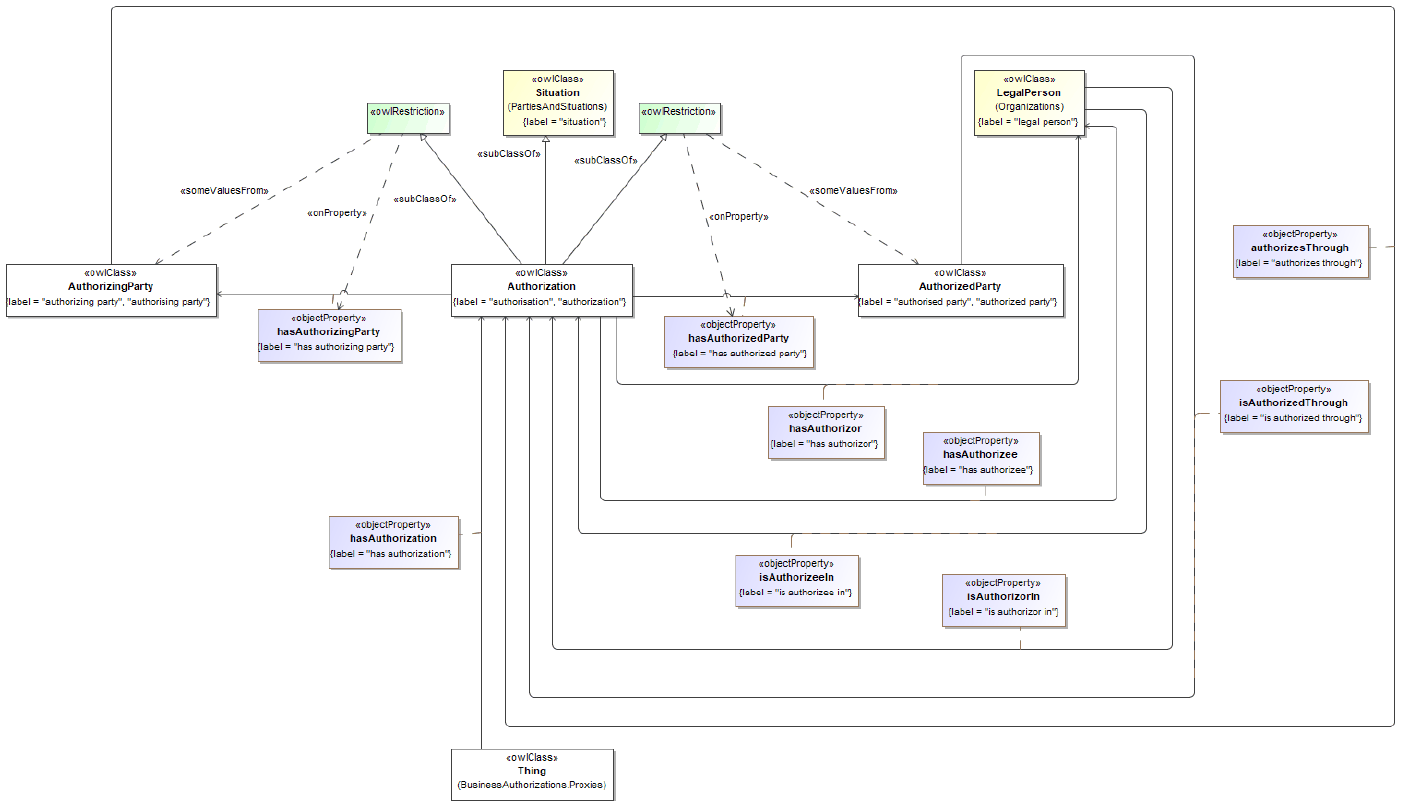
The detailed annotations and axioms that comprise the Commons Authorizations Ontology are provided in Commons Authorizations Ontology Details, below.
Classes
| Name | Annotations | Class Expressions |
|---|---|---|
|
Authorization (authorisation@en-GB, authorization@en-US) |
Definition: situation in which a party authorizes someone to act on their behalf or to have specific capabilities under certain conditions for some period of time Preferred label: authorization |
Parent Class: cmns-pts:Situation Property Restriction: ∃ hasAuthorizedParty.AuthorizedParty Property Restriction: ∃ hasAuthorizingParty.AuthorizingParty |
|
AuthorizedParty (authorised party@en-GB, authorized party@en-US) |
Definition: party that has been given the ability to act on behalf of another party or to have specified capabilities under some set of guidelines for some period of time Preferred label: authorized party |
Parent Class: cmns-rlcmp:FunctionalRole Property Restriction: ∃ cmns-rlcmp:isPlayedBy.cmns-org:LegalPerson Property Restriction: ∃ isAuthorizedThrough.Authorization |
|
AuthorizingParty (authorising party@en-GB, authorizing party@en-US) |
Definition: party that delegates some role, authority, or control to another party |
Parent Class: cmns-pts:Actor Property Restriction: ∃ cmns-rlcmp:isPlayedBy.cmns-org:LegalPerson Property Restriction: ∃ authorizesThrough.Authorization |
|
LegallyDelegatedAuthority (legally delegated authority) |
Definition: authorized party empowered with some level of legal control and corresponding responsibility |
Parent Class: AuthorizedParty |
|
ResponsibleParty (responsible party) |
Definition: legal person acting in a role that has some formal responsibility Example: party with a fiduciary responsibility such as a signatory, an examiner, registrar, obligor, payee, etc. |
Parent Class: AuthorizedParty |
Properties
| Name | Annotations | Property Axioms |
|---|---|---|
|
authorizes (authorizes) |
Definition: endorses, enables, empowers, or gives permission to |
Parent Property: cmns-pts:actsOn Domain: AuthorizingParty Range: AuthorizedParty Inverse: isAuthorizedBy |
|
authorizesDirectly (authorizes directly) |
Definition: endorses, enables, empowers, or gives permission directly to |
Parent Property: cmns-pts:directlyAffects Domain: AuthorizingParty Range: cmns-org:LegalPerson Inverse: isDirectlyAuthorizedBy |
|
authorizesThrough (authorizes through) |
Definition: indicates the situation that facilitates designation of an authorized party by the authorizing party for some purpose |
Parent Property: cmns-pts:actsIn Domain: AuthorizingParty Range: Authorization Inverse: hasAuthorizingParty |
|
delegatesControlTo (delegates control to) |
Definition: indicates a party to which the authorizing party has delegated some authority or control |
Parent Property: authorizes, cmns-org:designates Range: LegallyDelegatedAuthority |
|
hasAuthorization (has authorization) |
Definition: relates something to a specific authorization that is applicable to it in some context |
Parent Property: cmns-cxtdsg:isApplicableIn Range: Authorization |
|
hasAuthorizedParty (has authorized party) |
Definition: indicates the party (role) that is endorsed, enabled, empowered, or otherwise permitted to do something in the situation |
Parent Property: cmns-pts:hasUndergoer Domain: Authorization Range: AuthorizedParty |
|
hasAuthorizee (has authorizee) |
Definition: indicates the legal person that is endorsed, enabled, empowered, or otherwise permitted to do something in the situation |
Parent Property: cmns-pts:isExperiencedBy Domain: Authorization Range: cmns-org:LegalPerson |
|
hasAuthorizingParty (has authorizing party) |
Definition: indicates the party (role) that endorses, enables, empowers, or gives permission in the situation |
Parent Property: cmns-pts:hasActor Domain: Authorization Range: AuthorizingParty |
|
hasAuthorizor (has authorizor) |
Definition: indicates the legal person that endorses, enables, empowers, or gives permission in the situation |
Parent Property: cmns-pts:hasActiveParty Domain: Authorization Range: cmns-org:LegalPerson |
|
hasDelegatedControlOf (has delegated control of) |
Definition: indicates something or some party that is controlled via delegation |
Domain: LegallyDelegatedAuthority |
|
hasResponsibleParty (has responsible party) |
Definition: identifies a party that has some assignment, commitment or obligation with respect to some situation or organization |
Parent Property: cmns-pts:hasPartyRole Range: ResponsibleParty |
|
isAuthorizedBy (is authorized by) |
Definition: is endorsed, enabled, empowered, or otherwise permitted by |
Parent Property: cmns-pts:isAffectedBy Domain: AuthorizedParty Range: AuthorizingParty |
|
isAuthorizedThrough (is authorized through) |
Definition: indicates the situation that facilitates endorsement of the authorized party for some purpose |
Parent Property: cmns-pts:undergoes Domain: AuthorizedParty Range: Authorization Inverse: hasAuthorizedParty |
|
isAuthorizeeIn (is authorizee in) |
Definition: indicates the situation that facilitates designation of the legal person as an authorized party for some purpose |
Parent Property: cmns-pts:experiences Domain: cmns-org:LegalPerson Range: Authorization Inverse: hasAuthorizee |
|
isAuthorizorIn (is authorizor in) |
Definition: indicates the situation that facilitates designation of an authorized party by the legal person for some purpose |
Parent Property: cmns-pts:playsActiveRoleIn Domain: cmns-org:LegalPerson Range: Authorization Inverse: hasAuthorizor |
|
isDirectlyAuthorizedBy (is directly authorized by) |
Definition: is directly endorsed, enabled, empowered, or otherwise permitted by |
Parent Property: cmns-pts:isDirectlyAffectedBy Domain: cmns-org:LegalPerson Range: AuthorizingParty |
9.4. Commons Codes and Code Sets Ontology§
This ontology defines commonly used concepts for describing codes, including standardized codes such as ISO language, country, and other code sets, the North American Industry Classification System (NAICS) codes, and custom code sets that many organizations develop for various purposes, derived from the patterns specified in ISO 11179-3, Metadata Registries.
Metadata for the Commons Codes and Code Sets Ontology is given in Commons Codes and Code Sets Ontology Metadata.
| Metadata Term | Value |
|---|---|
|
Ontology IRI |
|
|
|
Commons Codes and Code Sets Ontology |
|
|
This ontology defines commonly used concepts for describing codes, including standardized codes such as ISO language, country, and other code sets, the North American Industry Classification System (NAICS) codes, and custom code sets that many organizations develop for various purposes, derived from the patterns specified in ISO 11179-3, Metadata Registries. |
|
|
Elisa Kendall, Thematix Partners LLC |
|
|
Pete Rivett, agnos.ai U.K. Ltd |
|
|
Copyright (c) 2014-2022 EDM Council, Inc. |
|
|
Copyright (c) 2014-2022 Thematix Partners LLC |
|
|
Copyright (c) 2021-2022 agnos.ai U.K. Ltd |
|
|
Copyright (c) 2022 Object Management Group, Inc. |
|
|
http://opensource.org/licenses/MIT |
|
|
|
|
|
The codes and code sets ontology conforms with the OWL 2 DL semantics, and is outside of OWL 2 RL due to (1) imported axioms from the designations ontology, and (2) the inclusion of a local some values constraint. The latter could be removed as needed to support OWL RL rule-based applications that cannot be extended to support it. |
|
|
This ontology was originally designed for use in the OMG Languages, Countries and Codes (LCC) specification as part of the broader LanguageRepresentation ontology. The concepts have also been used in the Financial Industry Business Ontology (FIBO) for representing currency codes, market identifiers (MIC codes), codes for corporate actions, and so forth. |
|
|
The https://www.omg.org/spec/Commons/20220501/CodesAndCodeSets.rdf version of this ontology was modified to make CodeSet a subclass of Arrangement (COMMONS-19) and to add a note to code set for clarity (COMMONS-26). |
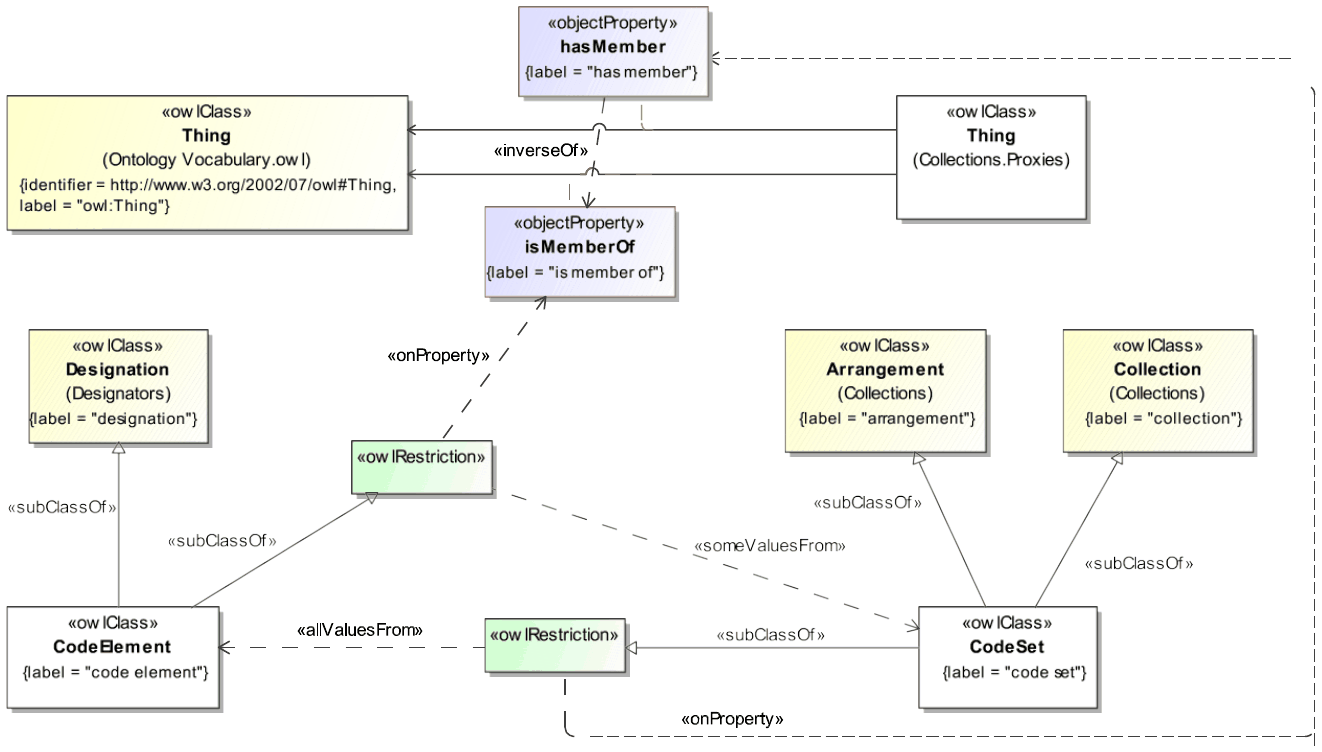
The detailed annotations and axioms that comprise the Commons Codes and Code Sets Ontology are provided in Commons Codes and Code Sets Ontology Details, below.
Classes
| Name | Annotations | Class Expressions |
|---|---|---|
|
CodeElement (code element) |
Definition: sequence of characters denoting something for some purpose, within a specified context, according to some rule set Example: An example of a code set that has multiple versions are the International Statistical Classification of Diseases and Related Health Problems (ICD) codes such as ICD-9, ICD-10, and so forth, that specify the same codes across multiple versions. Note: Note that codes may be included in multiple code lists, especially in cases where there are multiple versions of those code lists. ICD-9 and ICD-10 are examples of code sets that specify, in some cases, the same codes, but across different versions of those code sets. Source: ISO/IEC 11179-3 Information technology - Metadata registries (MDR) - Part 3: Registry metamodel and basic attributes, Third edition, 2013-02-15 |
Parent Class: cmns-dsg:Designation Property Restriction: ∃ cmns-col:isMemberOf.CodeSet |
|
CodeSet (code set) |
Definition: system of alpha-numeric symbols, or combinations of symbols, that stand for specified values in some context Synonym: coding scheme Note: Note that a given code set will typically include a finite and known list of codes. Code sets may also be versioned. ICD-9 and ICD-10 are examples of code sets that specify, in some cases, the same codes, but across different versions of those code sets. Source: ISO/IEC 11179-3 Information technology - Metadata registries (MDR) - Part 3: Registry metamodel and basic attributes, Third edition, 2013-02-15 |
Parent Class: cmns-col:Arrangement, cmns-col:Collection Property Restriction: ∀ cmns-col:hasMember.CodeElement |
9.5. Commons Classifiers Ontology§
This ontology defines abstract concepts for representation of classification schemes that enable the classification of arbitrary concepts into hierarchies (or partial orders) for use in many other ontologies, derived in part from the patterns defined in ISO 1087-1 for terminology work and ISO 11179-3, Metadata Registries.
Metadata for the Commons Classifiers Ontology is given in Commons Classifiers Ontology Metadata.
| Metadata Term | Value |
|---|---|
|
Ontology IRI |
|
|
|
Commons Classifiers Ontology |
|
|
This ontology defines abstract concepts for representation of classification schemes that enable the classification of arbitrary concepts into hierarchies (or partial orders) for use in many other ontologies, derived in part from the patterns defined in ISO 1087-1 for terminology work and ISO 11179-3, Metadata Registries. |
|
|
Elisa Kendall, Thematix Partners LLC |
|
|
Pete Rivett, Federated Knowledge, LLC |
|
|
Copyright (c) 2014-2024 EDM Council, Inc. |
|
|
Copyright (c) 2014-2024 Thematix Partners LLC |
|
|
Copyright (c) 2022-2024 Object Management Group, Inc. |
|
|
Copyright (c) 2024 Copyright (c) 2024 Adaptive, Inc. |
|
|
Copyright (c) 2024 Federated Knowledge, LLC |
|
|
Copyright (c) 2014-2024 EDM Council, Inc. Permission is hereby granted, free of charge, to any person obtaining a copy of this software and associated documentation files (the 'Software'), to deal in the Software without restriction, including without limitation the rights to use, copy, modify, merge, publish, distribute, sublicense, and/or sell copies of the Software, and to permit persons to whom the Software is furnished to do so, subject to the following conditions: The above copyright notice and this permission notice shall be included in all copies or substantial portions of the Software. THE SOFTWARE IS PROVIDED 'AS IS', WITHOUT WARRANTY OF ANY KIND, EXPRESS OR IMPLIED, INCLUDING BUT NOT LIMITED TO THE WARRANTIES OF MERCHANTABILITY, FITNESS FOR A PARTICULAR PURPOSE AND NONINFRINGEMENT. IN NO EVENT SHALL THE AUTHORS OR COPYRIGHT HOLDERS BE LIABLE FOR ANY CLAIM, DAMAGES OR OTHER LIABILITY, WHETHER IN AN ACTION OF CONTRACT, TORT OR OTHERWISE, ARISING FROM, OUT OF OR IN CONNECTION WITH THE SOFTWARE OR THE USE OR OTHER DEALINGS IN THE SOFTWARE. See https://opensource.org/licenses/MIT. |
|
|
|
|
|
The classifiers ontology conforms with the OWL 2 DL semantics, and is outside of OWL 2 RL due to the inclusion of local some values and minimum cardinality constraints. These constraints could be removed as needed to support OWL RL rule-based applications that cannot be extended to support them. |
|
|
This ontology was originally designed for use in the OMG Languages, Countries and Codes (LCC) specification as part of the broader CountryRepresentation ontology. The concepts have also been used in the Financial Industry Business Ontology (FIBO) for representing industry sectors, financial instrument classifiers (e.g., asset classes), lifecycle states, and so forth. |
|
|
https://www.omg.org/spec/Commons/20220501/Classifiers.rdf version of this ontology was modified to eliminate a double space in a note on ClassificationScheme (COMMONS-6), loosen the constraints on the restriction on Classifier for property classifies (COMMONS-9), and add a boolean property allowing users to state that only one classifier from a particular scheme can be used to classify something (i.e., the classifiers in the scheme are mutually exclusive and only one can apply to the thing being classified). |
|
|
https://www.omg.org/spec/Commons/20221101/Classifiers.rdf version of this ontology was revised to clarify the definition of aspect (COMMONS12-7). |
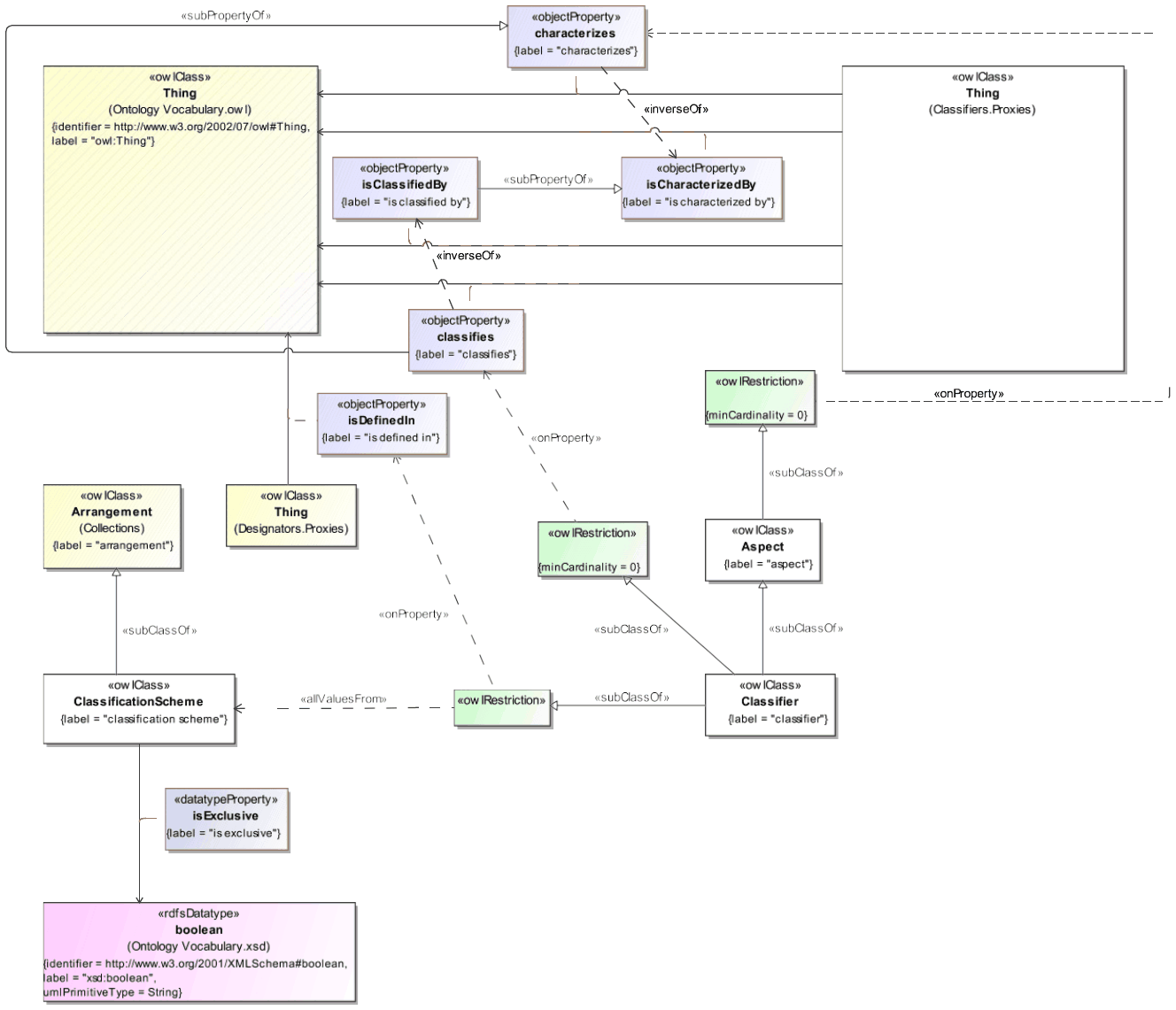
The detailed annotations and axioms that comprise the Commons Classifiers Ontology are provided in Commons Classifiers Ontology Details, below.
Classes
| Name | Annotations | Class Expressions |
|---|---|---|
|
Aspect (aspect) |
Definition: characteristic or feature that can be used to dimensionalize, filter, or subset a class, collection, or set of things Synonym: characteristic |
Property Restriction: ≥ 0 characterizes |
|
ClassificationScheme (classification scheme) |
Definition: system for allocating classifiers to things Note: ISO 11179-3 defines a classification scheme as descriptive information for an arrangement or division of objects into groups based on criteria such as characteristics, which the objects have in common. A classification scheme may be a taxonomy, a network, an ontology, or any other terminological system. Such classification schemes are intended to permit the classification of arbitrary objects into hierarchies, or partial orders, as appropriate. The classification may also be just a list of controlled vocabulary of property words (or terms). The list might be taken from the 'leaf level' of a taxonomy. Source: ISO/IEC 11179-3 Information technology - Metadata registries (MDR) - Part 3: Registry metamodel and basic attributes, Third edition, 2013-02-15 |
Parent Class: cmns-col:Arrangement |
|
Classifier (classifier) |
Definition: standardized classification or delineation for something, per some scheme for such delineation, within a specified context Example: The classifier 'color' embraces characteristics being red, blue, green, etc. The classifier 'material' embraces characteristics made of wood, metal, etc. Note: In ISO 1087, classifiers form categories of characteristics that serve as the criterion of subdivision when establishing concept systems. Source: ISO/IEC 11179-3 Information technology - Metadata registries (MDR) - Part 3: Registry metamodel and basic attributes, Third edition, 2013-02-15 |
Parent Class: Aspect Property Restriction: ∀ cmns-dsg:isDefinedIn.ClassificationScheme Property Restriction: ≥ 0 classifies |
Properties
| Name | Annotations | Property Axioms |
|---|---|---|
|
characterizes (characterizes) |
Definition: provides a discriminating feature or quality of |
Parent Property: cmns-dsg:describes |
|
classifies (classifies) |
Definition: arranges in categories according to one or more shared characteristics |
Parent Property: characterizes |
|
isCharacterizedBy (is characterized by) |
Definition: indicates a quality or feature of something, distinguishing it from something else |
Parent Property: cmns-dsg:isDescribedBy Inverse: characterizes |
|
isClassifiedBy (is classified by) |
Definition: is systematically grouped based on characteristics by |
Parent Property: isCharacterizedBy Inverse: classifies |
|
isExclusive (is exclusive) |
Definition: indicates that the classifiers in the scheme are all disjoint and that only one classifier may be used to classify something Usage note: This does not exclude classification by other classifiers from other schemes. It is simply a hint to users that whatever is classified by a classifier in this scheme should be classified by at most one of the classifiers in the scheme. |
Domain: ClassificationScheme Range: xsd:boolean |
9.6. Commons Collections Ontology§
The collections ontology defines commonly used concepts for arrangements and schemes for organizing information and collections of things, such as structured collections that may be organized according to some scheme, and related very high level mereology relations to enable association of things with such collections and schemes.
Metadata for the Commons Collections Ontology is given in Commons Collections Ontology Metadata.
| Metadata Term | Value |
|---|---|
|
Ontology IRI |
|
|
|
Commons Collections Ontology |
|
|
The collections ontology defines commonly used concepts for arrangements and schemes for organizing information and collections of things, such as structured collections that may be organized according to some scheme, and related very high level mereology relations to enable association of things with such collections and schemes. |
|
|
Davide Sottara, Mayo Clinic |
|
|
Elisa Kendall, Thematix Partners LLC |
|
|
Pete Rivett, agnos.ai |
|
|
Copyright (c) 2019-2022 Thematix Partners LLC |
|
|
Copyright (c) 2021-2022 EDM Council, Inc. |
|
|
Copyright (c) 2021-2022 Mayo Clinic |
|
|
Copyright (c) 2021-2022 agnos.ai U.K. Ltd |
|
|
Copyright (c) 2022 Object Management Group, Inc. |
|
|
http://opensource.org/licenses/MIT |
|
|
|
|
|
The collections ontology conforms with the OWL 2 DL semantics, and is outside of OWL 2 RL due to the inclusion of a min 0 cardinality constraint. This restriction may be removed as needed to support OWL RL rule-based applications that cannot be extended to support it. |
|
|
This ontology was originally designed for use in the OMG Languages, Countries and Codes (LCC) specification as part of the broader LanguageRepresentation ontology. The concepts have also been used in the Financial Industry Business Ontology (FIBO) for representing collections such as baskets, portfolios records, statistical universes and populations. |
|
|
The https://www.omg.org/spec/Commons/20220501/Collections.rdf version of this ontology was modified to better differentiate some of the properties that are subproperties of comprises to aid in user understanding, add new properties that allow for taxonomic parthood, and add a property allowing users to describe the intended method used with respect to arrangement (COMMONS-12). |
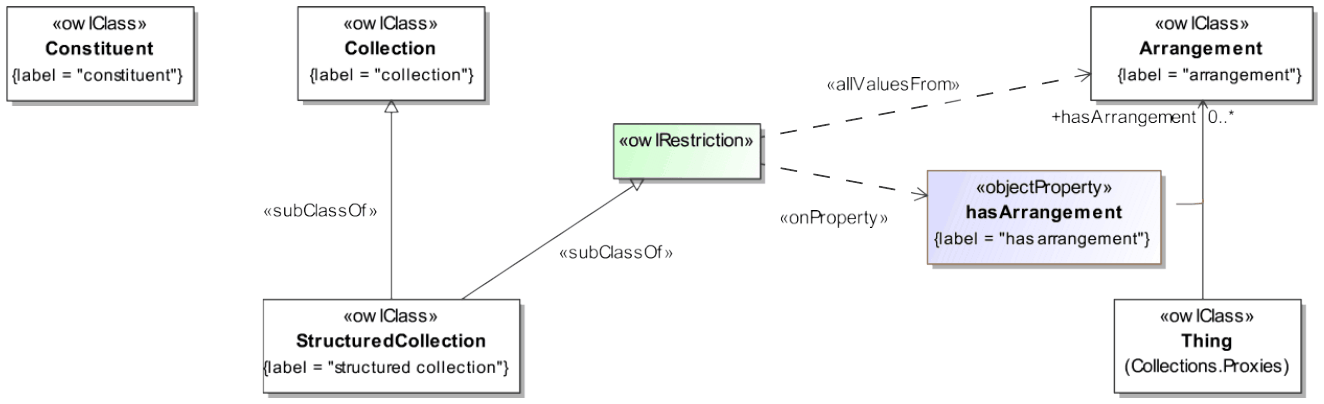
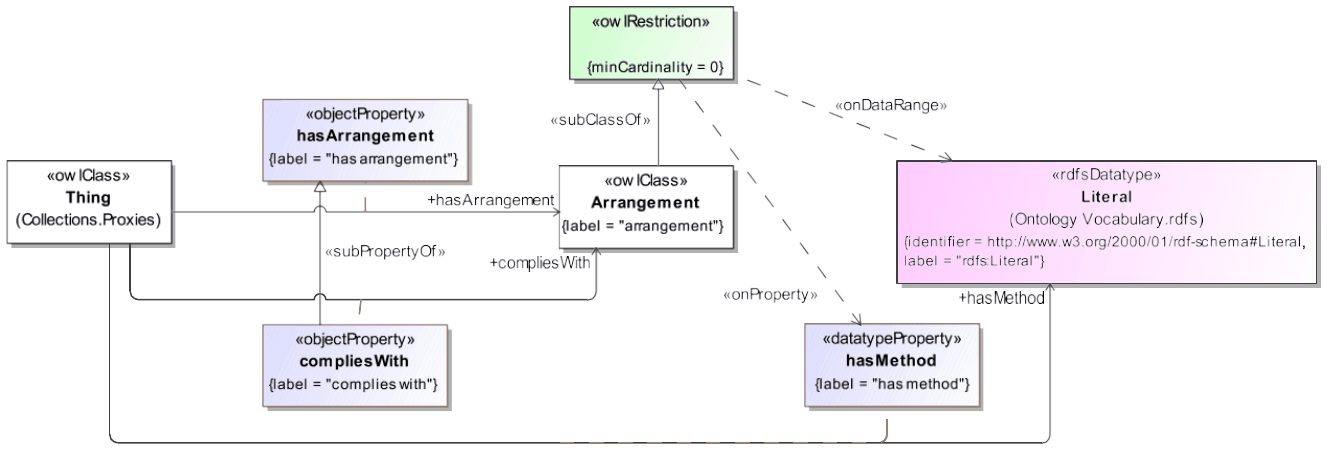
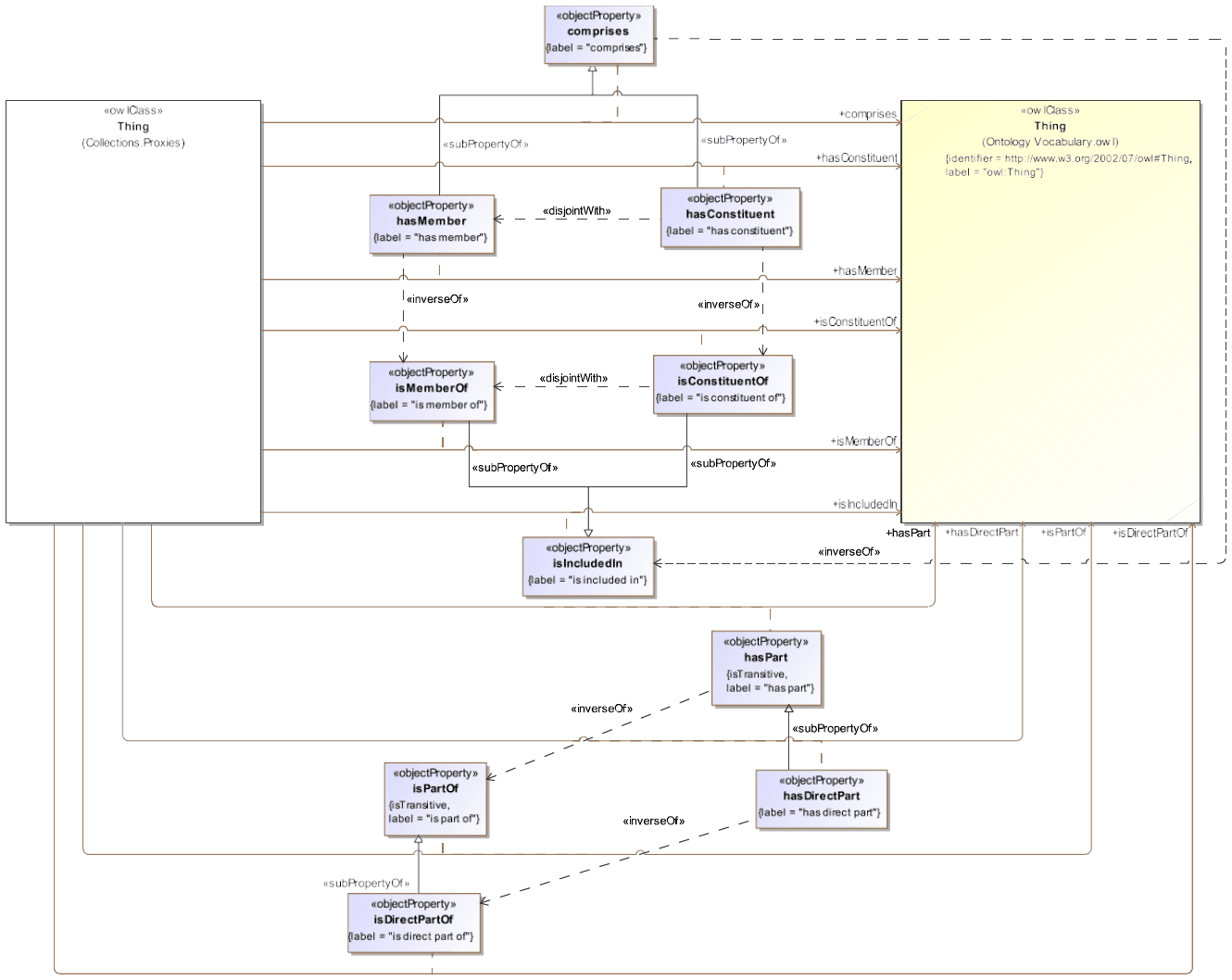
The detailed annotations and axioms that comprise the Commons Collections Ontology are provided in Commons Collections Ontology Details, below.
Classes
| Name | Annotations | Class Expressions |
|---|---|---|
|
Arrangement (arrangement) |
Definition: systematic plan, manner, or method for making, doing, achieving, or organizing something Example: Examples include designs, schema, models, methodologies, alphabetical or numeric ordering, and the like. |
Property Restriction: ≥ 0 hasMethod |
|
Collection (collection) |
Definition: grouping of things (may be zero) that have some shared significance Usage note: Users should use either comprises or hasPart, or one of their respective subproperties, to include things in a collection. |
|
|
Constituent (constituent) |
Definition: component of a collection or combination of things Usage note: Users should use either isIncludedIn or isPartOf, or one of their respective subproperties, to include a constituent in a collection. |
|
|
StructuredCollection (structured collection) |
Definition: collection that has a clearly defined structure or organization Example: Examples include collections organized thematically, alphabetically, by method used to develop them, according to time and/or version, or based on encoding schemes such as the Dewey Decimal System or Library of Congress Subject Headings. Usage note: Users should use the hasMethod property on arrangement to describe the methodology for structuring the collection. |
Parent Class: Collection Property Restriction: ∀ hasArrangement.Arrangement |
Properties
| Name | Annotations | Property Axioms |
|---|---|---|
|
compliesWith (complies with) |
Definition: adheres to policies or rules specified in |
Parent Property: hasArrangement Range: Arrangement |
|
comprises (comprises) |
Definition: includes, consists of, or contains, especially within a particular scope Note: Note that something can be comprised of something(s) that may or may not be understood as separable parts. In other words, comprises does not imply countability or uniqueness. Whole-part relations are transitive, whereas comprises is not defined to be transitive, so this property is useful in cases where cardinality constraints are needed. comprises and hasPart are not explicitly declared as disjoint to avoid reasoning issues, but should be considered as such. |
|
|
hasArrangement (has arrangement) |
Definition: is structured or organized according to |
Range: Arrangement |
|
hasConstituent (has constituent) |
Definition: consists of or contains Usage note: This property is disjoint with hasMember, and should be used in cases where the constituents of something are not considered discrete elements of whatever they are included in, such as a substance or composite. |
Parent Property: comprises Property Axiom: ¬ hasMember |
|
hasDirectPart (has direct part) |
Definition: indicates an immediate 'child' part of something Usage note: This property is useful in cases where one is interested in the direct relationships between parts of things, for example to build a tree view. |
Parent Property: hasPart |
|
hasMember (has member) |
Definition: includes, as a discrete element Note: Note that the domain of hasMember should be some sort of collection, aggregate, or group. In the Financial Industry Business Ontology (FIBO), hasMember is used in the case of parties (people and organizations), whereas comprises can have anything in its range. |
Parent Property: comprises |
|
hasMethod (has method) |
Definition: provides a text description of an approach or method used to accomplish something Example: This property can be used to describe an arrangement or ordering applied to a collection. |
Parent Property: cmns-txt:hasTextValue |
|
hasPart (has part) |
Definition: indicates any portion of something, regardless of whether the portion itself is attached to the remainder or detached; cognitively salient or arbitrarily demarcated; self-connected or disconnected; homogeneous or gerrymandered; material or immaterial; extended or unextended; spatial or temporal Note: Note that 'has part' is not a subproperty of 'comprises' in order to enable transitivity for whole-part relationships without limiting the use of cardinality constraints on comprises and membership. Source: Stanford Encyclopedia of Philosophy at http://plato.stanford.edu/entries/mereology/ |
Type: owl:TransitiveProperty |
|
isConstituentOf (is constituent of) |
Definition: is a component of something else |
Parent Property: isIncludedIn Inverse: hasConstituent Property Axiom: ¬ isMemberOf |
|
isDirectPartOf (is direct part of) |
Definition: indicates an immediate 'parent' of this part Usage note: This property is useful in cases where one is interested in the direct relationships between parts of things, for example to build a tree view. |
Parent Property: isPartOf Inverse: hasDirectPart |
|
isIncludedIn (is included in) |
Definition: is contained in or an element of Note: Something that is included in something else may be an independently identifiable, discrete element or may be an indistinguishable element once it is combined with the target. |
Inverse: comprises |
|
isMemberOf (is member of) |
Definition: is a discrete element of |
Parent Property: isIncludedIn Inverse: hasMember |
|
isPartOf (is part of) |
Definition: relates something to another thing that it is some component or portion of, regardless of how that whole-part relationship is manifested Note: Note that 'is part of' is not a subproperty of 'isIncludedIn' in order to enable transitivity for whole-part relationships without limiting the use of cardinality constraints on inclusion and membership. Source: Stanford Encyclopedia of Philosophy at http://plato.stanford.edu/entries/mereology/ |
Type: owl:TransitiveProperty Inverse: hasPart |
9.7. Commons Contextual Designators Ontology§
The contextual designators ontology extends the designators ontology to incorporate applicable dates and times and facilitate the inclusion of other context that is commonly needed, derived in part from the patterns defined in ISO 11179-3, Metadata Registries.
Metadata for the Commons Contextual Designators Ontology is given in Commons Contextual Designators Ontology Metadata.
| Metadata Term | Value |
|---|---|
|
Ontology IRI |
|
|
|
Commons Contextual Designators Ontology |
|
|
The contextual designators ontology extends the designators ontology to incorporate applicable dates and times and facilitate the inclusion of other context that is commonly needed, derived in part from the patterns defined in ISO 11179-3, Metadata Registries. |
|
|
Dean Allemang, Working Ontologist |
|
|
Elisa Kendall, Thematix Partners LLC |
|
|
Pete Rivett, Federated Knowledge, LLC |
|
|
Copyright (c) 2020-2025 Thematix Partners LLC |
|
|
Copyright (c) 2020-2025 Working Ontologist LLC |
|
|
Copyright (c) 2022-2025 Object Management Group, Inc. |
|
|
Copyright (c) 2022-2025 agnos.ai U.K. Ltd |
|
|
Copyright (c) 2023-2025 Federated Knowledge, LLC |
|
|
Copyright (c) 2020-2025 Thematix Partners LLC Permission is hereby granted, free of charge, to any person obtaining a copy of this software and associated documentation files (the 'Software'), to deal in the Software without restriction, including without limitation the rights to use, copy, modify, merge, publish, distribute, sublicense, and/or sell copies of the Software, and to permit persons to whom the Software is furnished to do so, subject to the following conditions: The above copyright notice and this permission notice shall be included in all copies or substantial portions of the Software. THE SOFTWARE IS PROVIDED 'AS IS', WITHOUT WARRANTY OF ANY KIND, EXPRESS OR IMPLIED, INCLUDING BUT NOT LIMITED TO THE WARRANTIES OF MERCHANTABILITY, FITNESS FOR A PARTICULAR PURPOSE AND NONINFRINGEMENT. IN NO EVENT SHALL THE AUTHORS OR COPYRIGHT HOLDERS BE LIABLE FOR ANY CLAIM, DAMAGES OR OTHER LIABILITY, WHETHER IN AN ACTION OF CONTRACT, TORT OR OTHERWISE, ARISING FROM, OUT OF OR IN CONNECTION WITH THE SOFTWARE OR THE USE OR OTHER DEALINGS IN THE SOFTWARE. See https://opensource.org/licenses/MIT. |
|
|
https://www.omg.org/spec/Commons/20250801/ContextualDesignators/ |
|
|
The contextual designators ontology conforms with the OWL 2 DL semantics, and is outside of OWL 2 RL due to (1) imported axioms from the designations and dates and times ontologies, and (2) the inclusion of local some values and min 0 cardinality constraints. The latter could be removed as needed to support OWL RL rule-based applications that cannot be extended to support it. |
|
|
The https://www.omg.org/spec/Commons/20220501/ContextualDesignators.rdf version of this ontology was modified to eliminate a double space in a note on ContextualName (COMMONS-6) and to require a ContextualName to have context (COMMONS-26). |
|
|
The https://www.omg.org/spec/Commons/20221101/ContextualDesignators.rdf version of this ontology was revised to clarify the definition of isUsedBy (COMMONS13-34). |
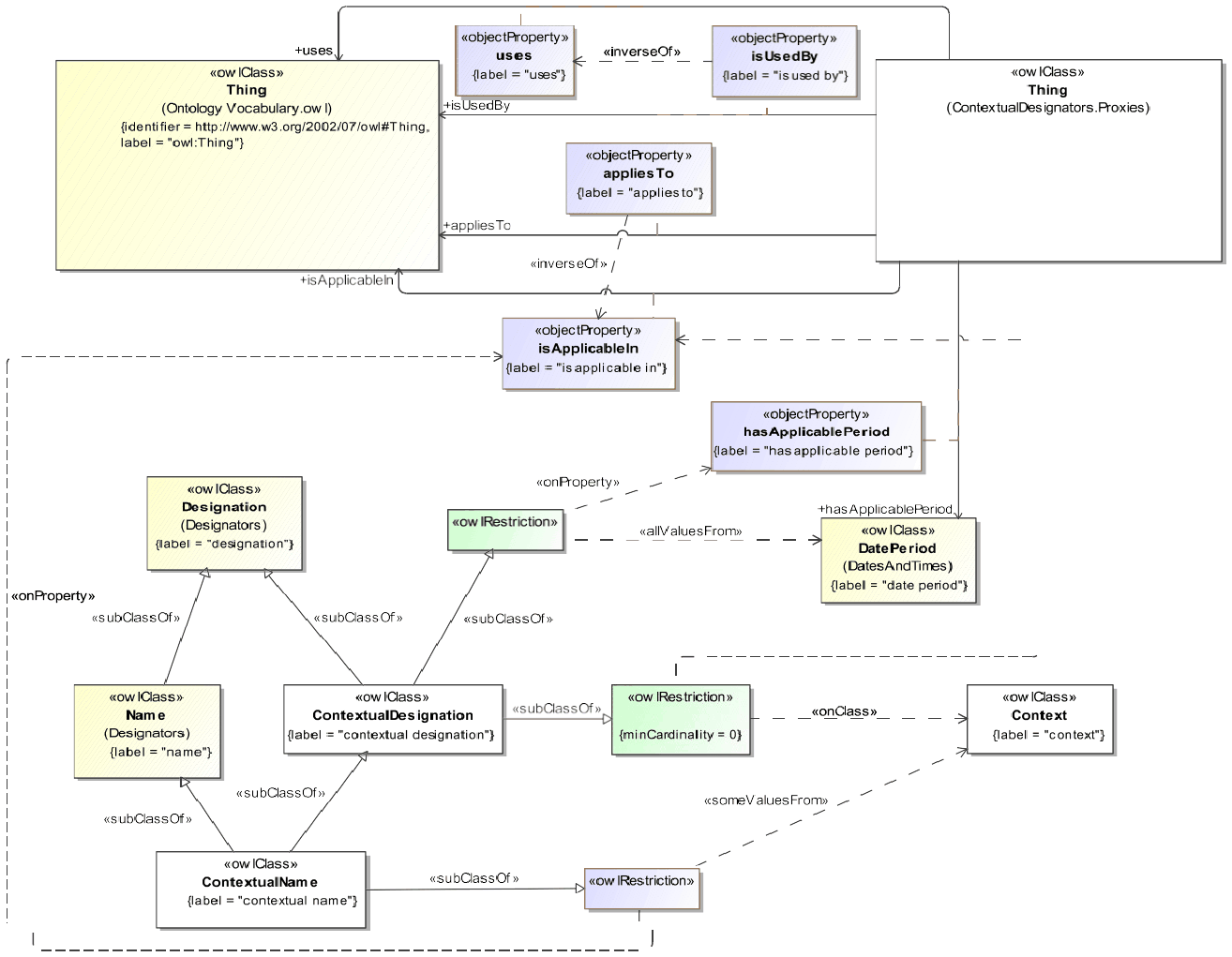
The detailed annotations and axioms that comprise the Commons Contextual Designators Ontology are provided in Commons Contextual Designators Ontology Details, below.
Classes
| Name | Annotations | Class Expressions |
|---|---|---|
|
Context (context) |
Definition: situation or frame of reference in which something applies, exists, happens, or is used and that helps to illustrate or explain it Note: From a terminology perspective, context provides information, including but not limited to text, that illustrates a concept or the use of a designation for a given situation. Source: ISO 1087 Terminology work and terminology science - Vocabulary, Second edition, 2019-09, clause 3.6.5 Source: ISO/IEC 11179-3 Information technology - Metadata registries (MDR) - Part 3: Registry metamodel and basic attributes, Third edition, 2013-02-15 |
|
|
ContextualDesignation (contextual designation) |
Definition: designation that applies to something in some context Note: Contextual designators may be structured such that they include other designators, for example, composite identifiers that include a country code to distinguish national identifiers from one another, for example, in the case of some manufacturing, agricultural, or financial instrument identifiers. Note: Note that the use of the min 0 cardinality restriction in the definition of this class is provided as a reminder that contextual designators are expected, in most cases, to have some sort of context associated with them. There may be cases where the context is limited to a time period, though, and thus additional context may not be required, or where more direct relationships to provenance, governance, or other contextual information is available. |
Parent Class: cmns-dsg:Designation Property Restriction: ≥ 0 isApplicableIn.Context Property Restriction: ∀ hasApplicablePeriod.cmns-dt:DatePeriod |
|
ContextualName (contextual name) |
Definition: designation by which someone, some place, or something is known in some context Note: Names for people may be considered to be personally identifying information (PII), especially when other details are also available. Specifying names as string values attached directly to an individual makes name reconciliation and management, including from a privacy perspective, more challenging. Note: Names of people, places, and organizations often change over time, and may be used in a particular context, such as a DBA name for a business or legal name for a person. Scope note: This class is designed to be extended to include provenance details regarding the source for a particular name as well as links to the various contexts in which it is used. |
Parent Class: ContextualDesignation, cmns-dsg:Name Property Restriction: ∃ isApplicableIn.Context |
Properties
| Name | Annotations | Property Axioms |
|---|---|---|
|
appliesTo (applies to) |
Definition: indicates something for which a context is material, germane, or relevant in some way |
|
|
hasApplicablePeriod (has applicable period) |
Definition: indicates a date period during which something may be used, applies, is valid or is accurate or relevant |
Parent Property: isApplicableIn, cmns-dt:hasDatePeriod Range: cmns-dt:DatePeriod |
|
isApplicableIn (is applicable in) |
Definition: indicates a context in which something is relevant |
Inverse: appliesTo |
|
isUsedBy (is used by) |
Definition: serves a function or purpose for |
Inverse: uses |
|
uses (uses) |
Definition: employs to accomplish some task or achieve some result |
9.8. Commons Contextual Identifiers Ontology§
The contextual identifiers ontology defines commonly used concepts for describing more complex identifiers, including those that apply for some period of time as well as those that are structured and include other codes or identifiers.
Metadata for the Commons Contextual Identifiers Ontology is given in Commons Contextual Identifiers Ontology Metadata.
| Metadata Term | Value |
|---|---|
|
Ontology IRI |
|
|
|
Commons Contextual Identifiers Ontology |
|
|
The contextual identifiers ontology defines commonly used concepts for describing more complex identifiers, including those that apply for some period of time as well as those that are structured and include other codes or identifiers. |
|
|
Elisa Kendall, Thematix Partners LLC |
|
|
Evan Wallace, U.S. National Institute of Standards and Technology (NIST) |
|
|
Copyright (c) 2022 Object Management Group, Inc. |
|
|
Copyright (c) 2022 Thematix Partners LLC |
|
|
http://opensource.org/licenses/MIT |
|
|
https://www.omg.org/spec/Commons/20221101/ContextualIdentifiers/ |
|
|
https://www.omg.org/spec/Commons/20220501/ContextualIdentifiers.rdf version of this ontology was modified to add a ContextualIdentificationScheme and require a ContextualIdentifier to have context (COMMONS-26). |
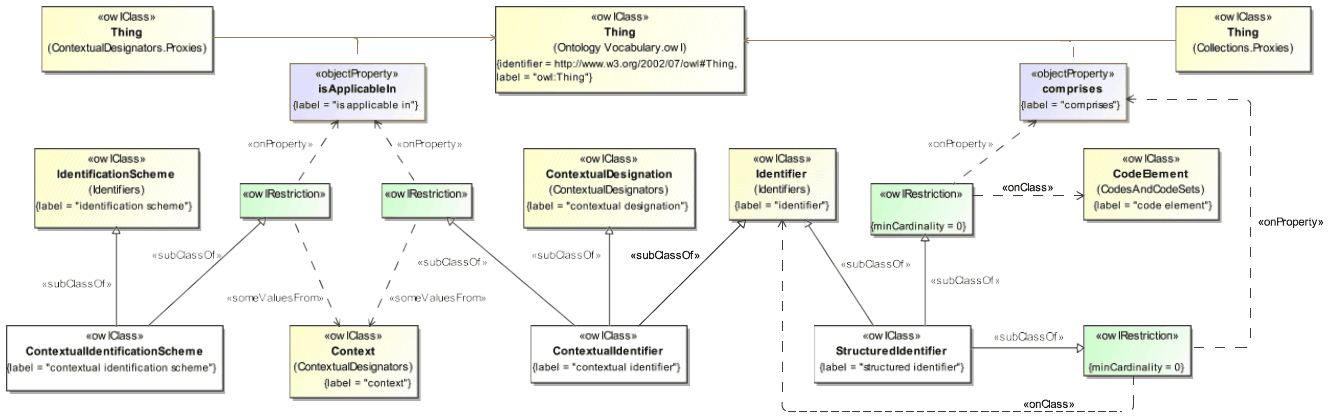
The detailed annotations and axioms that comprise the Commons Contextual Identifiers Ontology are provided in Commons Contextual Identifiers Ontology Details, below.
Classes
| Name | Annotations | Class Expressions |
|---|---|---|
|
ContextualIdentificationScheme (contextual identification scheme) |
Definition: identification scheme that applies within one or more contexts |
Parent Class: cmns-id:IdentificationScheme Property Restriction: ∃ cmns-cxtdsg:isApplicableIn.cmns-cxtdsg:Context |
|
ContextualIdentifier (contextual identifier) |
Definition: sequence of characters uniquely identifying that with which it is associated, within a specified context Note: The context within which an identifier is unique may be limited to a given data source, registry or jurisdiction, or may be designed to be globally unique such as a legal entity identifier issued by a registrar authorized by the Global LEI Foundation. Such identifiers may have other features associated with them, such as the date they were originally issued, and information related to registration, validation, recency, and so forth. |
Parent Class: cmns-cxtdsg:ContextualDesignation, cmns-id:Identifier Property Restriction: ∃ cmns-cxtdsg:isApplicableIn.cmns-cxtdsg:Context |
|
StructuredIdentifier (structured identifier) |
Definition: sequence of characters uniquely identifying that with which it is associated, that includes other codes or identifiers, or that is constructed from other notions Example: A vehicle identification number (VIN) includes a world-wide manufacturer identifier, a vehicle description (i.e., make, model), check digits, the year, plant and a specific vehicle number. Example: An international security identification number (ISIN) includes a country code and the national security identification number (NSIN), as defined in ISO 6166. Note: Many structured identifiers can be validated using a regular expression, such as a social security number in the United States. |
Parent Class: cmns-id:Identifier Property Restriction: ≥ 0 cmns-col:comprises.cmns-cds:CodeElement Property Restriction: ≥ 0 cmns-col:comprises.cmns-id:Identifier |
9.9. Commons Documents Ontology§
This ontology defines high-level concepts for representation of documents, including legal documents and records, such as a transaction record, purchase history, or payment history. It is deliberately lightweight in order to accommodate mappings to other document and bibliographic ontologies.
Metadata for the Commons Documents Ontology is given in Commons Documents Ontology Metadata.
| Metadata Term | Value |
|---|---|
|
Ontology IRI |
|
|
|
Commons Documents Ontology |
|
|
This ontology defines high-level concepts for representation of documents, including legal documents and records, such as a transaction record, purchase history, or payment history. It is deliberately lightweight in order to accommodate mappings to other document and bibliographic ontologies. |
|
|
Davide Sottara, Mayo Clinic |
|
|
Elisa Kendall, Thematix Partners LLC |
|
|
Evan Wallace, U.S. National Institute of Standards and Technology (NIST) |
|
|
Pete Rivett, Federated Knowledge LLC |
|
|
Copyright (c) 2014-2025 EDM Council, Inc. |
|
|
Copyright (c) 2022-2025 Federated Knowledge LLC |
|
|
Copyright (c) 2022-2025 Mayo Clinic |
|
|
Copyright (c) 2022-2025 Thematix Partners LLC |
|
|
Copyright (c) 2023-2025 Object Management Group, Inc. |
|
|
Copyright (c) 2014-2025 EDM Council, Inc. Permission is hereby granted, free of charge, to any person obtaining a copy of this software and associated documentation files (the 'Software'), to deal in the Software without restriction, including without limitation the rights to use, copy, modify, merge, publish, distribute, sublicense, and/or sell copies of the Software, and to permit persons to whom the Software is furnished to do so, subject to the following conditions: The above copyright notice and this permission notice shall be included in all copies or substantial portions of the Software. THE SOFTWARE IS PROVIDED 'AS IS', WITHOUT WARRANTY OF ANY KIND, EXPRESS OR IMPLIED, INCLUDING BUT NOT LIMITED TO THE WARRANTIES OF MERCHANTABILITY, FITNESS FOR A PARTICULAR PURPOSE AND NONINFRINGEMENT. IN NO EVENT SHALL THE AUTHORS OR COPYRIGHT HOLDERS BE LIABLE FOR ANY CLAIM, DAMAGES OR OTHER LIABILITY, WHETHER IN AN ACTION OF CONTRACT, TORT OR OTHERWISE, ARISING FROM, OUT OF OR IN CONNECTION WITH THE SOFTWARE OR THE USE OR OTHER DEALINGS IN THE SOFTWARE. See https://opensource.org/licenses/MIT. |
|
|
|
|
|
This ontology was derived from the Financial Industry Business Ontology (FIBO), and generalized for use in other domain areas. |
|
|
https://www.omg.org/spec/Commons/20230801/Documents.rdf version of this ontology was revised to add the concept of a document part (COMMONS-13-11). |
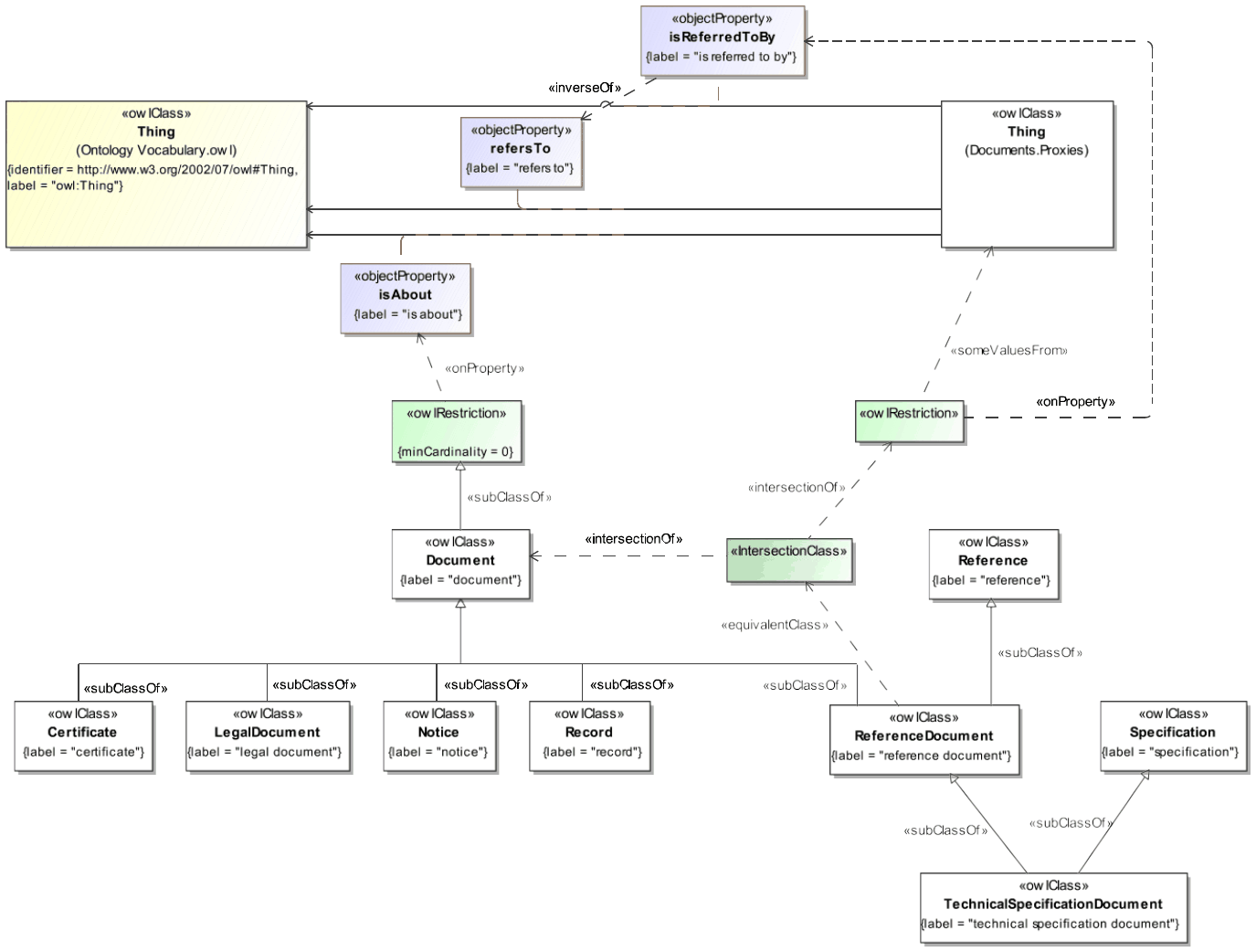
The detailed annotations and axioms that comprise the Commons Documents Ontology are provided in Commons Documents Ontology Details, below.
Classes
| Name | Annotations | Class Expressions |
|---|---|---|
|
Certificate (certificate) |
Definition: document attesting to the truth of some fact or set of facts Explanatory note: A certificate may or may not also be a legal document, depending on the issuing authority and how it can be used. Explanatory note: Certificates, such as electronic certificates, including public keys, may be issued by some certificate authority. Adapted from: ISO 5127 - Information and documentation - Foundation and vocabulary, Second edition, 2017-05, clause 3.1.1.38 |
Parent Class: Document |
|
Document (document) |
Definition: unitary expression of some realization of an intellectual or artistic work Note: See also ISO 25964–1:2011, definition 2.15; ISO 11005:2010, definition 3.1; ISO 15489–1:2016, definition 3.10; IEC 82045–1:2001, definition 3.2.3; ISO 9000:2015, definition 3.7.2 Note: The definition of document provided herein roughly corresponds to the concept of an expression in FRBR. A document is a realization of something that typically takes the form of alpha-numeric, musical, or choreographic notation, sound, image, etc., or any combination of such forms. A manifestation of the document must be inscribed, encoded, engraved, recorded, or otherwise imprinted in some medium. The concept of a manifestation of an expression corresponds to the ISO 5127 notion of a document. Documents can differ extensively in form and characteristics. Note: The manifestation of a document (FRBR expression) refers not only to written and printed materials in paper or microform versions (for example, conventional books, journals, diagrams, maps), but also to non-printed media such as machine-readable and digitized records, Internet and intranet resources, films, sound recordings, buildings, sites, monuments, three-dimensional objects or realia [when used to carry some sort of engraving]; and to collections of such items or parts of such items. (Note taken from ISO 25964–1:2011, definition 2.15.) Also, software, since recorded, can be considered a document. Explanatory note: A document, especially a legal document, may serve to establish one or several facts, and can be relied upon as a proof thereof. Usage note: This definition of document corresponds to a subclass of expression in FRBR. The notion of being a unitary expression is the differentiator between an FRBR expression and document in this sense. Adapted from: 'Functional Requirements for Bibliographic Records', Final Report, IFLA (International Federation of Library Associations and Institutions) Study Group on the Functional Requirements for Bibliographic Records, September 1997 - see https://repository.ifla.org/bitstream/123456789/811/2/ifla-functional-requirements-for-bibliographic-records-frbr.pdf Adapted from: ISO 5127 - Information and documentation - Foundation and vocabulary, Second edition, 2017-05, clause 3.1.1.38 See also: https://www.ifla.org/wp-content/uploads/2019/05/assets/cataloguing/frbr/frbroo_v2.2.pdf |
Property Restriction: ≥ 0 isAbout |
|
DocumentPart (document part) |
Definition: structurally distinct subdivision of a document Note: Parts of documents are typically identified separately based on the function they serve in conveying, organizing, or supporting the content. |
Parent Class: Document Property Restriction: ∃ cmns-col:isMemberOf.Document |
|
LegalDocument (legal document) |
Definition: document specifying the terms of, or provides evidence for, an agreement, attestation, certification, conditions, permissions, and/or decisions of legal persons, government entities, or courts of law, drawn up in accordance with certain rules that apply in the relevant jurisdiction(s) Example: Examples include some certificates, deeds, bonds, business documents (such as articles of incorporation, bylaws, partnership agreements), contracts, certain identity documents, wills, trusts, legislative acts, notarial acts, court writs or processes (such as related complaints and pleadings in the context of litigation as well as other documents relevant to some legal issue), and any law passed by a competent legislative body in municipal (domestic) or international law. Note: A legal document bears the original, official, or legal form of something, that can be fully attributed to its author(s), that records and formally expresses a legally enforceable act, process, or contractual duty, obligation, or right and that can be used to furnish decisive evidence for that act, process, or agreement. Note: Many legal documents only become 'legal' once they are signed and dated, and possibly notarized. Adapted from: ISO 5127 - Information and documentation - Foundation and vocabulary, Second edition, 2017-05, clause 3.4.6.02 |
Parent Class: Document |
|
Notice (notice) |
Definition: announcement, communication, intimation, or advance warning of something, usually, but not necessarily, to allow preparations to be made Example: registered trademark notice, disclaimer, copyright notice, overdue notice, recall notice Note: Although many notices are delivered electronically, certain legal notices must be given given in writing, often by regular mail or hand delivery, with the sender retaining sufficient proof of having given such notice (e.g., through a certificate of service). Adapted from: ISO 5127 - Information and documentation - Foundation and vocabulary, Second edition, 2017-05 |
Parent Class: Document |
|
Record (record) |
Definition: memorialization and objective evidence of activities performed, events occurred, results achieved, or statements made, regardless of its characteristics, media, physical form, or the manner in which it is recorded or stored Note: Records are created or received by an organization in routine transaction of its business or in pursuance of its legal obligations. |
Parent Class: Document |
|
Reference (reference) |
Definition: source that may be used to ascertain, interpret, or understand something Explanatory note: In linguistics, a reference characterizes, provides context for, or specifies the relationship of one linguistic expression to another, i.e., provides the information necessary to interpret the dependent expression. Explanatory note: References may be rendered in the form of a document, but may also take other forms, such as reference materials, scientific equations, and constants, including in some cases physical things, used as the basis for units of measure. |
|
|
ReferenceDocument (reference document) |
Definition: document that is used as a reference for something Explanatory note: A reference document is typically one that provides pertinent details for consultation about a subject. Adapted from: ISO/IEC 11179-3 Information technology - Metadata registries (MDR) - Part 3: Registry metamodel and basic attributes, Third edition, 2013-02-15 |
Parent Class: Document, Reference Class Axiom: ≡ Document ⊓ ∃ isReferredToBy.owl:Thing |
|
Specification (specification) |
Definition: explicit requirement or set of requirements to be satisfied by something, such as a product, material, model, process or system Abbreviation: spec Adapted from: ISO 6707-2:2017 Buildings and civil engineering works - Vocabulary - Part 2: Contract and communication terms, clause 3.2.22 |
|
|
TechnicalSpecificationDocument (technical specification document) |
Definition: document that sets out detailed requirements to be satisfied by a product, material, process or system and the procedures for checking conformity to these requirements Note: Technical specifications may evolve from a functional specification and define the technical requirements for the selected solution as part of a business agreement. Explanatory note: A technical specification is a specification expressing technical requirements, such as one for designing and developing a solution to be implemented. Adapted from: ISO 10795:2019 Space systems - Programme management and quality - Vocabulary, clause 3.238 Adapted from: ISO 6707-2:2017 Buildings and civil engineering works - Vocabulary - Part 2: Contract and communication terms, clause 3.2.22 |
Parent Class: ReferenceDocument, Specification |
Properties
| Name | Annotations | Property Axioms |
|---|---|---|
|
hasDataSource (has data source) |
Definition: relates something, such as an agreement, contract, document, record, report, or process, to a source of data used to analyze, develop, explain, produce, or otherwise create it Usage note: Although in many cases an annotation property, such as dct:source, is sufficient for this purpose, there are occasions when a more complete description of a source is required, such as to meet data lineage requirements, for which this property may be used. |
Parent Property: refersTo |
|
isAbout (is about) |
Definition: indicates the subject or topic of something, such as a document |
|
|
isReferredToBy (is referred to by) |
Definition: indicates something that is referenced as a source for information or explanation |
Inverse: refersTo |
|
isSpecifiedIn (is specified in) |
Definition: indicates the explicit source for some requirement, fact, or set of facts |
Parent Property: refersTo Inverse: specifies |
|
records (records) |
Definition: documents for later reference |
|
|
refersTo (refers to) |
Definition: makes reference to as a source for information or explanation |
|
|
specifies (specifies) |
Definition: mentions, names or states something clearly and definitively Explanatory note: Specifies may be used to refer to a requirement, fact, or set of facts. |
9.10. Commons Designators Ontology§
The designators ontology defines commonly used concepts for naming, derived in part from the patterns defined in ISO 1087 for terminology work and ISO 11179-3, Metadata Registries. It includes several very high level semiotic relationships, including defines, describes, and denotes for associating designators with the concepts they reference.
Metadata for the Commons Designators Ontology is given in Commons Designators Ontology Metadata.
| Metadata Term | Value |
|---|---|
|
Ontology IRI |
|
|
|
Commons Designators Ontology |
|
|
The designators ontology defines commonly used concepts for naming, derived in part from the patterns defined in ISO 1087 for terminology work and ISO 11179-3, Metadata Registries. It includes several very high level semiotic relationships, including defines, describes, and denotes for associating designators with the concepts they reference. |
|
|
Davide Sottara, Mayo Clinic |
|
|
Dean Allemang, Working Ontologist |
|
|
Elisa Kendall, Thematix Partners LLC |
|
|
Pete Rivett, Federated Knowledge, LLC |
|
|
2022-05-19T18:00:00 |
|
|
2025-08-10T18:00:00 |
|
|
Copyright (c) 2014-2025 Thematix Partners LLC |
|
|
Copyright (c) 2021-2025 Federated Knowledge, LLC |
|
|
Copyright (c) 2021-2025 Mayo Clinic |
|
|
Copyright (c) 2021-2025 Working Ontologist LLC |
|
|
Copyright (c) 2021-2025 agnos.ai U.K. Ltd |
|
|
Copyright (c) 2022-2025 Object Management Group, Inc. |
|
|
Copyright (c) 2014-2025 Thematix Partners LLC Permission is hereby granted, free of charge, to any person obtaining a copy of this software and associated documentation files (the 'Software'), to deal in the Software without restriction, including without limitation the rights to use, copy, modify, merge, publish, distribute, sublicense, and/or sell copies of the Software, and to permit persons to whom the Software is furnished to do so, subject to the following conditions: The above copyright notice and this permission notice shall be included in all copies or substantial portions of the Software. THE SOFTWARE IS PROVIDED 'AS IS', WITHOUT WARRANTY OF ANY KIND, EXPRESS OR IMPLIED, INCLUDING BUT NOT LIMITED TO THE WARRANTIES OF MERCHANTABILITY, FITNESS FOR A PARTICULAR PURPOSE AND NONINFRINGEMENT. IN NO EVENT SHALL THE AUTHORS OR COPYRIGHT HOLDERS BE LIABLE FOR ANY CLAIM, DAMAGES OR OTHER LIABILITY, WHETHER IN AN ACTION OF CONTRACT, TORT OR OTHERWISE, ARISING FROM, OUT OF OR IN CONNECTION WITH THE SOFTWARE OR THE USE OR OTHER DEALINGS IN THE SOFTWARE. See https://opensource.org/licenses/MIT. |
|
|
Commons Designators Ontology |
|
|
|
|
|
The designators ontology conforms with the OWL 2 DL semantics, and is outside of OWL 2 RL due to the inclusion of one minimum cardinality constraint (which is tyically ignored, but is important - see note on the Designator class) and two value restrictions. These constraints can be removed if required to support OWL RL rule-based applications that cannot be extended to support them. |
|
|
The https://www.omg.org/spec/Commons/20220501/Designators.rdf version of this ontology was modified to eliminate a double space in the abstract and a note on Designation (COMMONS-6) and to clarify the definition of designation, denotes, and name, and better align them with ISO 704 / ISO 1087 (COMMONS-26). |
|
|
The https://www.omg.org/spec/Commons/20221101/Designators.rdf version of this ontology was modified to add a textual name datatype property needed to represent language and country specific text names per ISO 639 and ISO 3166 for LCC (COMMONS-12-8). |
|
|
The https://www.omg.org/spec/Commons/20240801/Designators.rdf version of this ontology was modified to add a tag datatype property needed for encoding controlled vocabularies (COMMONS-1.3-27) and add usage notes to the description properties to assist users in understanding when to use which property (COMMONS13-32). |
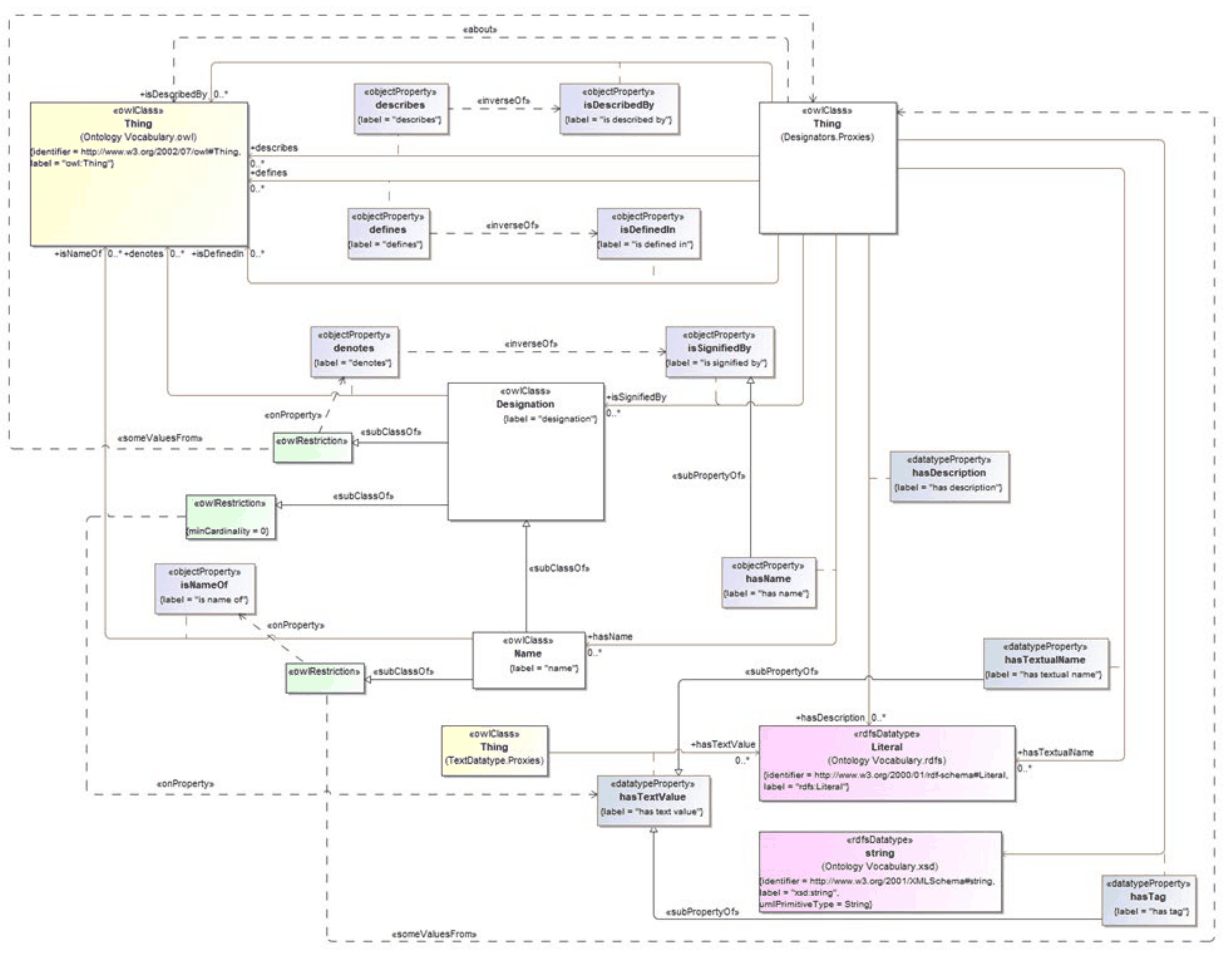
The detailed annotations and axioms that comprise the Commons Designators Ontology are provided in Commons Designators Ontology Details, below.
Classes
| Name | Annotations | Class Expressions |
|---|---|---|
|
Designation (designation) |
Definition: representation for something, or for a conceptualization thereof, that denotes it in a domain or subject Synonym: designator Note: A designation can be a term including appellations, a proper name, or a symbol. Note: A designation can be linguistic or non-linguistic. It can consist of various types of characters, but also punctuation marks such as hyphens and parentheses, governed by domain-, subject-, or language-specific conventions. Note: Note that the use of the min 0 cardinality restriction in the definition of this class is provided as a reminder that designators are expected, in many cases, to have a text value associated with them. There are cases where this is not true, however, including symbols. And, there may be cases where the value is not known. Additionally, not all tools support rdf:langString, thus its use in the definition of the Text datatype may cause errors, for example in value and some number restrictions. Min 0 cardinality constraints are ignored by reasoners and other processors, so this allows us to say that the possible values for this property are likely either xsd:string or rdf:langString, but does not require it depending on the environment in which the ontology is deployed. Adapted from: ISO 1087 Terminology work and terminology science - Vocabulary, Second edition, 2019-09, clause 3.4.1 Adapted from: ISO 704 Terminology work - Principles and methods, Fourth edition, 2022-07, Figure 1 |
Property Restriction: ∃ denotes.owl:Thing Property Restriction: ≥ 0 cmns-txt:hasTextValue.cmns-txt:Text |
|
Name (name) |
Definition: designation for something by a linguistic expression Note: In ISO 1087, a name may be an appellation and is defined as a term that is applied to a group of objects whose relevant properties are identical, whereas a proper name is a designation that represents an individual object. Explanatory note: Note that unlike symbols and other designations, a name is explicitly not linguistically neutral. Adapted from: ISO/IEC 11179-3 Information technology - Metadata registries (MDR) - Registry metamodel and basic attributes, Third edition, 2013-02-15, clause 3.2.83 |
Parent Class: Designation Property Restriction: ∃ isNameOf.owl:Thing |
Properties
| Name | Annotations | Property Axioms |
|---|---|---|
|
defines (defines) |
Definition: specifies the meaning of something in terms of one or more of its essential qualities Note: A quality is an elementary characteristic of something. An 'essential quality' is one that provides a necessary criteria for being that thing and differentiating criteria for not being something else. |
Inverse: isDefinedIn |
|
denotes (denotes) |
Definition: serves as a sign for something, or for a conceptualization thereof Note: Note that in some references, such as the semiotics ontology from Ontology Design Patterns,'denotes' can be used to talk about e.g. entities denoted by proper nouns: the proper noun 'Leonardo da Vinci' denotes the person Leonardo da Vinci; as well as to talk about sets of entities that can be described by a common noun: the common noun 'person' denotes the collection of all persons in a domain of discourse. Other references that may be useful for interpreting 'denotes' include OntoLex. The interpretation of 'denotes' in this context is more general, but intended to reflect its usage in the semiotic triangle. Scope note: This property could be specialized to differentiate the notion of referring to something, i.e., a referent, from the notion of evoking a concept. Consider that in OntoLex, the term denotes is used to designate the sign referent relationship specifically, which in ISO 704:2022 is called 'refers to' in Figure 1. This definition is also meant to cover the OntoLex notion of evokes, which in ISO 704:2022 is called designates or represents. Adapted from: ISO 1087 Terminology work and terminology science - Vocabulary, Second edition, 2019-09, clause 3.4.1 Adapted from: ISO 704 Terminology work - Principles and methods, Fourth edition, 2022-07, Figure 1 See also: http://www.ontologydesignpatterns.org/cp/owl/semiotics.owl# See also: https://www.w3.org/2016/05/ontolex/ |
Domain: Designation |
|
describes (describes) |
Definition: conveys the nature of Usage note: Note that the describes property defined herein as an object property has an implicit range of owl:Class. This is purposeful, so that users can specify any concept, such as a document, contract, specification, situation, or other domain-specific concept, as the thing being described by the domain of this property, which might also be a document, reference, or something else. |
Inverse: isDescribedBy |
|
hasDescription (has description) |
Definition: provides a textual statement, picture in words, or account that describes something Note: Note that the hasDescription property defined herein has an implicit range of rdfs:Literal. This is purposeful, so that users can specify any element that has a name with or without a language tag without concern for conflicting datatypes (i.e., xsd:string vs. rdf:langString, which are logically disjoint). Usage note: This property is a data property, rather than an annotation such as dct:description, enabling it to be used for mapping controlled vocabularies and other literals that are explicit, required attributes of other models. |
Parent Property: cmns-txt:hasTextValue |
|
hasName (has name) |
Definition: is known by |
Parent Property: isSignifiedBy Range: Name Inverse: isNameOf |
|
hasTag (has tag) |
Definition: associates unique combination of alphanumeric characters corresponding to a designator for something Note: Text-valued tags can be useful for controlled vocabulary encoding or transformation, such as those used to produce IETF compliant language tags in XML. |
Parent Property: cmns-txt:hasTextValue Range: xsd:string |
|
hasTextualName (has textual name) |
Definition: associates a name, reference name, or appellation with an individual concept Note: Note that the hasTextualName property defined herein has an implicit range of rdfs:Literal. This is purposeful, so that users can specify any element that has a name with or without a language tag without concern for conflicting datatypes (i.e., xsd:string vs. rdf:langString, which are logically disjoint). Adapted from: ISO 639:2023 Code for individual languages and language groups, Second edition, 2023-11 |
Parent Property: cmns-txt:hasTextValue |
|
isDefinedIn (is defined in) |
Definition: indicates something that specifies the meaning associated with the subject Note: Typically, a concept, such as a classifier or identifier, will be defined in terms of a scheme, contract, specification, standard, or other reference. |
|
|
isDescribedBy (is described by) |
Definition: has general nature or description of Usage note: Note that the 'is described by' property defined herein as an object property has an implicit range of owl:Class. This is purposeful, so that users can specify any concept, such as a document, reference, or other domain-specific concept, as the descriptive thing describing the domain of this property. |
|
|
isNameOf (is name of) |
Definition: denotes in some context |
Parent Property: denotes Domain: Name |
|
isSignifiedBy (is signified by) |
Definition: has representation, denotation or sign of |
Range: Designation Inverse: denotes |
9.11. Commons Dates and Times Ontology§
The dates and times ontology defines commonly used temporal concepts that cover those most frequently needed across domains, with a focus on terminology that is used in business applications. It is designed to be mappable to other date and time ontologies and specifications, such as the W3C Time Ontology in OWL (available at https://www.w3.org/TR/owl-time/), certain temporal elements in BFO 2020 (see https://basic-formal-ontology.org/bfo-2020.html), time concepts defined in schema.org, and the Object Management Group's Date Time Vocabulary (DTV) specification (available at https://www.omg.org/spec/DTV/), without the corresponding overhead or in some cases, issues. The concepts were originally derived from a number of date and time standards including ISO 8601:2004 Representation of Dates and Times. The ontology itself was derived from the Financial Industry Business Ontology (FIBO) Financial Dates ontology, with minor revisions to better reflect requirements for mapping to other ontologies.
Metadata for the Commons Dates and Times Ontology is given in Commons Dates and Times Ontology Metadata.
| Metadata Term | Value |
|---|---|
|
Ontology IRI |
|
|
|
Commons Dates and Times Ontology |
|
|
The dates and times ontology defines commonly used temporal concepts that cover those most frequently needed across domains, with a focus on terminology that is used in business applications. It is designed to be mappable to other date and time ontologies and specifications, such as the W3C Time Ontology in OWL (available at https://www.w3.org/TR/owl-time/), certain temporal elements in BFO 2020 (see https://basic-formal-ontology.org/bfo-2020.html), time concepts defined in schema.org, and the Object Management Group's Date Time Vocabulary (DTV) specification (available at https://www.omg.org/spec/DTV/), without the corresponding overhead or in some cases, issues. The concepts were originally derived from a number of date and time standards including ISO 8601:2004 Representation of Dates and Times. The ontology itself was derived from the Financial Industry Business Ontology (FIBO) Financial Dates ontology, with minor revisions to better reflect requirements for mapping to other ontologies. |
|
|
Elisa Kendall, Thematix Partners LLC |
|
|
Mark Linehan, Thematix Partners LLC |
|
|
Pete Rivett, Federated Knowledge LLC |
|
|
Copyright (c) 2014-2025 EDM Council, Inc. |
|
|
Copyright (c) 2014-2025 Object Management Group, Inc. |
|
|
Copyright (c) 2014-2025 Thematix Partners LLC |
|
|
Copyright (c) 2021-2025 agnos.ai U.K. Ltd |
|
|
Copyright (c) 2023-2025 Federated Knowledge LLC |
|
|
Copyright (c) 2014-2025 EDM Council, Inc. Permission is hereby granted, free of charge, to any person obtaining a copy of this software and associated documentation files (the 'Software'), to deal in the Software without restriction, including without limitation the rights to use, copy, modify, merge, publish, distribute, sublicense, and/or sell copies of the Software, and to permit persons to whom the Software is furnished to do so, subject to the following conditions: The above copyright notice and this permission notice shall be included in all copies or substantial portions of the Software. THE SOFTWARE IS PROVIDED 'AS IS', WITHOUT WARRANTY OF ANY KIND, EXPRESS OR IMPLIED, INCLUDING BUT NOT LIMITED TO THE WARRANTIES OF MERCHANTABILITY, FITNESS FOR A PARTICULAR PURPOSE AND NONINFRINGEMENT. IN NO EVENT SHALL THE AUTHORS OR COPYRIGHT HOLDERS BE LIABLE FOR ANY CLAIM, DAMAGES OR OTHER LIABILITY, WHETHER IN AN ACTION OF CONTRACT, TORT OR OTHERWISE, ARISING FROM, OUT OF OR IN CONNECTION WITH THE SOFTWARE OR THE USE OR OTHER DEALINGS IN THE SOFTWARE. See https://opensource.org/licenses/MIT. |
|
|
|
|
|
The dates and times ontology conforms with the OWL 2 DL semantics, and is outside of OWL 2 RL due to the inclusion of exact cardinality constraints on explicit date, explicit duration and time of day. These constraints can be changed to maximum cardinality constraints if needed to support OWL RL rule-based applications that cannot be extended to support them. |
|
|
https://www.omg.org/spec/Commons/20220501/DatesAndTimes.rdf version of this ontology was modified to eliminate a double space in the scope note on CombinedDateTime (COMMONS-6). |
|
|
https://www.omg.org/spec/Commons/20221101/DatesAndTimes.rdf version of this ontology was revised to add properties supporting start and end time and related concepts (COMMONS-11-8). |
|
|
https://www.omg.org/spec/Commons/20230801/DatesAndTimes.rdf version of this ontology was revised to correct an annotation on DateTime (COMMONS-13-20) and to revise the notes on DatePeriod to allow for cases where a date period, such as 5 days, is known but the start and end of that period are not known (COMMONS-13-19). |
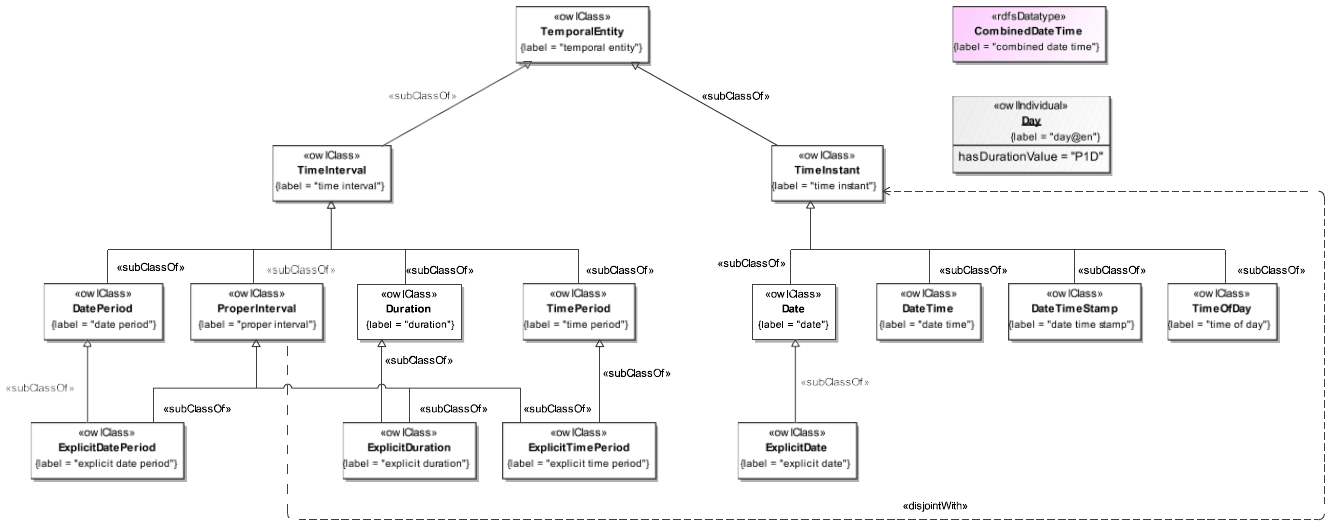
The detailed annotations and axioms that comprise the Commons Dates and Times Ontology are provided in Commons Dates and Times Ontology Details, below.
Classes
| Name | Annotations | Class Expressions |
|---|---|---|
|
Date (date) |
Definition: calendar day on some calendar Note: A date may or may not have a value, and may be explicit or calculated. A date that has a value is one that is either explicitly set as a literal when it is created, or is some form of 'calculated date'. In an instance of date, the existence of the 'has date value' property both indicates that the date is known, and gives the value of the date. A date that does not have a value is likely one that is some form of 'calculated date, in which the actual date has not (yet) been established. |
Parent Class: TimeInstant Property Restriction: ≤ 1 hasDateValue.xsd:string |
|
DatePeriod (date period) |
Definition: time span over one or more calendar days Note: A date period is considered unknown or incomplete if either the start date or the end date has no value. There may be cases, however, when the length of time is known, such as a 4-day work week, but the precise start and end of that week are not known. Note: A date period is typically defined by at least two of three properties: (1) a start date, (2) an end date, and (3) a duration. If more than one of these properties is missing, the date period may be invalid, incomplete, or unknown. |
Parent Class: TimeInterval Property Restriction: ≤ 1 hasStartDate.Date Property Restriction: ≤ 1 hasEndDate.Date Property Restriction: ≤ 1 hasDuration.Duration |
|
DateTime (date time) |
Definition: time point including a date and a time, optionally including a time zone offset Note: 'has date time value' is omitted if the 'date time' is not (yet) known. The time zone is implicitly UTC. |
Parent Class: TimeInstant Property Restriction: ≤ 1 hasDateTimeValue.xsd:dateTime |
|
DateTimeStamp (date time stamp) |
Definition: time point including a date and a time that requires a time zone offset Synonym: time stamp Note: 'has date time stamp value' is omitted if the 'date time stamp' is not (yet) established. |
Parent Class: TimeInstant Property Restriction: ≤ 1 hasDateTimeStampValue.xsd:dateTimeStamp |
|
Duration (duration) |
Definition: interval of time of some specific length Note: The 'has duration value' property is absent if the duration is not (yet) known. |
Parent Class: TimeInterval Property Restriction: ≤ 1 hasDurationValue.xsd:string |
|
ExplicitDate (explicit date) |
Definition: date in which the 'has date value' property is required |
Parent Class: Date Property Restriction: = 1 hasDateValue.xsd:string |
|
ExplicitDatePeriod (explicit date period) |
Definition: date period for which the start date, end date, and/or duration are required Note: As with 'date period', any one of {start date, end date, duration} may be omitted because the missing property can be inferred from the other two. |
Parent Class: DatePeriod, ProperInterval Property Restriction: ≤ 1 hasStartDate.ExplicitDate Property Restriction: ≤ 1 hasDuration.ExplicitDuration Property Restriction: ≤ 1 hasEndDate.ExplicitDate |
|
ExplicitDuration (explicit duration) |
Definition: duration for which the 'has duration value' property must have a value Note: This class is used when a duration is guaranteed to be known when it is created. |
Parent Class: Duration, ProperInterval Property Restriction: = 1 hasDurationValue.xsd:string |
|
ExplicitTimePeriod (explicit time period) |
Definition: time period for which the starting time, ending time, and/or duration are required Note: As with 'time period', any one of {start time, end time, duration} may be omitted because the missing property can be inferred from the other two. |
Parent Class: ProperInterval, TimePeriod Property Restriction: ≤ 1 hasDuration.ExplicitDuration Property Restriction: ≤ 1 hasStartTime.TimeOfDay Property Restriction: ≤ 1 hasEndTime.TimeOfDay |
|
ProperInterval (proper interval) |
Definition: time interval with a non-zero extent or duration Note: Proper interval is included explicitly to enable mapping to the same term in the Time Ontology in OWL for use with the Allen intervals encoded therein. Source: https://www.w3.org/TR/owl-time/#time:ProperInterval |
Parent Class: TimeInterval Class Axiom: ¬ TimeInstant |
|
TemporalEntity (temporal entity) |
Definition: time interval or instant See also: time:TemporalEntity |
|
|
TimeInstant (time instant) |
Definition: temporal entity that is a member of a time scale, with no extent or duration Synonym: instant in time Synonym: time point Example: The Battle of Hastings was on '14 October 1066'. (This gives the Julian date of the battle at a granularity of 'day'. If desired, the battle could be given more precisely as a time period within that calendar day.) Note: For scales that have a granularity specified in days, a date is a time point; for scales down to the seconds, the equivalent of an xsd:dateTime or xsd:dateTimeStamp is a time point. Note: The duration of each time interval that is an instance of the time point is the granularity of the time scale of the time point. Adapted from: https://www.omg.org/spec/DTV/ Adapted from: https://www.w3.org/TR/owl-time/#time:Instant |
Parent Class: TemporalEntity |
|
TimeInterval (time interval) |
Definition: segment of the time axis, a location in time, with an extent or duration Example: the day whose Gregorian calendar date is September 11, 2001 Example: the lifetime of Henry V Note: Every time interval has a beginning, an end, and a duration, even if not known. Every time interval is 'finite', a bounded segment of the time axis. The beginning or end of a time interval may be defined by reference to events that occur for a time interval that is not known. Note: Time intervals may be indefinite, meaning that their beginning is primordiality or their end is perpetuity, or both (eternity). This vocabulary assumes that indefinite time intervals exist and have some duration, but their duration is unknown. Adapted from: https://www.omg.org/spec/DTV/ Adapted from: https://www.w3.org/TR/owl-time/#time:Interval |
Parent Class: TemporalEntity |
|
TimeOfDay (time of day) |
Definition: explicit time, according to a clock Note: The representation similar to xsd:dateTime, but should exclude the date component and time zone. The value of the has time value property roughly corresponds to xsd:time in XML schema datatypes, which is prohibited from use in OWL due to ambiguity in its definition. |
Parent Class: TimeInstant Property Restriction: = 1 hasTimeValue.xsd:string |
|
TimePeriod (time period) |
Definition: time span over some finite window Note: A time period is defined by at least two of three properties: (1) a start time, (2) an end time, and (3) a duration. If more than one of these properties is missing, the time period may be invalid or unknown. Note: A time period is unknown if either the starting or ending time has no value. If a time period is unknown, then the duration should either be omitted or unknown (have no value). |
Parent Class: TimeInterval Property Restriction: ≤ 1 hasDuration.Duration Property Restriction: ≤ 1 hasStartTime.TimeOfDay Property Restriction: ≤ 1 hasEndTime.TimeOfDay |
Datatypes
| Name | Annotations | Class Expressions |
|---|---|---|
|
CombinedDateTime (combined date time) |
Definition: datatype that maps to several base types for dates and times Note: Valid values must use the ISO 8601 representation for a date, or the corresponding XML Schema Datatypes representation for a date and time, or date and time including the time zone. Scope note: There are many cases where the representation of a date may or may not include a time, and where the underlying data representation varies. This composite datatype should only be used in cases where a standard representation using one of the options in the union for date or date and time value specification does not work. |
Equivalent Datatype: xsd:string ⊔ xsd:dateTime ⊔ xsd:dateTimeStamp |
Individuals
| Name | Annotations | Individual Axioms |
|---|---|---|
|
Day (day@en) |
Definition: explicit period of 24 hours |
Type: ExplicitDuration hasDurationValue = "P1D" |
Properties
| Name | Annotations | Property Axioms |
|---|---|---|
|
hasDate (has date) |
Definition: identifies a calendar day, month and year |
Parent Property: hasTime Range: Date |
|
hasDateOfIssuance (has date of issuance) |
Definition: links something, such as an agreement, contract, license, or report, to the date it was made available |
Type: owl:FunctionalProperty Parent Property: hasStartDate Range: Date |
|
hasDatePeriod (has date period) |
Definition: identifies a specific window of time, including a start date, end date and/or duration |
Parent Property: hasTime Range: DatePeriod |
|
hasDateTime (has date time) |
Definition: identifies a specific date and time of day, possibly excluding the time zone |
Parent Property: hasTime Range: DateTime |
|
hasDateTimeStamp (has date time stamp) |
Definition: identifies a specific date and time of day, explicitly including the time zone |
Parent Property: hasTime Range: DateTimeStamp |
|
hasDateTimeStampValue (has date time stamp value) |
Definition: specifies an actual literal (explicit) date and time, including the time zone |
Range: xsd:dateTimeStamp |
|
hasDateTimeValue (has date time value) |
Definition: specifies an actual literal (explicit) date and time |
Range: xsd:dateTime |
|
hasDateValue (has date value) |
Definition: specifies an actual literal (explicit) date captured in the format specified for xsd:date (i.e., ISO 8601 format), WITHOUT the time or timezone information; the semantics are identical to those of xsd:date Example: 2002-10-10 means October 10, 2002 Note: In the Finance domain, for consistency with FpML (reference FpML Coding Schemes 30 June 2014, Version 1.56, section 2.1.1), the year MUST be specified as 4 digits, and the month and day MUST be specified as 2 digits with a leading zero if needed. Times and timezones should NOT be specified. |
Range: xsd:string |
|
hasDuration (has duration) |
Definition: specifies the time during which something continues Note: This duration may be omitted or unknown if either the start or end Date of the DatePeriod is an ExplicitDate. |
Parent Property: hasTime Range: Duration |
|
hasDurationValue (has duration value) |
Definition: specifies a literal (explicit) duration (amount of time) captured in the format specified for xsd:duration (i.e., ISO 8601 format); the semantics are identical to those of xsd:duration Example: -P3D means negative 3 days duration. This is used with OffsetDates to specify 3 days before (prior) to some other Date. Example: P1Y means 1 year Example: P1Y2M3DT4H5M6S means 1 year, 2 months, 3 days, 4 hours, 5 minutes, 6 seconds Example: P2M means 2 months Example: P3D means 3 days Example: PT4H means 4 hours Example: PT5M means 5 minutes Example: PT6S means 6 seconds Note: Negative durations are used to indicate relative dates that are before (rather than after) some other Date. |
Domain: Duration Range: xsd:string |
|
hasEnd (has end) |
Definition: indicates the final or ending time point associated with something |
Parent Property: hasTime Range: TimeInstant |
|
hasEndDate (has end date) |
Definition: indicates the final or ending date associated with something |
Parent Property: hasDate, hasEnd Range: Date |
|
hasEndTime (has end time) |
Definition: indicates the final or ending time associated with something Usage note: Use of the property 'hasTimeValue' as a property of the TimeOfDay to record the actual time, or use either the DateTime or DateTimeStamp class with the date zeroed out if the date is not relevant but with the time included. |
Parent Property: hasEnd Range: TimeOfDay |
|
hasExplicitDate (has explicit date) |
Definition: indicates a stated date, as opposed to a calculated or unknown date, associated with something |
Parent Property: hasDate Range: ExplicitDate |
|
hasObservedDateTime (has observed date and time) |
Definition: indicates a date and time associated with an event, measurement, record, or observation |
Range: CombinedDateTime |
|
hasStart (has start) |
Definition: indicates the initial time point associated with something |
Parent Property: hasTime Range: TimeInstant |
|
hasStartDate (has start date) |
Definition: indicates the initial date associated with something |
Parent Property: hasDate, hasStart Range: Date |
|
hasStartTime (has start time) |
Definition: indicates the initial or starting time associated with something Usage note: Use of the property 'hasTimeValue' as a property of the TimeOfDay to record the actual time, or use either the DateTime or DateTimeStamp class with the date zeroed out if the date is not relevant but with the time included. |
Parent Property: hasStart Range: TimeOfDay |
|
hasTime (has time) |
Definition: specifies a general time that can be associated with any element Note: This property corresponds to the property of the same name in the W3C Time Ontology, and can be used to support mapping. |
Range: TemporalEntity |
|
hasTimePeriod (has time period) |
Definition: identifies a specific window of time, including a starting time, ending time and/or duration |
Parent Property: hasTime Range: TimePeriod |
|
hasTimeValue (has time value) |
Definition: specifies an explicit time, captured in the format specified for xsd:time (i.e., ISO 8601 format), WITHOUT the date or timezone information |
Range: xsd:string |
|
precedes (precedes) |
Definition: associates based on prior spatial or temporal proximity; occurs before in a logical order or sequence Source: ISO 1087 Terminology work and terminology science - Vocabulary, Second edition, 2019-09, clause 3.2.24 |
|
|
succeeds (succeeds) |
Definition: associates based on subsequent spatial or temporal proximity; follows in a logical order or sequence Source: ISO 1087 Terminology work and terminology science - Vocabulary, Second edition, 2019-09, clause 3.2.24 |
Inverse: precedes |
9.12. Commons Identifiers Ontology§
The identifiers ontology defines commonly used concepts for describing identifiers and the identification schemes that define them, such as various national and international identifiers for legal entities, financial instruments, and the like, derived from the patterns specified in ISO 11179-3, Metadata Registries.
Metadata for the Commons Identifiers Ontology is given in Commons Identifiers Ontology Metadata.
| Metadata Term | Value |
|---|---|
|
Ontology IRI |
|
|
|
Commons Identifiers Ontology |
|
|
The identifiers ontology defines commonly used concepts for describing identifiers and the identification schemes that define them, such as various national and international identifiers for legal entities, financial instruments, and the like, derived from the patterns specified in ISO 11179-3, Metadata Registries. |
|
|
Elisa Kendall, Thematix Partners LLC |
|
|
Evan Wallace, U.S. National Institute of Standards and Technology (NIST) |
|
|
Pete Rivett, agnos.ai U.K. Ltd |
|
|
Copyright (c) 2014-2022 Thematix Partners LLC |
|
|
Copyright (c) 2021-2022 EDM Council, Inc. |
|
|
Copyright (c) 2021-2022 Object Management Group, Inc. |
|
|
Copyright (c) 2021-2022 agnos.ai U.K. Ltd |
|
|
http://opensource.org/licenses/MIT |
|
|
|
|
|
The identifiers ontology conforms with the OWL 2 DL semantics, and is outside of OWL 2 RL due to (1) imported axioms from the designations ontology, and (2) the inclusion of local some values constraints on the Identifier class. The latter could be removed as needed to support OWL RL rule-based applications that cannot be extended to support it. |
|
|
This ontology was originally designed for use in the OMG Languages, Countries and Codes (LCC) specification as part of the broader LanguageRepresentation ontology. The concepts have also been used in the Financial Industry Business Ontology (FIBO) for representing financial instrument, legal entity, and other identifiers. |
|
|
The https://www.omg.org/spec/Commons/20220501/Identifiers.rdf version of this ontology was modified to make the property 'identifies' functional (COMMONS-26). |
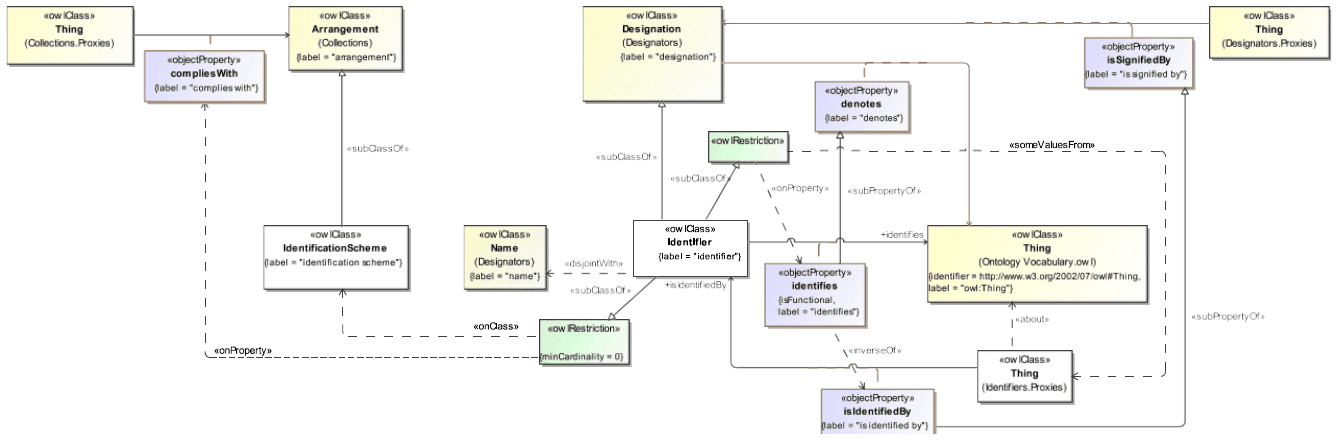
The detailed annotations and axioms that comprise the Commons Identifiers Ontology are provided in Commons Identifiers Ontology Details, below.
Classes
| Name | Annotations | Class Expressions |
|---|---|---|
|
IdentificationScheme (identification scheme) |
Definition: system for minting identifiers for things that specifies constraints on the structure of the identifier Adapted from: ISO/IEC 11179-3 Information technology - Metadata registries (MDR) - Part 3: Registry metamodel and basic attributes, Third edition, 2013-02-15 |
Parent Class: cmns-col:Arrangement |
|
Identifier (identifier) |
Definition: sequence of characters uniquely identifying that with which it is associated Note: Note that some identifiers may be reused, or may be components of other identifiers, thus the restriction on what an identifier identifies is a 'some values' restriction rather than an exact cardinality. Examples of reusable identifiers include ticker symbols, and in the United States, vehicle license numbers, such as vanity plates that can be reassigned and moved from one car to another. Narrower constraints can be added to specific kinds of identifiers that are not reassignable and that identify exactly one thing, such as many national identifiers for people including passport numbers and, in the United States, social security numbers. Also, not all identifiers are explicitly defined in formal schemes, although they may be created or generated according to some formula. Source: ISO/IEC 11179-3 Information technology - Metadata registries (MDR) - Part 3: Registry metamodel and basic attributes, Third edition, 2013-02-15, clause 3.1.1 |
Parent Class: cmns-dsg:Designation Property Restriction: ≥ 0 cmns-col:compliesWith.IdentificationScheme Property Restriction: ∃ identifies.owl:Thing Class Axiom: ¬ cmns-dsg:Name |
Properties
| Name | Annotations | Property Axioms |
|---|---|---|
|
identifies (identifies) |
Definition: recognizes or establishes identity within some context |
Type: owl:FunctionalProperty Parent Property: cmns-dsg:denotes Domain: Identifier |
|
isIdentifiedBy (is identified by) |
Definition: has an identifier that is unique within some context |
Parent Property: cmns-dsg:isSignifiedBy Range: Identifier Inverse: identifies |
9.13. Commons Languages Ontology§
This ontology, based at a very high level on ISO 639 as well as the language element of the Language Tag specified in BCP 47 (RFC 4646, RFC 4647), defines the concept of a language, and covers natural and engineered languages. It is provided in Commons as a bridge between a number of OMG ontologies, including the API4KP ontologies, the ontology associated with the Distributed Ontology, Model, and Specification Language (DOL) specification, the Languages, Countries, and Codes (LCC) specification and ontologies, and the Multiple Vocabulary Facility (MVF) ontologies, among others, and was derived from the original LCC Language Representation ontology. The model aligns with the latest ISO 639 revisions, which were formerly part of ISO-639-4, and with definitions in other ISO terminology and thesauri standards.
Metadata for the Commons Languages Ontology is given in Commons Languages Ontology Metadata.
| Metadata Term | Value |
|---|---|
|
Ontology IRI |
|
|
|
Commons Languages Ontology |
|
|
This ontology, based at a very high level on ISO 639 as well as the language element of the Language Tag specified in BCP 47 (RFC 4646, RFC 4647), defines the concept of a language, and covers natural and engineered languages. It is provided in Commons as a bridge between a number of OMG ontologies, including the API4KP ontologies, the ontology associated with the Distributed Ontology, Model, and Specification Language (DOL) specification, the Languages, Countries, and Codes (LCC) specification and ontologies, and the Multiple Vocabulary Facility (MVF) ontologies, among others, and was derived from the original LCC Language Representation ontology. The model aligns with the latest ISO 639 revisions, which were formerly part of ISO-639-4, and with definitions in other ISO terminology and thesauri standards. |
|
|
Elisa Kendall, Thematix Partners LLC |
|
|
Pete Rivett, Federated Knowledge LLC |
|
|
2025-07-24T18:00:00 |
|
|
Copyright (c) 2015-2017 Unisys |
|
|
Copyright (c) 2015-2019 Adaptive, Inc. |
|
|
Copyright (c) 2015-2025 Object Management Group, Inc. |
|
|
Copyright (c) 2015-2025 Thematix Partners LLC |
|
|
Copyright (c) 2019-2025 agnos.ai UK Ltd. |
|
|
Copyright (c) 2015-2025 Adaptive Analytics, Inc. Permission is hereby granted, free of charge, to any person obtaining a copy of this software and associated documentation files (the 'Software'), to deal in the Software without restriction, including without limitation the rights to use, copy, modify, merge, publish, distribute, sublicense, and/or sell copies of the Software, and to permit persons to whom the Software is furnished to do so, subject to the following conditions: The above copyright notice and this permission notice shall be included in all copies or substantial portions of the Software. THE SOFTWARE IS PROVIDED 'AS IS', WITHOUT WARRANTY OF ANY KIND, EXPRESS OR IMPLIED, INCLUDING BUT NOT LIMITED TO THE WARRANTIES OF MERCHANTABILITY, FITNESS FOR A PARTICULAR PURPOSE AND NONINFRINGEMENT. IN NO EVENT SHALL THE AUTHORS OR COPYRIGHT HOLDERS BE LIABLE FOR ANY CLAIM, DAMAGES OR OTHER LIABILITY, WHETHER IN AN ACTION OF CONTRACT, TORT OR OTHERWISE, ARISING FROM, OUT OF OR IN CONNECTION WITH THE SOFTWARE OR THE USE OR OTHER DEALINGS IN THE SOFTWARE. See https://opensource.org/licenses/MIT. |
|
|
BCP 47, Tags for Identifying Languages, see http://tools.ietf.org/html/bcp47 |
|
|
ISO 639 Code for individual languages and language groups, Second edition, 2023-11 |
|
|
|
|
|
|
|
|
Commons Languages Ontology |
|
|
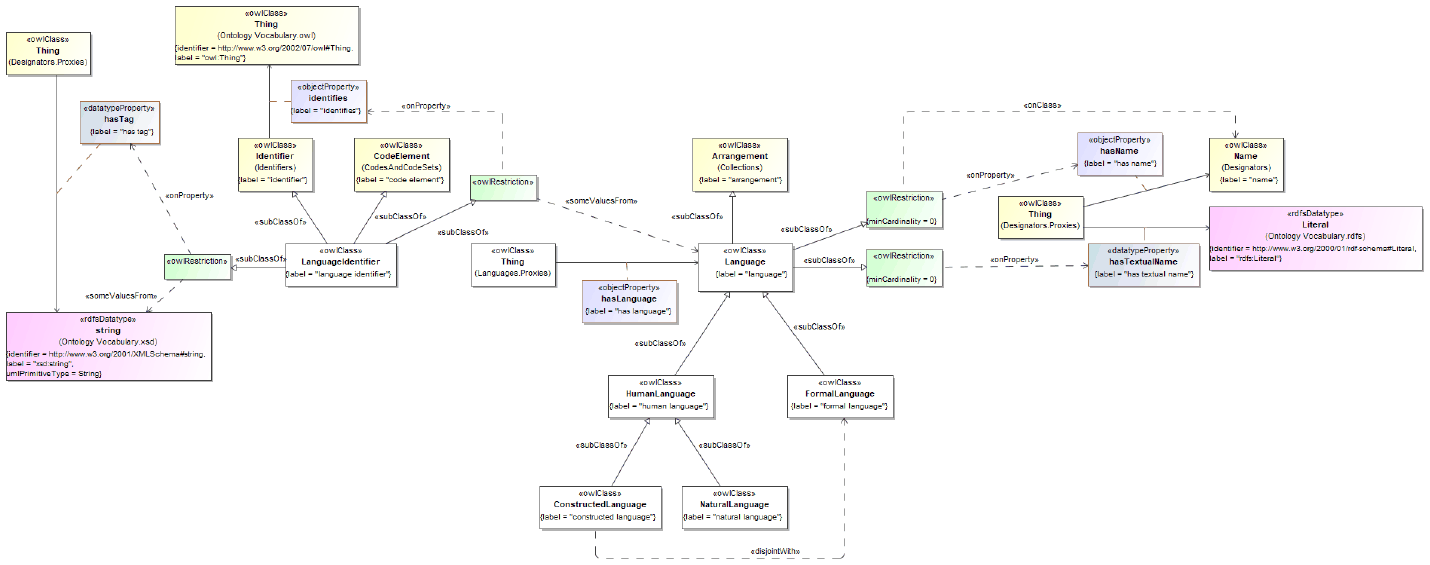
The detailed annotations and axioms that comprise the Commons Languages Ontology are provided in Commons Languages Ontology Details, below.
Classes
| Name | Annotations | Class Expressions |
|---|---|---|
|
ConstructedLanguage (constructed language) |
Definition: individual language whose rules are explicitly established prior to its use Note: Constructed languages do not include reconstructed languages, computer programming languages, mark-up languages or similar formal languages. Note: Some constructed languages are based on one or several natural languages and are therefore not 'artificial'. Adapted from: ISO 639 Code for individual languages and language groups, Second edition, 2023-11, clause 3.3.2 |
Parent Class: HumanLanguage Class Axiom: ¬ FormalLanguage |
|
FormalLanguage (formal language) |
Definition: language comprised of a set of finite-length strings (i.e., a body of words) constructed from a finite alphabet, following a set of methods of combining them (called a grammar), governed by precise syntactic rules Adapted from: Mateescu, A., Salomaa, A. (1997). Formal Languages: an Introduction and a Synopsis. In: Rozenberg, G., Salomaa, A. (eds) Handbook of Formal Languages. Springer, Berlin, Heidelberg. https://doi.org/10.1007/978-3-642-59136-5_1 Adapted from: https://mathworld.wolfram.com/FormalLanguage.html |
Parent Class: Language |
|
HumanLanguage (human language) |
Definition: language that may be used to express or communicate meaning or a message between humans Note: Human language was originally developed for, and mainly used in, direct communication between humans. Today its use is increasingly supported by information and communication technologies (ICTs). Adapted from: ISO 639 Code for individual languages and language groups, Second edition, 2023-11 |
Parent Class: Language |
|
Language (language) |
Definition: systematic use of sounds, visual-spatial signs, characters or other written symbols or signs that can be combined to express or communicate meaning, understood by a community Adapted from: ISO 639 Code for individual languages and language groups, Second edition, 2023-11, clause 3.1.1 |
Parent Class: cmns-col:Arrangement Property Restriction: ≥ 0 cmns-dsg:hasTextualName Property Restriction: ≥ 0 cmns-dsg:hasName.cmns-dsg:Name Property Restriction: ≥ 0 cmns-id:isIdentifiedBy.LanguageIdentifier |
|
LanguageIdentifier (language identifier) |
Definition: string of characters assigned to an individual language or a language group for the purpose of identifying it unequivocally Synonym: language symbol Scope note: In the ISO 639 language code, the string of characters consists of a string of letters. Adapted from: ISO 639 Code for individual languages and language groups, Second edition, 2023-11, clause 3.7.10 |
Parent Class: cmns-cds:CodeElement, cmns-id:Identifier Property Restriction: ∃ cmns-dsg:hasTag.xsd:string Property Restriction: ∃ cmns-id:identifies.Language |
|
NaturalLanguage (natural language) |
Definition: individual language which is or was in active use in a language community, passed on from one generation of speakers to the next Example: Bambara, English, Haitian Creole, Latin, LIBRAS (Língua Brasileira de Sinais/Brazilian Sign Language) Adapted from: ISO 639 Code for individual languages and language groups, Second edition, 2023-11, clause 3.3.1 |
Parent Class: HumanLanguage |
|
Script (script) |
Definition: comprehensive set of graphic characters used for the written form of one or more individual languages Example: Cyrillic, Hiragana Note: A script, as opposed to an arbitrary subset of characters, is defined in distinction to other scripts; in general, readers of one script can be unable to read the glyphs of another script easily, even where there is a historical relation between them. ISO 639 language identifiers may be combined with script identifiers from ISO 15924 (e.g., BCP 47). Adapted from: ISO 639 Code for individual languages and language groups, Second edition, 2023-11, clause 3.6.2 |
Parent Class: cmns-col:Collection |
|
ScriptIdentifier (script identifier) |
Definition: string of characters assigned to represent a script unequivocally Synonym: script symbol Adapted from: ISO 639 Code for individual languages and language groups, Second edition, 2023-11, clause 3.7.10 |
Parent Class: cmns-cds:CodeElement, cmns-id:Identifier Property Restriction: ∃ cmns-id:identifies.Script Property Restriction: ∃ cmns-dsg:hasTag.xsd:string |
Properties
| Name | Annotations | Property Axioms |
|---|---|---|
|
hasLanguage (has language) |
Definition: is expressed in or uses a given language in some context |
Parent Property: cmns-cxtdsg:uses Range: Language |
9.14. Commons Locations Ontology§
This ontology provides a very high level definition of geographic region and geopolitical entity related concepts, including, but not limited to, countries, sub-country regions such as states and provinces, and municipalities. The representation was derived from a combination of ISO 3166, the UN M49 Region codes, Geonames, the SWIFT registry, the UN FAO and CIA World Factbook, and other sources. It aims to provide a systematic description of the vocabulary used for country and geopolitical entity representation, useful for mapping among the various names and codes for countries and their subdivisions used world-wide, including but not limited to FIPA and International Olympics codes for countries, (based strictly on requirements for business applications, not broader geographic or political uses).The terms defined herein terms are reused by the OMG's LCC controlled vocabulary representing ISO 3166 country and country subdivision codes, and may be mapped to other standards and de facto standards such as those mentioned.
Metadata for the Commons Locations Ontology is given in Commons Locations Ontology Metadata.
| Metadata Term | Value |
|---|---|
|
Ontology IRI |
|
|
|
Commons Locations Ontology |
|
|
This ontology provides a very high level definition of geographic region and geopolitical entity related concepts, including, but not limited to, countries, sub-country regions such as states and provinces, and municipalities. The representation was derived from a combination of ISO 3166, the UN M49 Region codes, Geonames, the SWIFT registry, the UN FAO and CIA World Factbook, and other sources. It aims to provide a systematic description of the vocabulary used for country and geopolitical entity representation, useful for mapping among the various names and codes for countries and their subdivisions used world-wide, including but not limited to FIPA and International Olympics codes for countries, (based strictly on requirements for business applications, not broader geographic or political uses).The terms defined herein terms are reused by the OMG's LCC controlled vocabulary representing ISO 3166 country and country subdivision codes, and may be mapped to other standards and de facto standards such as those mentioned. |
|
|
Elisa Kendall, Thematix Partners LLC |
|
|
Evan Wallace, U.S. National Institute of Standards and Technology (NIST) |
|
|
Pete Rivett, Federated Knowledge, LLC |
|
|
Roy Bell, Thematix Partners LLC |
|
|
Copyright (c) 2015-2017 Unisys |
|
|
Copyright (c) 2015-2025 Adaptive Analytics, Inc. |
|
|
Copyright (c) 2015-2025 EDM Council, Inc. |
|
|
Copyright (c) 2015-2025 Object Management Group, Inc. |
|
|
Copyright (c) 2015-2025 Thematix Partners LLC |
|
|
Copyright (c) 2019-2025 agnos.ai UK Ltd. |
|
|
Copyright (c) 2021-2025 Federated Knowledge, LLC |
|
|
Copyright (c) 2015-2025 Adaptive Analytics, Inc. Permission is hereby granted, free of charge, to any person obtaining a copy of this software and associated documentation files (the 'Software'), to deal in the Software without restriction, including without limitation the rights to use, copy, modify, merge, publish, distribute, sublicense, and/or sell copies of the Software, and to permit persons to whom the Software is furnished to do so, subject to the following conditions: The above copyright notice and this permission notice shall be included in all copies or substantial portions of the Software. THE SOFTWARE IS PROVIDED 'AS IS', WITHOUT WARRANTY OF ANY KIND, EXPRESS OR IMPLIED, INCLUDING BUT NOT LIMITED TO THE WARRANTIES OF MERCHANTABILITY, FITNESS FOR A PARTICULAR PURPOSE AND NONINFRINGEMENT. IN NO EVENT SHALL THE AUTHORS OR COPYRIGHT HOLDERS BE LIABLE FOR ANY CLAIM, DAMAGES OR OTHER LIABILITY, WHETHER IN AN ACTION OF CONTRACT, TORT OR OTHERWISE, ARISING FROM, OUT OF OR IN CONNECTION WITH THE SOFTWARE OR THE USE OR OTHER DEALINGS IN THE SOFTWARE. See https://opensource.org/licenses/MIT. |
|
|
|
|
|
|
|
|
This ontology is largely derived from the Object Management Group's Languages, Countries and Codes (LCC) standard (to provide a more general ontology on which LCC can depend) and the Financial Industry Business Ontology (FIBO) Locations and Virtual Locations ontologies. |
|
|
The https://www.omg.org/spec/Commons/20240801/Locations.rdf version of this ontology was modified to add support for WGS 84 (COMMONS-1.3-28) and add a hasPrimarySubdivision property to enable better querying (COMMONS13-35). |
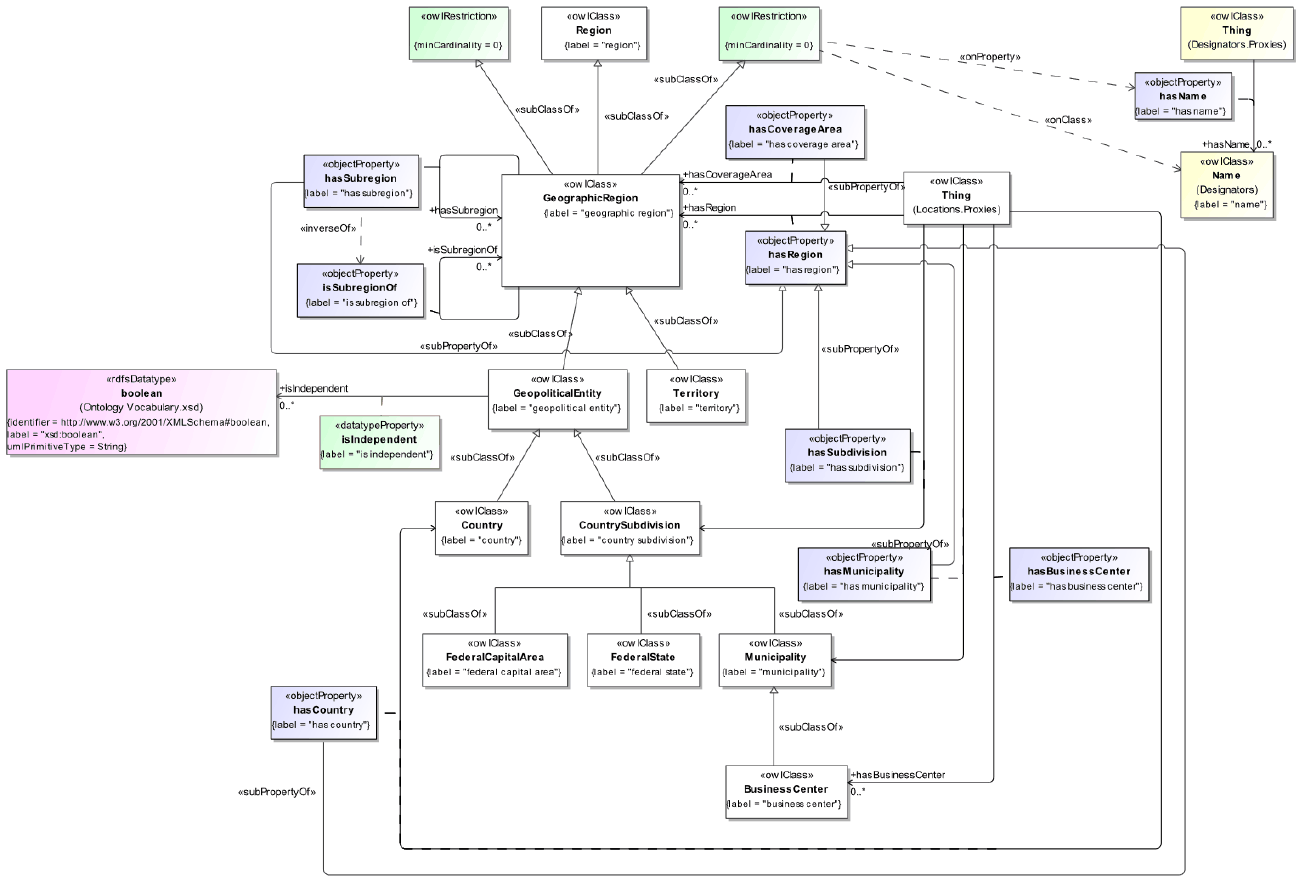
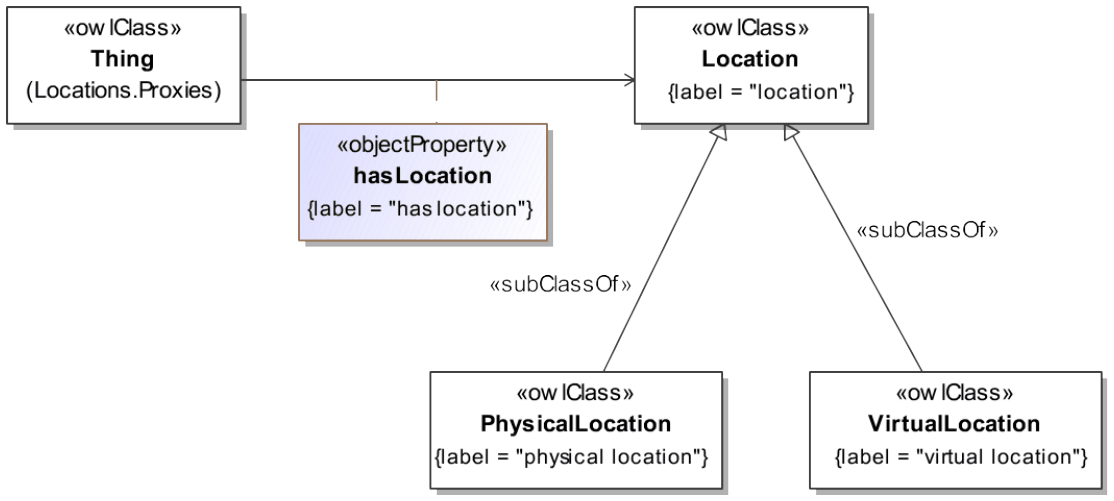
The detailed annotations and axioms that comprise the Commons Locations Ontology are provided in Commons Locations Ontology Details, below.
Classes
| Name | Annotations | Class Expressions |
|---|---|---|
|
BusinessCenter (business center) |
Definition: municipality where business is conducted, especially one that is considered a financial center Adapted from: FpML Business Center and related codes, see http://www.fpml.org/coding-scheme/business-center-7-14.xml |
Parent Class: Municipality |
|
Country (country) |
Definition: geopolitical entity representing a distinct territorial body or political entity or dependent territory Explanatory note: It may be an independent sovereign state or part of a larger state, as a non-sovereign or formerly sovereign political division, a physical territory with a government, or a geographic region associated with sets of previously independent or differently associated peoples with distinct political characteristics. See also: https://datahelpdesk.worldbank.org/knowledgebase/articles/906519 See also: https://www.un.org/development/desa/dpad/wp-content/uploads/sites/45/2017wesp_annex_en.pdf |
Parent Class: GeopoliticalEntity Property Restriction: = 1 isIndependent.xsd:boolean |
|
CountrySubdivision (country subdivision) |
Definition: geopolitical entity that is a legal division of a country, dependency, or other area of special geopolitical interest related to a country or other geopolitical entity Explanatory note: In the US, the US Census Bureau and other federal agencies may group some number of other subdivisions for statistical analysis and reporting purposes, ranging from multiple states to minor civil divisions. See also: https://www.census.gov/programs-surveys/popest/guidance-geographies/terms-and-definitions.html |
Parent Class: GeopoliticalEntity Property Restriction: ∃ cmns-cls:isClassifiedBy.GeographicRegionKind |
|
County (county) |
Definition: political and administrative division of a country, state or province, providing certain local governmental services |
Parent Class: CountrySubdivision |
|
FederalCapitalArea (federal capital area) |
Definition: country subdivision that is or includes the municipality or capital city that acts as the seat of the federal government Example: Examples include the District of Columbia in the US, and the Canberra area in Australia. Explanatory note: The capital administrative region of some federations includes those for which the capital is situated other than within one of the states or provinces which make up the country as a whole. |
Parent Class: CountrySubdivision |
|
FederalState (federal state) |
Definition: self-governing geopolitical unit which forms part of a wider geopolitical unit that is recognized as a country Synonym: canton Synonym: province Synonym: state Explanatory note: This type of entity, variously referred to as a state, province or canton, has a level of self government including its own legal system and court jurisdiction, but cedes a level of autonomy to the federation of which it forms a part. |
Parent Class: CountrySubdivision |
|
GeodeticCoordinateSystem (geodetic coordinate system) |
Definition: three-dimensional reference system that is a global frame of reference for precisely representing the position of locations on Earth or other planetary bodies by means of geodetic coordinates Example: The three most widely used systems for indicating point locations in the United States are (1) latitude and longitude [and optionally elevation], (2) Universal Transverse Mercator (UTM) system, and (3) State Plane Coordinate Systems (SPCS). Note: The unit of measure is usually decimal degrees. A point has two coordinate values, latitude and longitude. Latitude and longitude measure angles. Explanatory note: Geodetic coordinates are crucial to any technology or technique based on spatial location, including geodesy, navigation, surveying, geographic information systems, remote sensing, and cartography. Source: http://edndoc.esri.com/arcsde/9.1/general_topics/what_coord_sys.htm |
Parent Class: cmns-col:Arrangement |
|
GeographicRegion (geographic region) |
Definition: area of land that has common features Explanatory note: A region may be defined by natural or artificial features, and may be described as part of a country or the world having definable characteristics but not always fixed boundaries. Usage note: Many cases in which a geographic region, or subclass thereof, is mapped to certain applications or a relational store, or where codes are used to identify the region, require a class to represent the name of the region. In such situations, attributes of the name, such as the dates when a particular name was in use, or was valid under certain circumstances, may be important. For other applications, such as for addressing, a text value may be required. Thus, both options are provided here, with a preference for use of the full class option, depending on the use case. Source: https://www.nationalgeographic.org/encyclopedia/region/ |
Parent Class: Region Property Restriction: ≥ 0 cmns-dsg:hasTextualName Property Restriction: ≥ 0 cmns-dsg:hasName.cmns-dsg:Name |
|
GeographicRegionIdentificationScheme (geographic region identification scheme) |
Definition: identification scheme dedicated to the unique identification of geographic regions |
Parent Class: cmns-id:IdentificationScheme |
|
GeographicRegionIdentifier (geographic region identifier) |
Definition: string of letters that indicates a code or other identifier for geographical region, assigned for the purpose of uniquely identifying it within some context |
Parent Class: cmns-cds:CodeElement, cmns-id:Identifier Property Restriction: ∃ cmns-id:identifies.GeographicRegion Property Restriction: ∃ cmns-txt:hasTextValue.xsd:string Property Restriction: = 1 cmns-col:isMemberOf.GeographicRegionIdentificationScheme |
|
GeographicRegionKind (geographic region kind) |
Definition: classifier for a geographic region, including but not limited to a subdivision of a geopolitical entity, (noting that there may be more than one kind for a given country or other entity) |
Parent Class: cmns-cls:Classifier Property Restriction: ∀ cmns-cls:classifies.GeographicRegion |
|
GeopoliticalEntity (geopolitical entity) |
Definition: geographic area that represents a geophysical location associated with some form of political structure Example: A geopolitical entity may be any country, federal province, city or other administrative unit that represents a geophysical location |
Parent Class: GeographicRegion |
|
Location (location) |
Definition: place or position in time and/or space, including a virtual place |
|
|
Municipality (municipality) |
Definition: urban administrative division having corporate status and usually powers of self-government or jurisdiction Example: A municipality can be any political jurisdiction from a sovereign state, such as the Principality of Monaco, or a small village, such as West Hampton Dunes, New York. Explanatory note: A municipality is a general-purpose administrative subdivision, as opposed to a special-purpose district. Scope note: The territory over which a municipality has jurisdiction may encompass: - only one populated place such as a city, town, or village - several of such places (e.g., early jurisdictions in the state of New Jersey (1798-1899) as townships governing several villages, Municipalities of Mexico) - only parts of such places, sometimes boroughs of a city such as the 34 municipalities of Santiago, Chile. |
Parent Class: CountrySubdivision |
|
PhysicalLocation (physical location) |
Definition: location in physical space |
Parent Class: Location |
|
Region (region) |
Definition: area that is a continuous part of a surface, space, or body |
|
|
Territory (territory) |
Definition: geographic area, typically considered an area of special geopolitical interest, subject to the sovereignty, control, or jurisdiction of a state or other entity Note: Certain territories are included in the ISO 3166-2 code set without an alpha 2 or alpha 3 code. In these cases, the numeric code for the subregion may have more than 3 characters in their corresponding numeric region codes. |
Parent Class: GeographicRegion |
|
VirtualLocation (virtual location) |
Definition: place that does not exist in any single physical location Example: a network-based location without geographic boundaries |
Parent Class: Location Class Axiom: ¬ PhysicalLocation |
Properties
| Name | Annotations | Property Axioms |
|---|---|---|
|
geo:alt |
Note: WGS 84 provides the 'alt' property as an RDF property, so we declare it here to enable use in OWL. However, we have not made it equivalent to hasAltitude due to the potential semantic clash for people using 'alt' with string values or numeric values with different units. |
|
|
geo:lat |
Note: WGS 84 provides the 'lat' property as an RDF property, so we declare it here to enable use in OWL. However, we have not made it equivalent to hasLatitude due to the potential semantic clash for people using 'lat' with string values or numeric values with different units. |
|
|
geo:long |
Note: WGS 84 provides the 'long' property as an RDF property, so we declare it here to enable use in OWL. However, we have not made it equivalent to hasLongitude due to the potential semantic clash for people using 'long' with string values or numeric values with different units. |
|
|
hasAltitude (has altitude) |
Definition: the height or vertical elevation of a point above a reference surface Note: Altitude measurements are usually based on a given reference datum, such as mean sea level. Source: https://support.esri.com/en-us/gis-dictionary/altitude See also: geo:alt |
Parent Property: cmns-qtu:hasNumericValue Range: xsd:decimal |
|
hasBusinessCenter (has business center) |
Definition: identifies a location where business is conducted, and hence the business calendar used to adjust dates |
Parent Property: hasMunicipality Range: BusinessCenter |
|
hasCityName (has city name) |
Definition: indicates the name of a typically large, permanent, and densely settled place Explanatory note: Typical working definitions for small-city populations start at around 100,000 people. Common population definitions for an urban area (city or town) range between 1,500 and 50,000 people, with most U.S states using a minimum between 1,500 and 5,000 inhabitants. Some jurisdictions set no such minima. Usage note: This property should be used in cases where a formal individual for the business center or municipality is not available. Note that Geonames could be used as a source in cases where an individual is desired. Use the property cmns-loc;hasMunicipality in cases where an individual is available. Also note that with respect to an address, this property may stand in for any village, town, or city of any size. Adapted from: https://en.wikipedia.org/wiki/City Adapted from: https://www.gleif.org/en/about-lei/common-data-file-format/current-versions/level-1-data-lei-cdf-3-1-format |
Parent Property: cmns-dsg:hasTextualName |
|
hasCountry (has country) |
Definition: indicates a country, such as one that is recognized by the United Nations Adapted from: https://www.gleif.org/en/about-lei/common-data-file-format/current-versions/level-1-data-lei-cdf-3-1-format |
Parent Property: hasRegion Range: Country |
|
hasCounty (has county) |
Definition: indicates a country subdivision providing certain local governmental services |
Parent Property: hasSubdivision Range: County |
|
hasCoverageArea (has coverage area) |
Definition: indicates a geographic region in which some service is provided, or to which some policy applies, or in which something is available |
Parent Property: hasRegion Range: GeographicRegion |
|
hasLatitude (has latitude) |
Definition: the angle formed by the intersection of a line perpendicular to the Earth's (or other celestial body's) surface at a point and the plane of the Equator Note: Points north of the Equator have positive latitude values, while points south have negative values. Latitude values range from minus 90 to plus 90 degrees. Lines of latitude are also called parallels because a particular value of latitude forms a circle parallel to the Equator. Source: https://support.esri.com/en-us/gis-dictionary/latitude See also: geo:lat |
Parent Property: cmns-qtu:hasNumericValue Range: xsd:decimal[≤ "90"^^xsd:decimal, ≥ "-90"^^xsd:decimal] |
|
hasLocation (has location) |
Definition: relates something to a location, which might be physical or virtual |
Range: Location |
|
hasLongitude (has longitude) |
Definition: the angle between a plane that passes through the point and the North and South poles, and a reference plane Note: The reference plane is known as the prime meridian. The most common prime meridian passes through Greenwich, United Kingdom. Other examples of prime meridians in use pass through Paris and Bogota. Longitude values range from minus 180 to plus 180 degrees. Source: https://support.esri.com/en-us/gis-dictionary/longitude See also: geo:long |
Parent Property: cmns-qtu:hasNumericValue Range: xsd:decimal[≤ "180"^^xsd:decimal, ≥ "-180"^^xsd:decimal] |
|
hasMaximumLatitude (has maximum latitude) |
Definition: indicates the highest value / maximum for latitude with respect to a range |
Parent Property: hasLatitude Range: xsd:decimal |
|
hasMaximumLongitude (has maximum longitude) |
Definition: indicates the highest value / maximum for longitude with respect to a range |
Parent Property: hasLongitude Range: xsd:decimal |
|
hasMinimumLatitude (has minimum latitude) |
Definition: indicates the lowest value / latitude with respect to a range |
Parent Property: hasLatitude Range: xsd:decimal |
|
hasMinimumLongitude (has minimum longitude) |
Definition: indicates the lowest value / longitude with respect to a range |
Parent Property: hasLongitude Range: xsd:decimal |
|
hasMunicipality (has municipality) |
Definition: indicates a business center, city, or municipality Usage note: Note that certain greater metropolitan areas span multiple counties or states (e.g., the greater Washington, D.C. area, which includes parts of Maryland and Virginia, and divided/disputed cities such as Jerusalem), thus hasMunicipality is a subproperty of hasRegion rather than hasSubdivision. |
Parent Property: hasRegion Range: Municipality |
|
hasPrimarySubdivision (has primary subdivision) |
Definition: identifies the most immediate and main subdivision of a country, such as a state or province Usage note: This property is intended for use when using RDF entailment or other inferencing to query for only the primary subdivisions of a geopolitical entity and eliminate references to smaller subdivisions, such as counties, from being returned in results, if present in the data set. |
Parent Property: cmns-col:hasDirectPart, hasSubdivision Range: CountrySubdivision |
|
hasRegion (has region) |
Definition: indicates a demarcated area on the surface of the Earth |
Range: GeographicRegion |
|
hasSubdivision (has subdivision) |
Definition: identifies a country subdivision (state, province, region, etc.) Adapted from: https://www.gleif.org/en/about-lei/common-data-file-format/current-versions/level-1-data-lei-cdf-3-1-format |
Parent Property: hasRegion Range: CountrySubdivision |
|
hasSubregion (has subregion) |
Definition: relates a geographic region to another geographic region that is a designated subregion of it |
Parent Property: cmns-col:hasPart, hasRegion Domain: GeographicRegion Range: GeographicRegion |
|
isIndependent (is independent) |
Definition: indicates whether a geopolitical entity stands alone or is considered part of another geopolitical entity (e.g., a country) |
Domain: GeopoliticalEntity Range: xsd:boolean |
|
isSubregionOf (is subregion of) |
Definition: relates a geographic region to another geographic region that it is a part of |
Parent Property: cmns-col:isPartOf Domain: GeographicRegion Range: GeographicRegion Inverse: hasSubregion |
9.15. Commons Mapping Dates and Times to OWL Time Ontology§
This ontology maps the Commons Dates and Times ontology to the widely used W3C Time Ontology in OWL recommendation, available at https://www.w3.org/TR/owl-time/. Note that users of this mapping need to be aware of the usage of datatypes that are not allowed in RDFS or OWL in the W3C Time ontology. Usage of this mapping enables use of the Allen intervals defined in the W3C ontology, however, which are useful for a number of applications.
Metadata for the Commons Mapping Dates and Times to OWL Time Ontology is given in Commons Mapping Dates and Times to OWL Time Ontology Metadata.
| Metadata Term | Value |
|---|---|
|
Ontology IRI |
https://www.omg.org/spec/Commons/MappingDatesAndTimesToOWLTime/ |
|
|
Commons Mapping Dates and Times to OWL Time Ontology |
|
|
This ontology maps the Commons Dates and Times ontology to the widely used W3C Time Ontology in OWL recommendation, available at https://www.w3.org/TR/owl-time/. Note that users of this mapping need to be aware of the usage of datatypes that are not allowed in RDFS or OWL in the W3C Time ontology. Usage of this mapping enables use of the Allen intervals defined in the W3C ontology, however, which are useful for a number of applications. |
|
|
Elisa Kendall, Thematix Partners LLC |
|
|
Copyright (c) 2021-2022 Thematix Partners LLC |
|
|
Copyright (c) 2022 Object Management Group, Inc. |
|
|
http://opensource.org/licenses/MIT |
|
|
https://www.omg.org/spec/Commons/20220501/MappingDatesAndTimesToOWLTime/ |
The detailed annotations and axioms that comprise the Commons Mapping Dates and Times to OWL Time Ontology are provided in Commons Mapping Dates and Times to OWL Time Ontology Details, below.
Classes
| Name | Annotations | Class Expressions |
|---|---|---|
|
cmns-dt:Duration |
Equivalent Class: time:TemporalDuration | |
|
cmns-dt:ExplicitDate |
Parent Class: time:GeneralDateTimeDescription Property Restriction: = 1 time:year Property Restriction: = 1 time:month Property Restriction: = 1 time:day | |
|
cmns-dt:ProperInterval |
Equivalent Class: time:ProperInterval | |
|
cmns-dt:TemporalEntity |
Equivalent Class: time:TemporalEntity | |
|
cmns-dt:TimeInstant |
Equivalent Class: time:Instant | |
|
cmns-dt:TimeInterval |
Equivalent Class: time:Interval |
Properties
| Name | Annotations | Property Axioms |
|---|---|---|
|
time:hasXSDDuration |
Parent Property: cmns-dt:hasDurationValue | |
|
time:inXSDDate |
Parent Property: cmns-dt:hasDateValue | |
|
time:inXSDDateTimeStamp |
Parent Property: cmns-dt:hasDateTimeStampValue |
9.16. Commons Organizations Ontology§
This ontology defines high-level concepts for organizations, legal entities, and related terms, such as organization membership. It is purposefully underspecified to facilitate mapping to specific organization ontologies, such as the W3C organization ontology, organization from a business (BMM or BPMN) perspective, organization from a records management (RMS) and provenance (PPMN) perspective, and to other models describing organizations.
Metadata for the Commons Organizations Ontology is given in Commons Organizations Ontology Metadata.
| Metadata Term | Value |
|---|---|
|
Ontology IRI |
|
|
|
Commons Organizations Ontology |
|
|
This ontology defines high-level concepts for organizations, legal entities, and related terms, such as organization membership. It is purposefully underspecified to facilitate mapping to specific organization ontologies, such as the W3C organization ontology, organization from a business (BMM or BPMN) perspective, organization from a records management (RMS) and provenance (PPMN) perspective, and to other models describing organizations. |
|
|
Copyright (c) 2013-2025 EDM Council, Inc. |
|
|
Copyright (c) 2013-2025 Object Management Group, Inc. |
|
|
Copyright (c) 2013-2025 EDM Council, Inc. Permission is hereby granted, free of charge, to any person obtaining a copy of this software and associated documentation files (the 'Software'), to deal in the Software without restriction, including without limitation the rights to use, copy, modify, merge, publish, distribute, sublicense, and/or sell copies of the Software, and to permit persons to whom the Software is furnished to do so, subject to the following conditions: The above copyright notice and this permission notice shall be included in all copies or substantial portions of the Software. THE SOFTWARE IS PROVIDED 'AS IS', WITHOUT WARRANTY OF ANY KIND, EXPRESS OR IMPLIED, INCLUDING BUT NOT LIMITED TO THE WARRANTIES OF MERCHANTABILITY, FITNESS FOR A PARTICULAR PURPOSE AND NONINFRINGEMENT. IN NO EVENT SHALL THE AUTHORS OR COPYRIGHT HOLDERS BE LIABLE FOR ANY CLAIM, DAMAGES OR OTHER LIABILITY, WHETHER IN AN ACTION OF CONTRACT, TORT OR OTHERWISE, ARISING FROM, OUT OF OR IN CONNECTION WITH THE SOFTWARE OR THE USE OR OTHER DEALINGS IN THE SOFTWARE. See https://opensource.org/licenses/MIT. |
|
|
|
|
|
This ontology is derived, in part, from the Financial Industry Business Ontology (FIBO) Organizations, Formal Organizations, and Legal Persons ontologies. |
|
|
The https://www.omg.org/spec/Commons/20240801/Organizations.rdf version of the ontology was modified to add the concept of capacity (COMMONS13-25). |
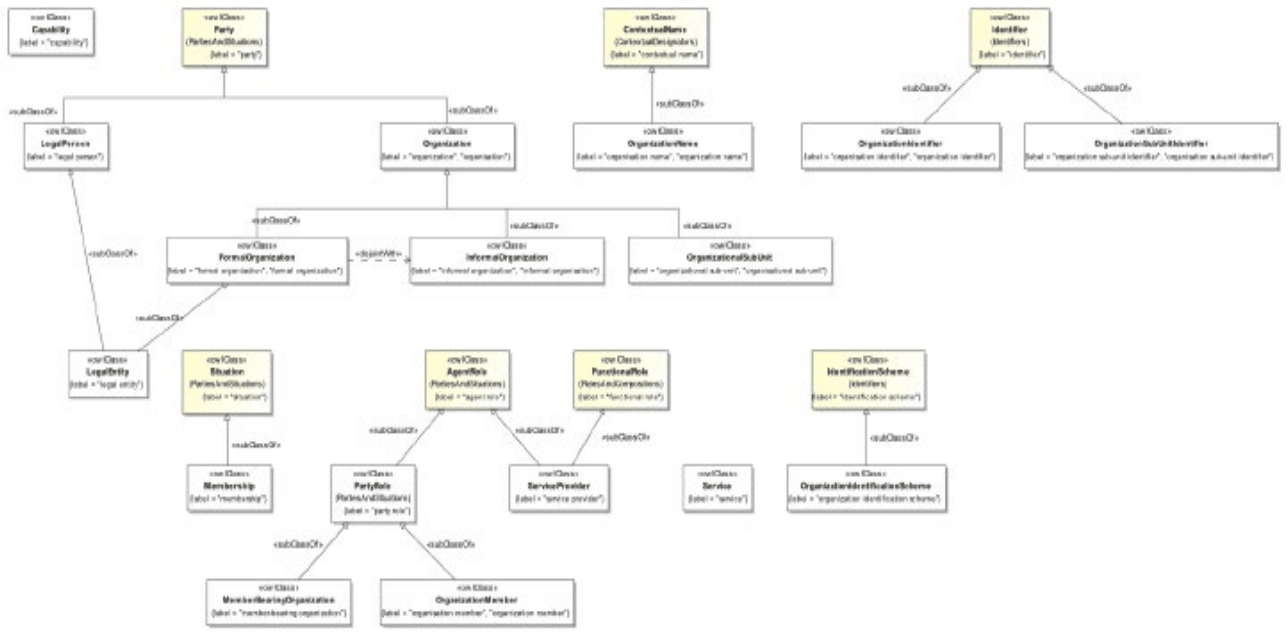
The detailed annotations and axioms that comprise the Commons Organizations Ontology are provided in Commons Organizations Ontology Details, below.
Classes
| Name | Annotations | Class Expressions |
|---|---|---|
|
Capability (capability) |
Definition: ability to perform a specific function or achieve a particular outcome Explanatory note: Capabilities are described in terms of outcomes as well as the roles involved in achieving those outcomes. The ability for an organization to perform or provide some capability may involve people with particular skills and knowledge, intellectual property, defined practices, operating facilities, tools and equipment. Adapted from: Business Architecture Core Metamodel, https://www.omg.org/spec/BACM Adapted from: The TOGAF Standard, https://pubs.opengroup.org/togaf-standard/business-architecture/business-capability-planning.html Adapted from: Value Delivery Modeling Language Specification, https://www.omg.org/spec/VDML |
Parent Class: cmns-cls:Aspect |
|
Capacity (capacity) |
Definition: maximum extent to which something or someone can perform a function or produce an output under specified conditions Explanatory note: In contrast with capability, the concept of capacity is constrained by upper limits on resources including time and within some context, in addition to having the ability to do so if circumstances allow. |
Parent Class: cmns-cls:Aspect |
|
FormalOrganization (formal organisation@en-GB, formal organization@en-US) |
Definition: organization that is recognized in some legal jurisdiction, with associated rights and responsibilities Preferred label: formal organization Example: Examples include a corporation, charity, government or church. Adapted from: https://www.w3.org/TR/vocab-org/#class-formalorganization |
Parent Class: Organization Property Restriction: ≥ 0 isDomiciledIn.cmns-loc:GeopoliticalEntity Class Axiom: ¬ InformalOrganization |
|
InformalOrganization (informal organisation@en-GB, informal organization@en-US) |
Definition: group of individuals who come together for a common purpose without forming a legal entity Preferred label: informal organization Explanatory note: A bridge club with officers and a bank account can be classified as an informal organization, but it depends on how the club is structured and whether it has taken steps to formalize its existence. If the bridge club has officers and a bank account but has not incorporated or registered as a legal entity (like a nonprofit organization or a corporation), it would be considered an informal organization. The officers manage the club's affairs, and the bank account is likely opened under the names of the officers or with the designation 'on behalf of the bridge club'. Explanatory note: There is usually no formal registration with governmental authorities, and the group operates based on mutual agreement among its members rather than a formal legal structure. |
Parent Class: Organization |
|
LegalEntity (legal entity) |
Definition: legal person that is a partnership, corporation, or other organization having the capacity to negotiate contracts, assume financial obligations, and pay off debts, organized under the laws of some jurisdiction Synonym: artificial person Synonym: juridical entity Synonym: juridical person Synonym: juristic person Scope note: The term 'legal entity' includes, but is not limited to, unique parties that are legally or financially responsible for the performance of financial transactions or have the legal right in their jurisdiction to enter independently into legal contracts, regardless of whether they are incorporated or constituted in some other way (e.g. trust, partnership, contractual). It excludes natural persons, but includes governmental organizations and supranationals. Adapted from: ISO 17442, Financial services - Legal Entity Identifier (LEI), first edition, 2012-06-01, section 3.1 |
Parent Class: FormalOrganization, LegalPerson |
|
LegalPerson (legal person@en) |
Definition: party that is recognized as having rights and obligations under the law, including but not limited to the right to sue and be sued, enter into contracts, own property, and incur financial and other obligations Explanatory note: To have legal personality means to be capable of having legal rights and duties within a certain legal system, such as to enter into contracts, sue, and be sued. Legal personality is a prerequisite to legal capacity, the ability of any legal person to amend (enter into, transfer, etc.) rights and obligations. |
Parent Class: cmns-pts:Party |
|
MemberBearingOrganization (member-bearing organization) |
Definition: role of a group or organization that has members that are people or other organizations |
Parent Class: cmns-pts:PartyRole Property Restriction: ∃ cmns-rlcmp:isPlayedBy.∃ cmns-col:hasMember.cmns-pts:Party |
|
Membership (membership@en) |
Definition: situation, corresponding to an n-ary relation, in which some group or organization has at least one member (person or organization) for some period of time |
Parent Class: cmns-pts:Situation Property Restriction: ∃ hasMembership.MemberBearingOrganization Property Restriction: ∃ hasOrganizationMember.OrganizationMember |
|
Organization (organisation@en-GB, organization@en-US) |
Definition: framework of authority within which a person, persons, or groups of people act, or are designated to act, towards some purpose, such as to meet a need or pursue collective goals Preferred label: organization Example: This may be a business entity, government, international organization, not-for-profit, academic institution, or other unincorporated and/or informal social organization. Adapted from: ISO/IEC 6523-1:1998 Information technology — Structure for the identification of organizations and organization parts — Part 1: Identification of organization identification schemes, https://www.iso.org/obp/ui/#iso:std:iso-iec:6523:-1:ed-1:v1:en |
Parent Class: cmns-pts:Party Property Restriction: ≥ 0 cmns-dsg:hasName.OrganizationName Property Restriction: ∀ cmns-col:hasPart.Organization Property Restriction: ∀ cmns-col:hasMember.cmns-pts:Party |
|
OrganizationalSubUnit (organisational sub-unit@en-GB, organizational sub-unit@en-US) |
Definition: any department or other entity within a larger organization that only has full recognition within the context of that organization, but requires identification for some purpose Preferred label: organizational sub-unit Synonym: organization part Explanatory note: In other words, it is not a legal entity in its own right. Adapted from: ISO/IEC 6523-1:1998 Information technology — Structure for the identification of organizations and organization parts — Part 1: Identification of organization identification schemes, https://www.iso.org/obp/ui/#iso:std:iso-iec:6523:-1:ed-1:v1:en See also: https://www.w3.org/TR/vocab-org/#org:OrganizationalUnit |
Parent Class: Organization Property Restriction: ∀ cmns-col:isPartOf.Organization |
|
OrganizationIdentificationScheme (organization identification scheme) |
Definition: identification scheme dedicated to the unique identification of organizations Adapted from: ISO/IEC 6523-1:1998 Information technology — Structure for the identification of organizations and organization parts — Part 1: Identification of organization identification schemes, https://www.iso.org/obp/ui/#iso:std:iso-iec:6523:-1:ed-1:v1:en |
Parent Class: cmns-id:IdentificationScheme |
|
OrganizationIdentifier (organisation identifier@en-GB, organization identifier@en-US) |
Definition: identifier assigned to an organization within an organization identification scheme, and unique within that scheme Preferred label: organization identifier Adapted from: ISO/IEC 6523-1:1998 Information technology — Structure for the identification of organizations and organization parts — Part 1: Identification of organization identification schemes, https://www.iso.org/obp/ui/#iso:std:iso-iec:6523:-1:ed-1:v1:en |
Parent Class: cmns-id:Identifier Property Restriction: ∃ cmns-id:identifies.Organization Property Restriction: = 1 cmns-col:isMemberOf.OrganizationIdentificationScheme |
|
OrganizationMember (organisation member@en-GB, organization member@en-US) |
Definition: party (person or organization) that has a membership role with respect to some organization Preferred label: organization member |
Parent Class: cmns-pts:PartyRole Property Restriction: ∃ cmns-rlcmp:isPlayedBy.∀ cmns-col:isMemberOf.Organization |
|
OrganizationName (organisation name@en-GB, organization name@en-US) |
Definition: designation by which some organization is known in some context Preferred label: organization name |
Parent Class: cmns-cxtdsg:ContextualName Property Restriction: ≥ 0 cmns-dsg:isNameOf.Organization |
|
OrganizationSubUnitIdentifier (organisation sub-unit identifier@en-GB, organization sub-unit identifier@en-US) |
Definition: identifier allocated to a particular organizational sub-unit Preferred label: organization sub-unit identifier Abbreviation: OPI Synonym: organization part identifier Adapted from: ISO/IEC 6523-1:1998 Information technology — Structure for the identification of organizations and organization parts — Part 1: Identification of organization identification schemes, https://www.iso.org/obp/ui/#iso:std:iso-iec:6523:-1:ed-1:v1:en |
Parent Class: cmns-id:Identifier Property Restriction: ∃ cmns-id:identifies.OrganizationalSubUnit |
|
Service (service) |
Definition: intangible activity performed by some party for the benefit of another party Example: Services include intangible products, such as accounting, banking, cleaning, consultancy, education, insurance, expertise, medical treatment, or transportation services. Explanatory note: Sometimes services are difficult to identify because they are closely associated with a good; such as the combination of a diagnosis with the administration of a medicine. No transfer of possession or ownership takes place when services are sold, and they (1) cannot be stored or transported, (2) are instantly perishable, and (3) come into existence at the time they are bought and consumed. Explanatory note: The OECD defines services as outputs produced to order and which cannot be traded separately from their production; ownership rights cannot be established over services and by the time their production is completed they must have been provided to the consumers. As an exception to this rule there is a group of industries, generally classified as service industries, some of whose outputs have characteristics of goods, i.e. those concerned with the provision, storage, communication and dissemination of information, advice and entertainment in the broadest sense of those terms; the products of these industries, where ownership rights can be established, may be classified either as goods or services depending on the medium by which these outputs are supplied. See also: https://unstats.un.org/unsd/nationalaccount/glossresults.asp?gID=501 |
Property Restriction: ∃ isProvidedBy.ServiceProvider Property Restriction: ≥ 0 provides.Capability |
|
ServiceProvider (service provider) |
Definition: role of an agent that provides some service, including but not limited to commercial or professional services Example: Example services may include consulting, financial, legal, real estate, education, communications, registration, regulatory, manufacturing, storage, processing, or other services. |
Parent Class: cmns-pts:AgentRole, cmns-rlcmp:FunctionalRole |
Properties
| Name | Annotations | Property Axioms |
|---|---|---|
|
designates (designates) |
Definition: appoints someone officially Explanatory note: This property is intended to cover assigning a job or role to someone, selecting or designating someone to fill an office or a position, and fixing or setting by authority or by mutual agreement. |
Parent Property: cmns-pts:hasRelatedPartyRole Domain: cmns-pts:PartyRole Range: cmns-pts:PartyRole |
|
hasMembership (has membership) |
Definition: identifies the organization acting in the role of having members in an organizational membership situation |
Parent Property: cmns-pts:hasActor Domain: Membership Range: MemberBearingOrganization Inverse: isMembershipPartyIn |
|
hasOrganizationMember (has organization member) |
Definition: indicates the party acting in the role of the member in an organizational membership situation |
Parent Property: cmns-pts:hasUndergoer Domain: Membership Range: OrganizationMember Inverse: isOrganizationMember |
|
hasSubUnit (has sub-unit) |
Definition: relates an organization to a part of that organization See also: https://www.w3.org/TR/vocab-org/#org:hasSubOrganization |
Parent Property: cmns-col:hasPart Domain: Organization Range: OrganizationalSubUnit Inverse: isSubUnitOf |
|
hasURL (has URL) |
Definition: links something to a web resource that specifies its location on a computer network and a method for retrieving it Synonym: has uniform resource locator |
Range: xsd:anyURI |
|
hasWebsite (has website) |
Definition: links something to a page or set of related web pages located under a single domain name, typically produced by a single person or organization Explanatory note: Web Design and Applications involve the standards for building and Rendering Web pages, including HTML, CSS, SVG, device APIs, and other technologies for Web Applications ('WebApps'). HTML (the Hypertext Markup Language) and CSS (Cascading Style Sheets) are two of the core technologies for building Web pages. HTML provides the structure of the page, CSS the (visual and aural) layout, for a variety of devices and services. See also: https://www.w3.org/standards/webdesign/ |
Parent Property: hasURL Range: xsd:anyURI |
|
isDesignatedBy (is designated by) |
Definition: indicates the role of the party that has assigned or appointed someone to an office or position |
Parent Property: cmns-pts:hasRelatedPartyRole Domain: cmns-pts:PartyRole Range: cmns-pts:PartyRole Inverse: designates |
|
isDomiciledIn (is domiciled in) |
Definition: indicates the principal place where an entity conducts business within some country, such as where its headquarters is located Explanatory note: Corporate domicile refers to a place where a company's affairs are discharged. It is also typically the legal home of a corporation within a country because the place is considered by law as the center of corporate affairs. In cases where a business has incorporated in one location for convenience, such as for taxation, legal, or regulatory purposes, but operates primarily in one or more other locations, domicile refers to the operational location(s) rather than legal location. Many companies in the US have incorporated in the State of Delaware, for example, but do not have operational facilities in Delaware (or only have small offices there). |
Parent Property: cmns-loc:hasRegion Domain: FormalOrganization Range: cmns-loc:GeopoliticalEntity |
|
isManagedBy (is managed by) |
Definition: indicates the role of a party that directs the affairs or administration of something or someone |
Parent Property: cmns-pts:hasPartyRole Range: cmns-pts:PartyRole |
|
isMembershipPartyIn (is membership party in) |
Definition: indicates the membership situation in which the party plays the role of having members |
Parent Property: cmns-pts:actsIn Domain: MemberBearingOrganization Range: Membership |
|
isOrganizationMember (is organization member) |
Definition: indicates the context of membership in which the party plays the role of an organization member |
Parent Property: cmns-pts:undergoes Domain: OrganizationMember Range: Membership |
|
isProvidedBy (is provided by) |
Definition: is made available by |
Inverse: provides |
|
isProvidedTo (is provided to) |
Definition: is made available to |
|
|
isSubUnitOf (is sub-unit of) |
Definition: relates a part of an organization to the larger entity See also: https://www.w3.org/TR/vocab-org/#org:subOrganizationOf |
Parent Property: cmns-col:isPartOf Domain: OrganizationalSubUnit Range: Organization |
|
manages (manages) |
Definition: relates a party role to something or someone that it directs or administers in some way |
Parent Property: cmns-rlcmp:isRoleIn Domain: cmns-pts:PartyRole Inverse: isManagedBy |
|
provides (provides) |
Definition: makes available |
9.17. Commons Parties and Situations Ontology§
This ontology defines the high-level concepts of parties and the roles they play in various situations.
Metadata for the Commons Parties and Situations Ontology is given in Commons Parties and Situations Ontology Metadata.
| Metadata Term | Value |
|---|---|
|
Ontology IRI |
|
|
|
Commons Parties and Situations Ontology |
|
|
This ontology defines the high-level concepts of parties and the roles they play in various situations. |
|
|
Dean Allemang, Working Ontologist |
|
|
Elisa Kendall, Thematix Partners LLC |
|
|
Copyright (c) 2020-2025 EDM Council, Inc. |
|
|
Copyright (c) 2020-2025 Thematix Partners LLC |
|
|
Copyright (c) 2020-2025 Working Ontologist LLC |
|
|
Copyright (c) 2022-2025 Object Management Group, Inc. |
|
|
Copyright (c) 2022-2025 Pistoia Alliance, Inc. |
|
|
Copyright (c) 2020-2025 EDM Council, Inc. Permission is hereby granted, free of charge, to any person obtaining a copy of this software and associated documentation files (the 'Software'), to deal in the Software without restriction, including without limitation the rights to use, copy, modify, merge, publish, distribute, sublicense, and/or sell copies of the Software, and to permit persons to whom the Software is furnished to do so, subject to the following conditions: The above copyright notice and this permission notice shall be included in all copies or substantial portions of the Software. THE SOFTWARE IS PROVIDED 'AS IS', WITHOUT WARRANTY OF ANY KIND, EXPRESS OR IMPLIED, INCLUDING BUT NOT LIMITED TO THE WARRANTIES OF MERCHANTABILITY, FITNESS FOR A PARTICULAR PURPOSE AND NONINFRINGEMENT. IN NO EVENT SHALL THE AUTHORS OR COPYRIGHT HOLDERS BE LIABLE FOR ANY CLAIM, DAMAGES OR OTHER LIABILITY, WHETHER IN AN ACTION OF CONTRACT, TORT OR OTHERWISE, ARISING FROM, OUT OF OR IN CONNECTION WITH THE SOFTWARE OR THE USE OR OTHER DEALINGS IN THE SOFTWARE. See https://opensource.org/licenses/MIT. |
|
|
https://www.omg.org/spec/Commons/20250801/PartiesAndSituations/ |
|
|
This ontology was originally designed for use in the Financial Industry Business Ontology (FIBO) for representing complex relationships between parties, such as employment, ownership and control. It has since been extended based on usage in other projects, such as the Pistoia Alliance Identification of Medicinal Products (IDMP) ontology project. |
|
|
The https://www.omg.org/spec/Commons/20230801/PartiesAndSituations.rdf version of the ontology was modified to add missing inverses needed to integrate the authorization pattern (COMMONS13-38). |
|
|
Note that inference with respect to property chains, which this ontology makes extensive use of, requires a knowledge graph solution that understands these chains, or requires running a reasoner outside of the graph database and asserting the inferences in order to make use of them. |
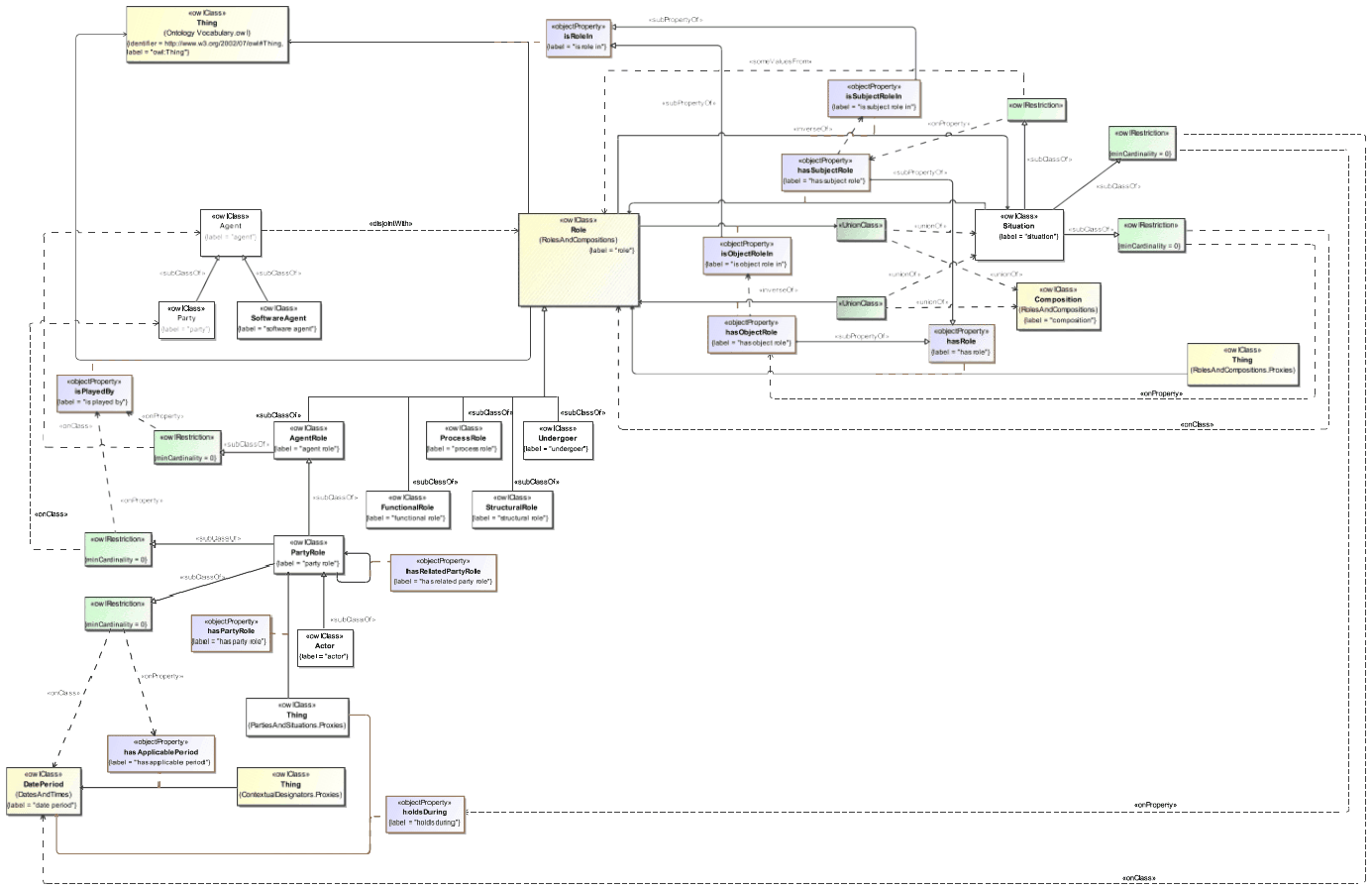
The detailed annotations and axioms that comprise the Commons Parties and Situations Ontology are provided in Commons Parties and Situations Ontology Details, below.
Classes
| Name | Annotations | Class Expressions |
|---|---|---|
|
Actor (actor) |
Definition: primary performer in a relationship between parties, i.e., the party that does something, causes something to happen, or otherwise plays an agentive role in the relationship Example: Examples include owner, controlling party, beneficiary, guarantor, partner in a partnership, shareholder, etc. Explanatory note: The concept of actor here is in a more linguistic sense, from core semantic theories reflecting actor/undergoer/null roles of an argument in an expression. Adapted from: ISO 14813-1:2015(en), Intelligent transport systems - Reference model architecture(s) for the ITS sector - Part 1: ITS service domains, service groups and services, clause 3.1 Adapted from: ISO 23234:2021(en), Buildings and civil engineering works - Security - Planning of security measures in the built environment, clause 3.4 Adapted from: ISO/TR 21965:2019(en), Information and documentation - Records management in enterprise architecture, clause 3.2.1 |
Parent Class: PartyRole |
|
Agent (agent) |
Definition: something autonomous that can adapt to and interact with its environment Note: Agents can be human beings, organizations, software agents, robots and living things other than plants. They are defined as having the following three important properties: autonomy, interactive behavior, and adaptability. (1) Autonomy - an agent is capable of acting without direct external intervention. This includes software or other agents that have some degree of control over their internal state and can act based on their own experiences. They can also possess their own set of internal responsibilities and capabilities that enable them to act without any external choreography. This definition excludes agents that act on on behalf of (or as a proxy for) some person or thing (see AgentRole). (2) Interactive behavior - they are capable of exchanging communicating with other things in their environment. This includes, in the case of software agents, messages that can support requests for services and other kinds of resources, as well as event detection and notification. They can be synchronous or asynchronous in nature. The interaction can also be conversational in nature, such as negotiating contracts, marketplace-style bidding, or simply making a query. (3) Adaptability - an agent is capable of responding to other agents and/or its environment. Agents can react to communications and events and then respond appropriately. Software agents can be designed to make difficult decisions and even modify their behavior based on their experiences. In other words, they can learn and evolve. Note: Note that this does not necessarily imply that an agent is free to act as it sees fit, without constraint. Rather, an agent in the sense meant here is something which may or may not be subject to controls and constraints but is self-actualizing in its behavior in response to any such constraints. Direct source: http://www.omg.org/techprocess/meetings/schedule/AMP.html See also: http://www.jamesodell.com/WhatIsAnAgent.pdf See also: http://www.jamesodell.com/WhyShouldWeCareAboutAgents.pdf |
Property Restriction: ≥ 0 cmns-dsg:hasName.cmns-cxtdsg:ContextualName Class Axiom: ¬ cmns-rlcmp:Role |
|
AgentRole (agent role) |
Definition: role played by any agent |
Parent Class: cmns-rlcmp:Role Property Restriction: ≥ 0 cmns-rlcmp:isPlayedBy.Agent |
|
Party (party) |
Definition: person or organization |
Parent Class: Agent |
|
PartyRole (party role) |
Definition: role played by an organization or individual that may be time bound Example: Examples include organization member, employee, issuer, owner, partner in a partnership, shareholder, and so forth. Note: Note that there may be cases where the identity of the party playing the role is not known, as well as cases where in some situation, such as ownership, there may be more than one party playing the role of owner. Scope note: The concept of a party role is used in contexts in which one would call someone a 'party to something', such as party to a contract or to a transaction, a supplier, buyer, customer, student, employee, and so forth. More specific roles such as those that are performed in the context of some activity or process are actors in that situation. Adapted from: ISO 14813-1:2015(en), Intelligent transport systems - Reference model architecture(s) for the ITS sector - Part 1: ITS service domains, service groups and services, clause 3.1 Adapted from: ISO 23234:2021(en), Buildings and civil engineering works - Security - Planning of security measures in the built environment, clause 3.4 |
Parent Class: AgentRole Property Restriction: ≥ 0 cmns-cxtdsg:hasApplicablePeriod.cmns-dt:DatePeriod Property Restriction: ≥ 0 cmns-rlcmp:isPlayedBy.Party |
|
Situation (situation) |
Definition: setting, state of being, or relationship that is relatively stable for some period of time Example: Examples include ownership, control, possession, affiliation, beneficial ownership, employment, and other similar situations. Note: From a usage perspective, situations are essentially reified relations, sometimes called mediating relationships. |
Property Restriction: ≥ 0 hasObjectRole.cmns-rlcmp:Role Property Restriction: ≥ 0 holdsDuring.cmns-dt:DatePeriod Property Restriction: ∃ hasSubjectRole.cmns-rlcmp:Role |
|
SoftwareAgent (software agent) |
Definition: digital entity that perceives its environment and takes actions that maximize its chance of successfully achieving its goals Source: ISO/IEC TR 29119-11:2020(en), Software and systems engineering - Software testing - Part 11: Guidelines on the testing of AI-based systems, clause 3.1.73 |
Parent Class: Agent Class Axiom: ¬ Party |
|
Undergoer (undergoer) |
Definition: something that plays the role of the object or recipient in a situation, i.e., the thing (or party) that the situation impacts, affects, or that otherwise plays a passive recipient / patient or thematic role Example: Examples include something that is owned or controlled. |
Parent Class: cmns-rlcmp:Role |
Properties
| Name | Annotations | Property Axioms |
|---|---|---|
|
actsIn (acts in) |
Definition: indicates a situation in which the actor plays a primary role |
Parent Property: isSubjectRoleIn Domain: Actor Range: Situation Inverse: hasActor |
|
actsOn (acts on) |
Definition: relates an actor in a given situation to the undergoer that they affect under the circumstances |
Inverse: isAffectedBy Property Chain: actsIn ∘ hasUndergoer |
|
directlyAffects (directly affects) |
Definition: relates an actor in a given situation to the thing (or party) that they impact under the circumstances |
Inverse: experiencesWith Property Chain: actsIn ∘ hasUndergoer ∘ cmns-rlcmp:isPlayedBy |
|
experiences (experiences) |
Definition: relates something to a situation that affects them in some way |
Property Chain: cmns-rlcmp:playsRole ∘ undergoes |
|
experiencesDirectly (experiences directly) |
Definition: relates something directly to a party that drives a situation involving it |
Property Chain: cmns-rlcmp:playsRole ∘ undergoes ∘ hasActor ∘ cmns-rlcmp:isPlayedBy |
|
experiencesWith (experiences with) |
Definition: relates something to an actor that drives a situation involving it |
Property Chain: cmns-rlcmp:playsRole ∘ undergoes ∘ hasActor |
|
hasActiveParty (has active party) |
Definition: relates a situation to the person or organization acting in a primary (agentive) role |
Inverse: playsActivePartyIn Property Chain: hasActor ∘ cmns-rlcmp:isPlayedBy |
|
hasActiveRole (has active role) |
Definition: relates a situation to something that is acting in a primary (agentive) role |
Inverse: playsActiveRoleIn Property Chain: hasSubjectRole ∘ cmns-rlcmp:isPlayedBy |
|
hasActor (has actor) |
Definition: identifies the primary party acting in a specific role with respect to a given situation |
Parent Property: hasPartyRole, hasSubjectRole Domain: Situation Range: Actor |
|
hasObjectRole (has object role) |
Definition: identifies a person or thing that is affected by, or is a secondary argument in a specific role with respect to a given relation or situation |
Parent Property: cmns-rlcmp:hasRole Domain: cmns-rlcmp:Composition ⊔ Situation Range: cmns-rlcmp:Role |
|
hasParty (has party) |
Definition: identifies a party associated with an agreement, contract, policy, regulation, situation, or other arrangement |
Range: Party |
|
hasPartyRole (has party role) |
Definition: identifies a specific role played by some person or organization as related to a situation, agreement, contract, policy, regulation, activity or other relationship |
Parent Property: cmns-rlcmp:hasRole Range: PartyRole |
|
hasRelatedPartyRole (has related party role) |
Definition: relates a party acting in a specific role directly to another party acting in the same or another role Usage note: This property is intended as an abstract property, whose subproperties may or may not be symmetric, but could be inverses of one another. |
Parent Property: cmns-rlcmp:hasRole Domain: PartyRole Range: PartyRole |
|
hasSubjectRole (has subject role) |
Definition: identifies the person or thing that is being discussed, described, dealt with, or is the main topic in a specific role with respect to a given situation |
Parent Property: cmns-rlcmp:hasRole Domain: Situation Range: cmns-rlcmp:Role |
|
hasUndergoer (has undergoer) |
Definition: identifies an experiencer / passive or other object role in a given situation |
Parent Property: hasObjectRole Domain: Situation Range: Undergoer |
|
holdsDuring (holds during) |
Definition: indicates a date period during which something is true |
Parent Property: cmns-cxtdsg:hasApplicablePeriod Range: cmns-dt:DatePeriod |
|
isAffectedBy (is affected by) |
Definition: relates an undergoer in a given situation to the actor that has an impact on them under the circumstances |
|
|
isAPartyTo (is a party to) |
Definition: identifies an agreement, contract, policy, regulation, situation, or other arrangement that a party is associated with |
Domain: Party Inverse: hasParty |
|
isDirectlyAffectedBy (is directly affected by) |
Definition: relates an undergoer in a given situation to the person or organization that has an impact on them under the circumstances |
Property Chain: undergoes ∘ hasActor ∘ cmns-rlcmp:isPlayedBy |
|
isExperiencedBy (is experienced by) |
Definition: relates a situation to something that is directly involved in or affected by it |
Inverse: experiences Property Chain: hasUndergoer ∘ cmns-rlcmp:isPlayedBy |
|
isObjectRoleIn (is object role in) |
Definition: indicates a situation in which the role is secondary, such as an experiencer or passive participant |
Parent Property: cmns-rlcmp:isRoleIn Domain: cmns-rlcmp:Role Range: cmns-rlcmp:Composition ⊔ Situation Inverse: hasObjectRole |
|
isRealizedIn (is realized in) |
Definition: relates a situation or constituency to something that is affected by, or is a secondary argument to in a specific role with respect to a given relation or situation |
Inverse: realizes Property Chain: hasObjectRole ∘ cmns-rlcmp:isPlayedBy |
|
isSubjectRoleIn (is subject role in) |
Definition: indicates a situation in which the role is the primary topic |
Parent Property: cmns-rlcmp:isRoleIn Domain: cmns-rlcmp:Role Range: Situation Inverse: hasSubjectRole |
|
playsActivePartyIn (plays active party in) |
Definition: relates a person or organization to a situation that they are directly involved in |
Property Chain: cmns-rlcmp:playsRole ∘ actsIn |
|
playsActiveRoleIn (plays active role in) |
Definition: relates something to a situation that it is directly involved in |
Property Chain: cmns-rlcmp:playsRole ∘ isSubjectRoleIn |
|
playsActiveRoleThatAffects (plays active role that affects) |
Definition: relates a person or organization to an undergoer they have an impact on under the circumstances |
Inverse: isDirectlyAffectedBy Property Chain: cmns-rlcmp:playsRole ∘ actsIn ∘ hasUndergoer |
|
playsActiveRoleThatDirectlyAffects (plays active role that directly affects) |
Definition: relates a person or organization to something they have a direct impact on under the circumstances |
Inverse: experiencesDirectly Property Chain: cmns-rlcmp:playsRole ∘ actsIn ∘ hasUndergoer ∘ cmns-rlcmp:isPlayedBy |
|
realizes (realizes) |
Definition: relates something to a situation or constituency in which the role they play is secondary, such as an experiencer or passive participant |
Property Chain: cmns-rlcmp:playsRole ∘ isObjectRoleIn |
|
undergoes (undergoes) |
Definition: indicates a situation that the undergoer experiences |
Parent Property: isObjectRoleIn Domain: Undergoer Range: Situation Inverse: hasUndergoer |
9.18. Commons Quantities and Units Ontology§
This ontology provides a core set of concepts for quantities, units, systems of quantities, and systems of units. The most widely accepted, scrutinized, and globally used system of quantities and system of units are the International System of Quantities (ISQ) and the International System of Units (SI). They are formally standardized through [ISO 31] and [IEC 60027]. The harmonization of these two sets of standards into one new set [ISO/IEC 80000] has been published by ISO in 2009 and 2010. This ontology is based on the Object Management Group (OMG)'s SysML standard and on ISO/IEC 80000-1:2009, which refers normatively to the ISO/IEC Guide 99:2007. It is compatible with and can be mapped directly to the OMG Date Time Vocabulary (DTV) Quantities Ontology, the de-facto QUDT ontology representing Units of Measure, Quantity Kinds, Dimensions and Data Types (see http://www.qudt.org/), the Units of Measurement Ontology (UO) ontology available from the BioPortal (https://bioportal.bioontology.org/ontologies/UO) and others, as well as the quantities and units library in the SysML specification.
Metadata for the Commons Quantities and Units Ontology is given in Commons Quantities and Units Ontology Metadata.
| Metadata Term | Value |
|---|---|
|
Ontology IRI |
|
|
|
Commons Quantities and Units Ontology |
|
|
This ontology provides a core set of concepts for quantities, units, systems of quantities, and systems of units. The most widely accepted, scrutinized, and globally used system of quantities and system of units are the International System of Quantities (ISQ) and the International System of Units (SI). They are formally standardized through [ISO 31] and [IEC 60027]. The harmonization of these two sets of standards into one new set [ISO/IEC 80000] has been published by ISO in 2009 and 2010. This ontology is based on the Object Management Group (OMG)'s SysML standard and on ISO/IEC 80000-1:2009, which refers normatively to the ISO/IEC Guide 99:2007. It is compatible with and can be mapped directly to the OMG Date Time Vocabulary (DTV) Quantities Ontology, the de-facto QUDT ontology representing Units of Measure, Quantity Kinds, Dimensions and Data Types (see http://www.qudt.org/), the Units of Measurement Ontology (UO) ontology available from the BioPortal (https://bioportal.bioontology.org/ontologies/UO) and others, as well as the quantities and units library in the SysML specification. |
|
|
Davide Sottara, Mayo Clinic |
|
|
Elisa Kendall, Thematix Partners LLC |
|
|
Evan Wallace, U.S. National Institute of Standards and Technology (NIST) |
|
|
Hans Peter de Koning, DEKonsult |
|
|
Jim Logan, Ontogenesis Solutions, LLC |
|
|
Michel Sauvage, Airbus Group |
|
|
Roger Burkhart, Thematix Partners LLC |
|
|
Steve Jenkins, Jet Propulsion Laboratory (JPL), California Institute of Technology, National Aeronautics and Space Administration (NASA) |
|
|
Stuart Chalk, University of North Florida |
|
|
Thomas Barre, Airbus Group |
|
|
Copyright (c) 2011-2024 Thematix Partners LLC |
|
|
Copyright (c) 2015-2024 EDM Council, Inc. |
|
|
Copyright (c) 2015-2024 Object Management Group, Inc. |
|
|
Copyright (c) 2023-2024 DEKonsult |
|
|
Copyright (c) 2023-2024 Mayo Clinic |
|
|
Copyright (c) 2023-2024 University of North Florida |
|
|
Copyright (c) 2024 Airbus Group |
|
|
Copyright (c) 2024 Ontogenesis Solutions, LLC |
|
|
Copyright (c) 2011-2024 Thematix Partners LLC Permission is hereby granted, free of charge, to any person obtaining a copy of this software and associated documentation files (the 'Software'), to deal in the Software without restriction, including without limitation the rights to use, copy, modify, merge, publish, distribute, sublicense, and/or sell copies of the Software, and to permit persons to whom the Software is furnished to do so, subject to the following conditions: The above copyright notice and this permission notice shall be included in all copies or substantial portions of the Software. THE SOFTWARE IS PROVIDED 'AS IS', WITHOUT WARRANTY OF ANY KIND, EXPRESS OR IMPLIED, INCLUDING BUT NOT LIMITED TO THE WARRANTIES OF MERCHANTABILITY, FITNESS FOR A PARTICULAR PURPOSE AND NONINFRINGEMENT. IN NO EVENT SHALL THE AUTHORS OR COPYRIGHT HOLDERS BE LIABLE FOR ANY CLAIM, DAMAGES OR OTHER LIABILITY, WHETHER IN AN ACTION OF CONTRACT, TORT OR OTHERWISE, ARISING FROM, OUT OF OR IN CONNECTION WITH THE SOFTWARE OR THE USE OR OTHER DEALINGS IN THE SOFTWARE. See https://opensource.org/licenses/MIT. |
|
|
https://www.omg.org/spec/Commons/20240801/QuantitiesAndUnits/ |
|
|
The https://www.omg.org/spec/Commons/20230801/QuantitiesAndUnits.rdf version of this ontology was modified to loosen functional constraints on a number of properties, which caused reasoning errors when these generic properties were reused with multiple subproperties on the same concept and eliminate potentially circular restrictions (Commons-1.2-5) and to add the concept of a measurement reference to enable better alignment of such references with quantity values whose reference is something other than a unit of measure (Commons-1.2-3). |
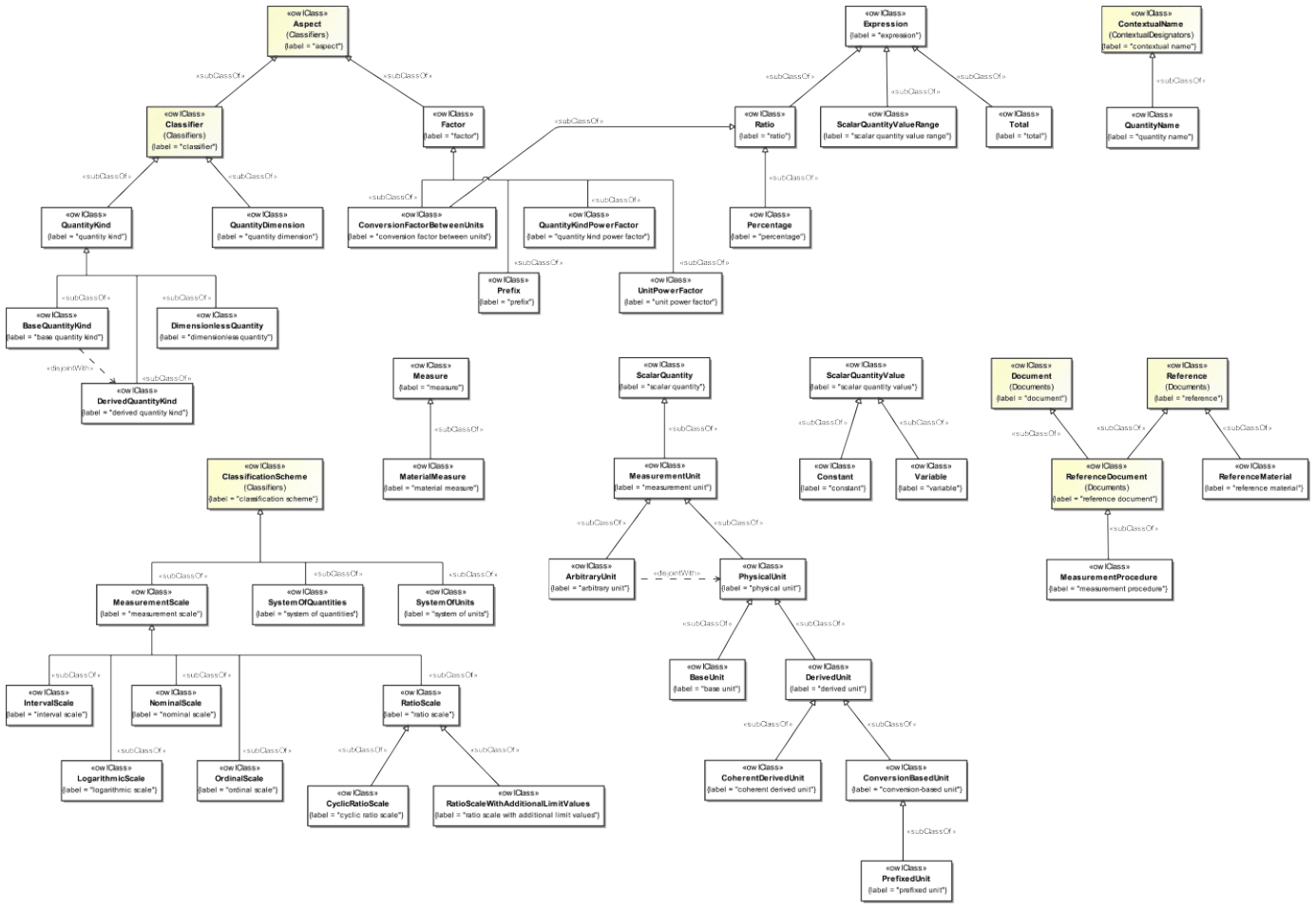
The detailed annotations and axioms that comprise the Commons Quantities and Units Ontology are provided in Commons Quantities and Units Ontology Details, below.
Classes
| Name | Annotations | Class Expressions |
|---|---|---|
|
ArbitraryUnit (arbitrary unit) |
Definition: arbitrarily defined unit of measurement, where a relation of the unit to a physical unit of the SI does not exist or is unknown Note: Arbitrary units represent references to materials or procedures that are defined outside of the SI system. A quantity value is arbitrarily assigned to the reference preparation or the result of a measurement procedure, usually specific for a particular substance. This generally precludes comparability of quantity values across different systems and components for this type of units. Source: ISO 11240 Health informatics - Identification of medicinal products - Data elements and structures for the unique identification and exchange of units of measurement, clause 3.1.1 |
Parent Class: MeasurementUnit Property Restriction: ≥ 0 cmns-doc:refersTo.MaterialMeasure Property Restriction: ≥ 0 cmns-doc:refersTo.ReferenceMaterial Property Restriction: ≥ 0 cmns-doc:refersTo.MeasurementProcedure Class Axiom: ¬ PhysicalUnit |
|
BaseQuantityKind (base quantity kind) |
Definition: quantity in a conventionally chosen subset of a given system of quantities, where no quantity in the subset can be expressed in terms of the other quantities within that subset Synonym: base quantity Synonym: simple quantity kind Example: The International System of Quantities (ISQ) comprises these base quantities (with their SI base measurement units): length (meter), mass (kilogram), duration (second), electric current (ampere), thermodynamic temperature (kelvin), amount of substance (mole), and luminous intensity (candela). These base quantities are not mutually comparable. All quantities of any one of these kinds are, however, mutually comparable. Note: The subset mentioned in the definition is termed the 'set of base quantities'. Base quantities are referred to as being mutually independent since a base quantity cannot be expressed as a product of powers of the other base quantities. Source: ISO 11240 Health informatics - Identification of medicinal products - Data elements and structures for the unique identification and exchange of units of measurement, clause 3.1.2 Source: ISO 80000-1:2009 Quantities and units - Part 1: General, clause 3.4 Source: https://www.omg.org/spec/SysML/ |
Parent Class: QuantityKind Property Restriction: = 1 cmns-dsg:isDefinedIn.SystemOfQuantities |
|
BaseUnit (base unit) |
Definition: measurement unit that is defined by a system of units to be the reference measurement unit for a base quantity Synonym: simple unit Example: In the SI, the meter is the base unit of length. In the CGS systems, the centimeter is the base unit of length. Note: In each coherent system of units, there is only one base unit for each base quantity. A base unit may also serve for a derived quantity of the same quantity dimension. Source: ISO 11240 Health informatics - Identification of medicinal products - Data elements and structures for the unique identification and exchange of units of measurement, clause 3.1.3 Source: ISO 80000-1:2009 Quantities and units - Part 1: General, clause 3.10 Source: https://www.omg.org/spec/SysML/ |
Parent Class: PhysicalUnit |
|
CoherentDerivedUnit (coherent derived unit) |
Definition: derived unit that, for a given system of quantities and for a chosen set of base units, is a product of powers of base units with no other proportionality factor than one Example: If the meter, the second, and the mole are base units, the mole per cubic meter is the coherent derived unit of amount-of-substance concentration when amount-of-substance concentration is defined by the quantity equation c = n/V. The kilometer per hour and the knot, given as examples of derived units, are not coherent derived units in such a system of quantities. Note: A power of a base unit is the base unit raised to an exponent. Coherence can be determined only with respect to a particular system of quantities and a given set of base units. Source: ISO 11240 Health informatics - Identification of medicinal products - Data elements and structures for the unique identification and exchange of units of measurement, clause 3.1.4 Source: ISO 80000-1:2009 Quantities and units - Part 1: General, clause 3.12 |
Parent Class: DerivedUnit |
|
Constant (constant) |
Definition: symbol that represents a value that does not change (i.e., is fixed) with respect to a formula or expression |
Parent Class: ScalarQuantityValue |
|
ConversionBasedUnit (conversion-based unit) |
Definition: derived unit that is defined with respect to another reference unit through an explicit conversion relationship Source: https://www.omg.org/spec/SysML/ |
Parent Class: DerivedUnit Property Restriction: ≥ 0 hasExpression.Expression |
|
ConversionFactorBetweenUnits (conversion factor between units) |
Definition: ratio of two measurement units for quantities of the same kind Source: ISO 11240 Health informatics - Identification of medicinal products - Data elements and structures for the unique identification and exchange of units of measurement, clause 3.1.6 Source: ISO 80000-1:2009 Quantities and units - Part 1: General, clause 3.24 |
Property Restriction: = 1 hasQuantityKind.QuantityKind |
|
CyclicRatioScale (cyclic ratio scale) |
Definition: measurement scale that represents a ratio scale with a periodic cycle Example: 'cyclic degree' (to express planar angular measures) with modulus = 360 and unit 'degree' Example: 'hour of day' with modulus = 24 and unit 'hour' Source: https://www.omg.org/spec/SysML/ |
Parent Class: RatioScale |
|
DerivedQuantityKind (derived quantity kind) |
Definition: quantity, in a system of quantities, defined in terms of the base quantities of that system Example: In a system of quantities having the base quantities length and mass, mass density is a derived quantity defined as the quotient of mass and volume (length to the power three). Source: ISO 11240 Health informatics - Identification of medicinal products - Data elements and structures for the unique identification and exchange of units of measurement, clause 3.1.7 Source: ISO 80000-1:2009 Quantities and units - Part 1: General, clause 3.5 Source: https://www.omg.org/spec/SysML/ |
Parent Class: QuantityKind Property Restriction: ∃ isDerivedFrom.QuantityKind Property Restriction: ≥ 0 hasFactor.QuantityKindPowerFactor Class Axiom: ¬ BaseQuantityKind |
|
DerivedUnit (derived unit) |
Definition: measurement unit for a derived quantity, i.e., one that is defined with respect to one or more base units, such as as a product of powers of one or more other measurement units Example: The meter per second, symbol m/s, and the centimeter per second, symbol cm/s, are derived units of speed in the SI. The kilometer per hour, symbol km/h, is a measurement unit of speed outside the SI but accepted for use with the SI. The knot, equal to one nautical mile per hour, is a measurement unit of speed outside the SI. Source: ISO 11240 Health informatics - Identification of medicinal products - Data elements and structures for the unique identification and exchange of units of measurement, clause 3.1.8 Source: ISO 80000-1:2009 Quantities and units - Part 1: General, clause 3.11 Source: https://www.omg.org/spec/SysML/ |
Parent Class: PhysicalUnit Property Restriction: ∃ isDerivedFrom.BaseUnit Property Restriction: ≥ 0 hasFactor.UnitPowerFactor |
|
DimensionlessQuantity (dimensionless quantity) |
Definition: quantity for which all the exponents of the factors corresponding to the base quantities in its quantity dimension are zero Synonym: quantity of dimension one Example: Plane angle, solid angle, refractive index, relative permeability, mass fraction, friction factor, Mach number Note: Some quantities of dimension one are defined as the ratios of two quantities of the same kind. The coherent derived unit is the number one, symbol 1. Note: The measurement units and values of quantities of dimension one are numbers, but such quantities convey more information than a number. Note: The term 'dimensionless quantity' is commonly used and is included for historical reasons. It stems from the fact that all exponents are zero in the symbolic representation of the dimension for such quantities. The term 'quantity of dimension one' reflects the convention in which the symbolic representation of the dimension for such quantities is the symbol 1. This dimension is not a number, but the neutral element for multiplication of dimensions. Source: ISO 11240 Health informatics - Identification of medicinal products - Data elements and structures for the unique identification and exchange of units of measurement, clause 3.1.10 Source: ISO 80000-1:2009 Quantities and units - Part 1: General, clause 3.8 Source: https://www.omg.org/spec/SysML/ |
Parent Class: QuantityKind |
|
Expression (expression) |
Definition: finite combination of symbols that are well-formed according to applicable rules |
Property Restriction: ≥ 0 hasArgument.Variable Property Restriction: ≥ 0 hasArgument.Constant |
|
Factor (factor) |
Definition: number or quantity that when multiplied with another produces a given number or expression |
Parent Class: cmns-cls:Aspect |
|
IntervalScale (interval scale) |
Definition: measurement scale that represents quantitative values and for which mode, median and mean can be calculated Example: Celsius and Fahrenheit are examples of interval scales: they represent equality or inequality among intervals of temperature, but not ratios of temperature, because their zero points are arbitrary. Rating scales, where it is assumed that the distances between the single expressions of evaluation (score) are equal, are also interval scales with no natural zero point. Note: Linear interval scales allow both multiplication by a positive number and a constant shift, e.g., the conversion from Celsius to Fahrenheit. Source: https://plato.stanford.edu/entries/measurement-science/ Source: https://www.omg.org/spec/SysML/ Source: https://www.statista.com/statistics-glossary/definition/320/interval_scale/ |
Parent Class: MeasurementScale |
|
LogarithmicScale (logarithmic scale) |
Definition: measurement scale on which the actual distance of a point from the scale's zero is proportional to the logarithm of the corresponding scale number rather than to the number itself Example: A logarithmic scale (or log scale) is a way of displaying numerical data over a very wide range of values in a compact way - typically the largest numbers in the data are hundreds or even thousands of times larger than the smallest numbers. Such a scale is nonlinear: the numbers 10 and 20, and 60 and 70, are not the same distance apart on a log scale. Rather, the numbers 10 and 100, and 60 and 600 are equally spaced. Thus moving a unit of distance along the scale means the number has been multiplied by 10 (or some other fixed factor). Source: https://en.wikipedia.org/wiki/Logarithmic_scale/ Source: https://plato.stanford.edu/entries/measurement-science/ Source: https://www.omg.org/spec/SysML/ |
Parent Class: MeasurementScale |
|
MaterialMeasure (material measure) |
Definition: something that reproduces or supplies one or more quantities, each with an assigned quantity value Example: Ruler, standard weight, volume measure Source: ISO 11240 Health informatics - Identification of medicinal products - Data elements and structures for the unique identification and exchange of units of measurement, clause 3.1.14 |
Parent Class: Measure |
|
Measure (measure) |
Definition: amount or degree of something; the dimensions, capacity, or amount of something ascertained by measuring Note: Measure refers to the phenomenon or phenomena to be measured in a data set. In a data set, the instance of a measure is often called an observation. Source: https://stats.oecd.org/glossary/detail.asp?ID=7062 |
|
|
MeasurementProcedure (measurement procedure) |
Definition: procedure of a measurement according to one or more measurement principles (i.e. phenomena, observables) and a given measurement method, based on a measurement model and including any calculation to obtain a measurement result Abbreviation: SOP Synonym: standard operating procedure Example: Lowering of the concentration of glucose in blood in a fasting rabbit is an observable that can be applied to the measurement of insulin concentration in a preparation. Together with a description of the measurement method this can be used to define a measurement procedure. Note: A measurement procedure can include a statement concerning a target measurement uncertainty. Note: A measurement procedure is usually documented in sufficient detail to enable an operator to perform a measurement. Adapted from: ISO 11240 Health informatics - Identification of medicinal products - Data elements and structures for the unique identification and exchange of units of measurement, clause 3.1.16 |
Parent Class: MeasurementReference |
|
MeasurementReference (measurement reference) |
Definition: measurement unit, measurement procedure, reference material, or a combination of such Note: Note that the concept of a measurement reference is currently not defined in terms and definitions in the VIM standard, but rather in Note 2 on quantity. Adapted from: International Vocabulary of Metrology - Basic and General Concepts and Associated Terms (VIM), Third Edition, JCGM 200:2012, available at https://www.bipm.org/documents/20126/2071204/JCGM_200_2012.pdf |
Parent Class: cmns-doc:Reference Parent Class: MeasurementProcedure ⊔ MeasurementUnit ⊔ ReferenceMaterial ⊔ MeasurementScale |
|
MeasurementScale (measurement scale) |
Definition: ordered set of quantity values of quantities of a given kind of quantity used in ranking, according to magnitude, quantities of that kind Synonym: quantity-value scale Note: Note that the majority of scalar quantities can be expressed by just using a MeasurementUnit directly as its measurement reference. This implies expression of a scalar quantity value on a ratio scale. However, for full coverage of all quantity value expressions, additional explicit measurement scales with additional semantics are needed, such as ordinal scale, interval scale, ratio scale with additional limit values, cyclic ratio scale and logarithmic scale. Source: ISO 80000-1:2009 Quantities and units - Part 1: General, clause 3.27 Source: https://plato.stanford.edu/entries/measurement-science/ Source: https://www.omg.org/spec/SysML/ |
Parent Class: cmns-cls:ClassificationScheme, MeasurementReference Property Restriction: ≥ 0 isMinimumInclusive.xsd:boolean Property Restriction: ≥ 0 hasMinimumPermissiveValue.ScalarQuantityValue Property Restriction: ≥ 0 isMaximumInclusive.xsd:boolean Property Restriction: ∃ cmns-cls:classifies.MeasurementUnit Property Restriction: ≥ 0 hasMaximumPermissiveValue.ScalarQuantityValue |
|
MeasurementUnit (measurement unit) |
Definition: real scalar quantity, defined and adopted by convention, with which any other quantity of the same kind can be compared to express the ratio of the second quantity to the first one as a number Synonym: unit of measurement Example: week, day, hour, minute, second, kilogram, joule, meter Note: A Unit is a quantity in terms of which the magnitudes of other quantities that have the same quantity kind can be stated. A unit often relies on precise and reproducible ways to measure the unit. For example, a unit of length such as meter may be specified as a multiple of a particular wavelength of light. A unit may also specify less stable or precise ways to express some value, such as a cost expressed in some currency, or a severity rating measured by a numerical scale. Note: Depending on the nature of the reference scale, the unit of measurement expression may stand either for a physical unit of measurement that is related to a system of quantities (e.g. SI units) or for an arbitrarily defined unit of measurement, which may refer to a certain reference material, a standard measurement procedure, a material measure or even to a combination of those. Note: For a given quantity, the short term 'unit' is often combined with the quantity name, such as 'mass unit' or 'unit of mass'. Note: Measurement units are designated by conventionally assigned names and symbols. Note: Measurement units of quantities of dimension one are numbers. In some cases, these measurement units are given special names, e.g. radian, steradian, and decibel, or are expressed by quotients such as millimole per mole equal to 10 to the power minus 3 and microgram per kilogram equal to 10 to the power minus 9. Note: Measurement units of quantities of the same quantity dimension may be designated by the same name and symbol even when the quantities are not of the same kind. For example, joule per kelvin and J/K are respectively the name and symbol of both a measurement unit of heat capacity and a measurement unit of entropy, which are generally not considered to be quantities of the same kind. However, in some cases special measurement unit names are restricted to be used with quantities of specific kind only. For example, the measurement unit 'second to the power minus one' (1/s) is called hertz (Hz) when used for frequencies and becquerel (Bq) when used for activities of radionuclides. As another example, the joule (J) is used as a unit of energy, but never as a unit of moment of force, i.e. the newton meter (N m). Source: ISO 11240 Health informatics - Identification of medicinal products - Data elements and structures for the unique identification and exchange of units of measurement, clause 3.1.33 Source: ISO 80000-1:2009 Quantities and units - Part 1: General, clause 3.9 Source: https://www.omg.org/spec/SysML/ |
Parent Class: MeasurementReference, ScalarQuantity Property Restriction: ≥ 0 cmns-dsg:isDefinedIn.SystemOfUnits Property Restriction: ≥ 0 hasFactor.UnitPowerFactor Property Restriction: ≥ 0 specializes.MeasurementUnit |
|
NominalScale (nominal scale) |
Definition: measurement scale that represents objects as belonging to classes that have no particular order Example: Many nominal scales are qualitative in nature. A common example of a nominal scale is that of gender identity, which is a way of describing one's persistent inner concept of their gender. While the terminology from a psychological and medical perspective continues to evolve, the scale covers individuals who self identify as male or female as well as those that have a less determinant perspective, such as transsexual or non-binary. Source: https://plato.stanford.edu/entries/measurement-science/ Source: https://www.ncbi.nlm.nih.gov/pmc/articles/PMC4589638/ |
Parent Class: MeasurementScale |
|
OrdinalScale (ordinal scale) |
Definition: quantity-value scale for ordinal quantities, i.e., one that represents order but no further algebraic structure Synonym: ordinal quantity-value scale Synonym: ordinal value scale Example: For example, the Mohs scale of mineral hardness represents minerals with numbers ranging from 1 (softest) to 10 (hardest), but there is no empirical significance to equality among intervals or ratios of those numbers. Note: An ordinal quantity-value scale may be established by measurements according to a measurement procedure. Note: Ordinal scales allow any transformation function as long as it is monotonic and increasing. Source: ISO 80000-1:2009 Quantities and units - Part 1: General, clause 3.28 Source: https://plato.stanford.edu/entries/measurement-science/ Source: https://www.omg.org/spec/SysML/ |
Parent Class: MeasurementScale |
|
Percentage (percentage) |
Definition: ratio value expressed as a fraction of 100, i.e., in which the denominator is fixed rather than variable and equal to 100 Note: The percent value is computed by multiplying the numeric value of the ratio by 100. Note: While many percentage values are between 0 and 100, there is no mathematical restriction and percentages may take on other values (positive or negative), particularly in the case of comparisons (percent change). |
Parent Class: Ratio |
|
PhysicalUnit (physical unit) |
Definition: unit of measurement that is defined using a physical quantity Synonym: physical unit of measurement Note: Its definition relates measured quantities to the base quantities through a set of well-defined equations. Note: Physical units and their related scales are defined independently of the measurement procedure and the measured components. They relate to an internationally standardized system of units and equations governing the mathematical relations between those units. Source: ISO 11240 Health informatics - Identification of medicinal products - Data elements and structures for the unique identification and exchange of units of measurement, clause 3.1.21 |
Parent Class: MeasurementUnit Property Restriction: ∃ cmns-dsg:isDefinedIn.SystemOfUnits |
|
Prefix (prefix) |
Definition: named multiple or sub-multiple multiplication factor used in the specification of a derived unit Note: A prefix is a word or symbol for attachment to the name or symbol of a unit in order to form units that are multiples or sub-multiples of that unit. Note: A system of units may specify a set of prefixes. Source: ISO 11240 Health informatics - Identification of medicinal products - Data elements and structures for the unique identification and exchange of units of measurement, clause 3.1.22 |
Parent Class: Factor Property Restriction: = 1 hasFactorValue.owl:rational |
|
PrefixedUnit (prefixed unit) |
Definition: conversion-based unit that is defined with respect to another measurement reference unit through a linear conversion relationship with a named prefix that represents a multiple or submultiple of a unit Source: https://www.omg.org/spec/SysML/ |
Parent Class: ConversionBasedUnit |
|
QuantityDimension (quantity dimension) |
Definition: expression of the dependence of a quantity on the base quantities of a system of quantities as a product of powers of factors corresponding to the base quantities, omitting any numerical factor Synonym: dimension Synonym: dimension of a quantity Note: A power of a factor is the factor raised to an exponent. Each factor is the dimension of a base quantity. Note: In a given system of quantities, - quantities of the same kind have the same quantity dimension, - quantities of different quantity dimensions are always of different kinds, and - quantities having the same quantity dimension are not necessarily of the same kind. Note: In deriving the dimension of a quantity, no account is taken of its scalar, vector, or tensor character. Note: The conventional symbolic representation of the dimension of a base quantity is a single upper case letter in roman (upright) type. The conventional symbolic representation of the dimension of a derived quantity is the product of powers of the dimensions of the base quantities according to the definition of the derived quantity. The dimension of a quantity Q is denoted by dim Q. Source: ISO 11240 Health informatics - Identification of medicinal products - Data elements and structures for the unique identification and exchange of units of measurement, clause 3.1.9 Source: ISO 80000-1:2009 Quantities and units - Part 1: General, clause 3.7 Source: https://www.omg.org/spec/SysML/ |
Parent Class: cmns-cls:Classifier Property Restriction: ≥ 0 hasFactor.QuantityKindPowerFactor |
|
QuantityKind (quantity kind) |
Definition: aspect common to mutually comparable quantities Synonym: kind of quantity Example: The quantities diameter, circumference, and wavelength are generally considered to be quantities of the same kind, namely, of the kind of quantity called length. Example: The quantities heat, kinetic energy, and potential energy are generally considered to be quantities of the same kind, namely, of the kind of quantity called energy. Example: The quantities moment of force and energy are, by convention, not regarded as being of the same kind, although they have the same dimension. Similarly for heat capacity and entropy, as well as for number of entities, relative permeability, and mass fraction. Note: Quantities of the same kind within a given system of quantities have the same quantity dimension. However, quantities of the same dimension are not necessarily of the same kind. Source: ISO 11240 Health informatics - Identification of medicinal products - Data elements and structures for the unique identification and exchange of units of measurement, clause 3.1.12 Source: ISO 80000-1:2009 Quantities and units - Part 1: General, clause 3.2 Source: https://www.omg.org/spec/SysML/ |
Parent Class: cmns-cls:Classifier Property Restriction: ≥ 0 hasMeasurementUnit.MeasurementUnit Property Restriction: ≥ 0 specializes.QuantityKind Property Restriction: ≥ 0 cmns-dsg:isDefinedIn.SystemOfQuantities Property Restriction: = 1 hasDimension.QuantityDimension |
|
QuantityKindPowerFactor (quantity kind power factor) |
Definition: factor in a product of powers that defines a derived quantity Source: https://www.omg.org/spec/SysML/ |
Parent Class: Factor Property Restriction: = 1 hasExponent.owl:rational Property Restriction: ∃ hasQuantityKind.QuantityKind |
|
QuantityName (quantity name) |
Definition: human-readable textual representation of the quantity Note: A number of systems of quantities and units encode a quantity, such as a unit of measure, via a generally accepted abbreviation. URIs representing such quantities are very useful in applications that require globally unique, machine readable names, but are less accessible to people. This concept is intended to provide the corresponding name for a given quantity in the context of a specific system of quantities and units for human consumption. |
Parent Class: cmns-cxtdsg:ContextualName Property Restriction: ∃ cmns-dsg:isNameOf.ScalarQuantity Property Restriction: ≥ 0 cmns-cxtdsg:isApplicableIn.SystemOfUnits Property Restriction: ≥ 0 cmns-cxtdsg:isApplicableIn.SystemOfQuantities |
|
Ratio (ratio) |
Definition: proportional relationship between two different quantity values that gives rise to a datum of a specific quantity kind Synonym: rate Note: A ratio is a quantity measured with respect to some other quantity, or in mathematics a quotient of two numbers or expressions, arrived at by dividing one by the other. Source: https://stats.oecd.org/glossary/detail.asp?ID=6688 Source: https://www150.statcan.gc.ca/n1/edu/power-pouvoir/glossary-glossaire/5214842-eng.htm#r |
Parent Class: Expression Property Restriction: = 1 hasDenominator.ScalarQuantityValue Property Restriction: = 1 hasNumerator.ScalarQuantityValue |
|
RatioScale (ratio scale) |
Definition: measurement scale that represents quantitative values, allows comparison of differences in values, has a fixed zero value and is invariant under multiplication by a positive number Example: The Kelvin scale is a ratio scale, as are the familiar scales representing mass in kilograms, length in meters and duration in seconds. Source: https://plato.stanford.edu/entries/measurement-science/ Source: https://www.omg.org/spec/SysML/ |
Parent Class: MeasurementScale |
|
RatioScaleWithAdditionalLimitValues (ratio scale with additional limit values) |
Definition: measurement scale that that represents a ratio scale that has additional limit values Source: https://www.omg.org/spec/SysML/ |
Parent Class: RatioScale |
|
ReferenceMaterial (reference material) |
Definition: material, sufficiently homogeneous and stable with reference to specified properties, which has been established to be fit for its intended use in measurement or in examination of nominal properties Note: Some reference materials have assigned quantity values that are metrologically traceable to a measurement unit outside a system of units. Such materials include vaccines to which International Units (IU) have been assigned by the World Health Organization (WHO). Source: ISO 11240 Health informatics - Identification of medicinal products - Data elements and structures for the unique identification and exchange of units of measurement, clause 3.1.26 |
Parent Class: MeasurementReference |
|
ScalarQuantity (scalar quantity) |
Definition: property of a phenomenon, body, or substance, where the property has a magnitude that can be expressed by means of a number and a reference Example: second, kilogram, joule, meter Note: A quantity as defined in ISO 80000 is a scalar. However, a vector or a tensor, the components of which are quantities, is also considered to be a quantity. Note: A reference can be a measurement unit, a measurement procedure, a reference material, or a combination of such. Source: ISO 11240 Health informatics - Identification of medicinal products - Data elements and structures for the unique identification and exchange of units of measurement, clause 3.1.24 Source: ISO 80000-1:2009 Quantities and units - Part 1: General, clause 3.1 Source: https://www.omg.org/spec/SysML/ |
Property Restriction: ∃ hasQuantityKind.QuantityKind Property Restriction: ≥ 0 cmns-dsg:hasName.QuantityName |
|
ScalarQuantityValue (scalar quantity value) |
Definition: number and reference together expressing the magnitude of a quantity Synonym: measurement Synonym: value of a quantity Note: According to the type of reference, a quantity value is either - a product of a number and a measurement unit; the measurement unit one is generally not indicated for quantities of dimension one, or - a number and a reference to a measurement procedure, or - a number and a reference material. Source: ISO 11240 Health informatics - Identification of medicinal products - Data elements and structures for the unique identification and exchange of units of measurement, clauses 3.1.19, 3.1.25 Source: ISO 80000-1:2009 Quantities and units - Part 1: General, clause 3.19 Source: https://www.omg.org/spec/SysML/ |
Property Restriction: ∃ hasMeasurementReference.MeasurementReference Property Restriction: = 1 hasNumericValue.xsd:decimal Property Restriction: ≥ 0 expressesTheMagnitudeOf.ScalarQuantity |
|
ScalarQuantityValueRange (scalar quantity value range) |
Definition: expression of the lowest possible value and/or highest possible value for some scalar quantity |
Parent Class: Expression Property Restriction: ≤ 1 hasUpperBound.ScalarQuantityValue Property Restriction: ≤ 1 hasLowerBound.ScalarQuantityValue |
|
SystemOfQuantities (system of quantities@en) |
Definition: set of quantities together with a set of non-contradictory equations relating those quantities Example: The International System of Quantities (ISQ) is an example of a SystemOfQuantities, defined in ISO 31 and ISO/IEC 80000. Note: Ordinal quantities, such as Rockwell C hardness, and nominal properties, such as color of light, are usually not considered to be part of a system of quantities because they are related to other quantities through empirical relations only. Source: ISO 11240 Health informatics - Identification of medicinal products - Data elements and structures for the unique identification and exchange of units of measurement, clause 3.1.29 Source: ISO 80000-1:2009 Quantities and units - Part 1: General, clause 3.3 Source: https://www.omg.org/spec/SysML/ |
Parent Class: cmns-cls:ClassificationScheme |
|
SystemOfUnits (system of units) |
Definition: set of base units and derived units, together with their multiples and submultiples, defined in accordance with given rules, for a given system of quantities Source: ISO 11240 Health informatics - Identification of medicinal products - Data elements and structures for the unique identification and exchange of units of measurement, clause 3.1.30 Source: ISO 80000-1:2009 Quantities and units - Part 1: General, clause 3.13 Source: https://www.omg.org/spec/SysML/ |
Parent Class: cmns-cls:ClassificationScheme |
|
Total (total) |
Definition: sum of the values for some characteristic of all units |
Parent Class: Expression |
|
UnitPowerFactor (unit power factor) |
Definition: factor in a product of powers that defines a derived unit Source: https://www.omg.org/spec/SysML/ |
Parent Class: Factor Property Restriction: = 1 hasExponent.owl:rational Property Restriction: = 1 hasMeasurementUnit.MeasurementUnit |
|
Variable (variable) |
Definition: symbol that represents a parameter in a formula or expression |
Parent Class: ScalarQuantityValue |
Individuals
| Name | Annotations | Individual Axioms |
|---|---|---|
|
InternationalSystemOfQuantities (International System of Quantities) |
Definition: system of quantities based on the seven base quantities: length, mass, time, electric current, thermodynamic temperature, amount of substance, and luminous intensity Abbreviation: ISQ Note: The International System of Units (SI) is based on the ISQ. Note: This system of quantities is published in the ISO 80000 and IEC 80000 series Quantities and units, Parts 3 to 14. Source: ISO 80000-1:2009 Quantities and units - Part 1: General, clause 3.6 |
Type: SystemOfQuantities |
|
InternationalSystemOfUnits (International System of Units) |
Definition: system of units, based on the International System of Quantities, their names and symbols, including a series of prefixes and their names and symbols, together with rules for their use, adopted by the General Conference on Weights and Measures (CGPM) Abbreviation: SI Note: The SI is founded on the seven base quantities of the ISQ and the names and symbols of the corresponding base units. The base units and the coherent derived units of the SI form a coherent set, designated the 'set of coherent SI units'. Source: ISO 80000-1:2009 Quantities and units - Part 1: General, clause 3.16 |
Type: SystemOfUnits |
Properties
| Name | Annotations | Property Axioms |
|---|---|---|
|
describesActualExpression (describes actual expression) |
Definition: specifies the calculation or expression used to determine the value of something Note: In cases where some expression can only be calculated in SPARQL or via rules, this property is useful for stating what that calculation should be using the input arguments to the expression. |
Parent Property: cmns-dsg:hasDescription |
|
expressesTheMagnitudeOf (expresses the magnitude of) |
Definition: specifies the quantity that some quantity value reflects |
Range: ScalarQuantity |
|
hasArgument (has argument) |
Definition: indicates a specific input to a function, formula or expression, also known as an independent variable Scope note: Note that this property and its subproperties apply in the context of quantities and units as well as statistical measures. They are not intended to support more general mathematics. |
|
|
hasDenominator (has denominator) |
Definition: specifies the quantity value that is the part of a fraction 'below the line' and signifies the value by which the numerator should be divided Note: If a fraction is considered as an ordered pair, the denominator is the second argument of the fraction. |
Parent Property: hasArgument |
|
hasDimension (has dimension) |
Definition: indicates a measurable extent associated with a given quantity kind in some system of quantities, which may be derived, depending on the choice of base quantity |
Parent Property: cmns-cls:isClassifiedBy Domain: QuantityKind Range: QuantityDimension |
|
hasExponent (has exponent) |
Definition: indicates the number of times a number should be multiplied by itself |
Range: owl:rational |
|
hasExpression (has expression) |
Definition: specifies a finite combination of symbols, including constants, variables that may be ordered via one or more operators, that is well-formed according to rules that depend on the language and context |
Range: Expression |
|
hasFactor (has factor) |
Definition: indicates a number or quantity that when multiplied with another produces a given number or expression |
Parent Property: hasArgument |
|
hasFactorValue (has factor value) |
Definition: indicates the numeric multiple or submultiple multiplication factor |
Range: owl:rational |
|
hasLowerBound (has lower bound) |
Definition: specifies the quantity value that is the lower value of a pair of values representing a range |
Parent Property: hasArgument, hasQuantityValue Range: ScalarQuantityValue |
|
hasMaximumPermissiveValue (has maximum permissive value) |
Definition: indicates the maximum allowed value for a measurement on the given scale |
Parent Property: hasQuantityValue Domain: MeasurementScale Range: ScalarQuantityValue |
|
hasMeasurementReference (has measurement reference) |
Definition: indicates the reference against which a quantity can be expressed with respect to a number |
Range: MeasurementReference |
|
hasMeasurementUnit (has measurement unit) |
Definition: indicates the unit against which a quantity can be expressed in a quantity value |
Parent Property: hasMeasurementReference Range: MeasurementUnit |
|
hasMinimumPermissiveValue (has minimum permissive value) |
Definition: indicates the minimum allowed value for a measurement on the given scale |
Parent Property: hasQuantityValue Domain: MeasurementScale Range: ScalarQuantityValue |
|
hasNumerator (has numerator) |
Definition: specifies the quantity value that is the part of a fraction 'above the line' and signifies the value to be divided by the denominator Note: If a fraction is considered as an ordered pair, the numerator is the first argument of the fraction. |
Parent Property: hasArgument |
|
hasNumericValue (has numeric value) |
Definition: indicates a particular magnitude or designation for a given observable characteristic that is a number Source: https://www.omg.org/spec/SysML/ |
Range: xsd:decimal |
|
hasQuantityKind (has quantity kind) |
Definition: indicates the class of mutually comparable quantities involved in the definition of an individual quantity or factor |
Parent Property: cmns-cls:isClassifiedBy Range: QuantityKind |
|
hasQuantityValue (has quantity value) |
Definition: relates something (an expression, formula, etc.) to its magnitude expressed as a number together with its unit of measure (if applicable) |
Range: ScalarQuantityValue |
|
hasQuantityValueRange (has quantity value range) |
Definition: relates something (an expression, formula, etc.) to its magnitude expressed as range of numbers together with their unit(s) of measure (if applicable) |
Parent Property: hasExpression Range: ScalarQuantityValueRange |
|
hasUpperBound (has upper bound) |
Definition: specifies the quantity value that is the higher value of a pair of values representing a range |
Parent Property: hasArgument, hasQuantityValue Range: ScalarQuantityValue |
|
isDerivedFrom (is derived from) |
Definition: indicates something from which the subject is obtained or determined Example: a derived quantity is derived from a base quantity; a derived unit is derived from a base unit |
|
|
isDimensionOf (is dimension of) |
Definition: indicates a measurable extent associated with a given quantity kind in some system of quantities, which may be derived, depending on the choice of base quantity |
Parent Property: cmns-cls:classifies Domain: QuantityDimension Range: QuantityKind Inverse: hasDimension |
|
isMaximumInclusive (is maximum inclusive) |
Definition: indicates whether something, such as a measurement scale, includes the absolute maximum permissive value or not |
Range: xsd:boolean |
|
isMinimumInclusive (is minimum inclusive) |
Definition: indicates whether something, such as a measurement scale, includes the absolute minimum permissive value or not |
Range: xsd:boolean |
|
isValueOf (is value of) |
Definition: is the measure that the value represents |
Parent Property: cmns-cxtdsg:appliesTo Domain: ScalarQuantityValue Inverse: hasQuantityValue |
|
specializes (specializes) |
Definition: indicates something whose nature is more general (broader than) the subject |
9.19. Commons Registration Authorities Ontology§
This ontology defines concepts for representation of registration authorities, registrars, registration-specific identifiers and related identification schemes. It was derived from the FIBO Registration Authorities Ontology and ISO 11179-3, and adapted for broader use.
Metadata for the Commons Registration Authorities Ontology is given in Commons Registration Authorities Ontology Metadata.
| Metadata Term | Value |
|---|---|
|
Ontology IRI |
|
|
|
Commons Registration Authorities Ontology |
|
|
This ontology defines concepts for representation of registration authorities, registrars, registration-specific identifiers and related identification schemes. It was derived from the FIBO Registration Authorities Ontology and ISO 11179-3, and adapted for broader use. |
|
|
Copyright (c) 2015-2025 EDM Council, Inc. |
|
|
Copyright (c) 2015-2025 Object Management Group, Inc. |
|
|
Copyright (c) 2015-2025 EDM Council, Inc. Permission is hereby granted, free of charge, to any person obtaining a copy of this software and associated documentation files (the 'Software'), to deal in the Software without restriction, including without limitation the rights to use, copy, modify, merge, publish, distribute, sublicense, and/or sell copies of the Software, and to permit persons to whom the Software is furnished to do so, subject to the following conditions: The above copyright notice and this permission notice shall be included in all copies or substantial portions of the Software. THE SOFTWARE IS PROVIDED 'AS IS', WITHOUT WARRANTY OF ANY KIND, EXPRESS OR IMPLIED, INCLUDING BUT NOT LIMITED TO THE WARRANTIES OF MERCHANTABILITY, FITNESS FOR A PARTICULAR PURPOSE AND NONINFRINGEMENT. IN NO EVENT SHALL THE AUTHORS OR COPYRIGHT HOLDERS BE LIABLE FOR ANY CLAIM, DAMAGES OR OTHER LIABILITY, WHETHER IN AN ACTION OF CONTRACT, TORT OR OTHERWISE, ARISING FROM, OUT OF OR IN CONNECTION WITH THE SOFTWARE OR THE USE OR OTHER DEALINGS IN THE SOFTWARE. See https://opensource.org/licenses/MIT. |
|
|
https://www.omg.org/spec/Commons/20250801/RegistrationAuthorities/ |
|
|
The https://www.omg.org/spec/Commons/20240801/RegistrationAuthorities.rdf version of the ontology was modified to clarify the distinction between a registrar and registration authority (COMMONS13-33) and to integrate the authorization pattern (COMMONS13-38). |
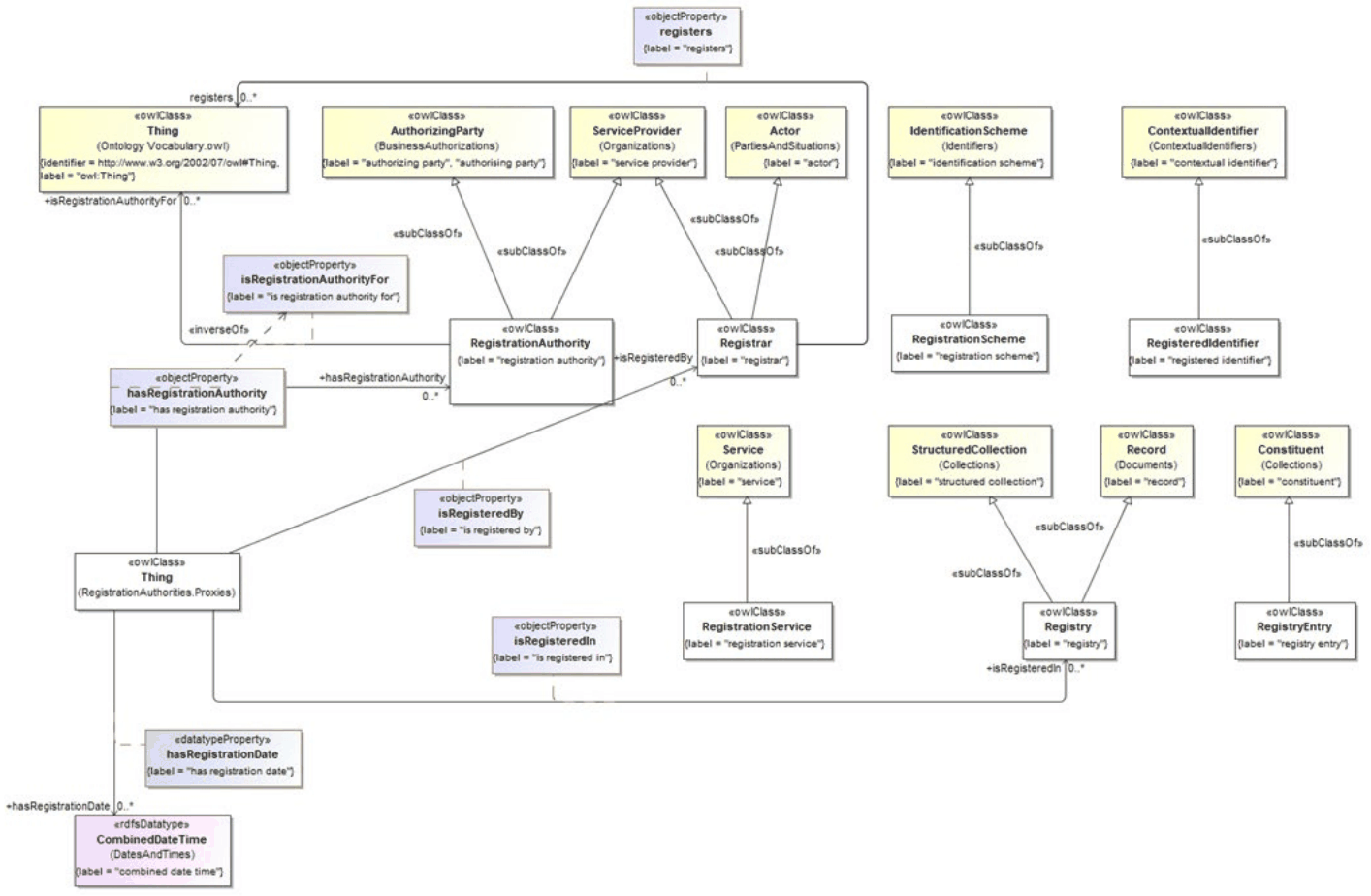
The detailed annotations and axioms that comprise the Commons Registration Authorities Ontology are provided in Commons Registration Authorities Ontology Details, below.
Classes
| Name | Annotations | Class Expressions |
|---|---|---|
|
RegisteredIdentifier (registered identifier) |
Definition: contextual identifier that is registered in a registry by, or on behalf of, a registration authority according to some registration scheme |
Parent Class: cmns-cxtid:ContextualIdentifier Property Restriction: = 1 hasRegistrationDate.cmns-dt:CombinedDateTime Property Restriction: ∃ isRegisteredIn.Registry Property Restriction: = 1 cmns-col:compliesWith.RegistrationScheme Property Restriction: ∃ isRegisteredBy.Registrar |
|
Registrar (registrar) |
Definition: role of a party that acts as a representative of a registration authority to provide registration services, including official record keeping Adapted from: Barron's Dictionary of Business and Economic Terms, Fifth Edition, 2012 Adapted from: ISO/IEC 11179-3:2023, Information technology - Metadata registries (MDR) - Part 3: Metamodel for registry common facilities, Fourth edition, 2023 |
Parent Class: cmns-org:ServiceProvider, cmns-pts:Actor Property Restriction: ∃ cmns-org:isDesignatedBy.RegistrationAuthority Property Restriction: ∃ registers.owl:Thing Property Restriction: ≥ 0 cmns-org:provides.RegistrationService |
|
RegistrationAuthority (registration authority) |
Definition: service provider that is officially responsible for maintaining a registry and providing registration services and/or for delegating of some or all of these roles to a registrar Abbreviation: RA Adapted from: ISO/IEC 11179-3:2023, Information technology - Metadata registries (MDR) - Part 3: Metamodel for registry common facilities, Fourth edition, 2023 |
Parent Class: cmns-bauth:AuthorizingParty, cmns-org:ServiceProvider Property Restriction: ≥ 0 isRegistrationAuthorityFor Property Restriction: ≥ 0 cmns-org:manages.Registry |
|
RegistrationScheme (registration scheme) |
Definition: scheme for organizing information in a registry and allocating identifiers to registered items Adapted from: ISO/IEC 11179-3:2023, Information technology - Metadata registries (MDR) - Part 3: Metamodel for registry common facilities, Fourth edition, 2023 |
Parent Class: cmns-id:IdentificationScheme |
|
RegistrationService (registration service) |
Definition: service provided to individuals and/or organizations for the registration of items in a registry |
Parent Class: cmns-org:Service Property Restriction: ∃ cmns-org:isProvidedBy.Registrar |
|
Registry (registry) |
Definition: authoritative record or collection of records relating to something Explanatory note: Electronic registries typically contain a unique identifier for each entry, so that individual records can be referenced from other documents and registries. Adapted from: ISO/IEC 11179-3:2023, Information technology - Metadata registries (MDR) - Part 3: Metamodel for registry common facilities, Fourth edition, 2023 |
Parent Class: cmns-col:StructuredCollection, cmns-doc:Record Property Restriction: ∃ cmns-org:isManagedBy.RegistrationAuthority Property Restriction: ≥ 0 cmns-col:comprises.RegistryEntry |
|
RegistryEntry (registry entry) |
Definition: constituent of a registry that includes the details for something recorded in that registry Synonym: registry item Explanatory note: Note: From an ISO 11179 perspective, a registry item (entry) is recorded in the registry, but is not necessarily identified, named, defined, classified, registered or administered. Specific information needs to be provided for each of these categories which can be provided when the item is initially recorded, or later. Adapted from: ISO/IEC 11179-3:2023, Information technology - Metadata registries (MDR) - Part 3: Metamodel for registry common facilities, Fourth edition, 2023 |
Parent Class: cmns-col:Constituent Property Restriction: ∀ cmns-col:isIncludedIn.Registry Property Restriction: ≥ 0 cmns-col:comprises.RegisteredIdentifier |
Properties
| Name | Annotations | Property Axioms |
|---|---|---|
|
hasRegistrationAuthority (has registration authority) |
Definition: indicates the registration authority for something |
Parent Property: cmns-pts:hasPartyRole Range: RegistrationAuthority Inverse: isRegistrationAuthorityFor |
|
hasRegistrationDate (has registration date) |
Definition: indicates the date or date and time on which something is registered |
Parent Property: cmns-dt:hasObservedDateTime Range: cmns-dt:CombinedDateTime |
|
isRegisteredBy (is registered by) |
Definition: indicates the registration authority or registrar that registers something |
Parent Property: cmns-pts:hasPartyRole Range: Registrar |
|
isRegisteredIn (is registered in) |
Definition: indicates the registry that something is registered in |
Parent Property: cmns-doc:refersTo Range: Registry |
|
isRegistrationAuthorityFor (is registration authority for) |
Definition: indicates something (typically an identifier or code) that the registration authority issues |
Parent Property: cmns-rlcmp:isRoleIn Domain: RegistrationAuthority |
|
registers (registers) |
Definition: records something in a registry or archive |
Parent Property: cmns-doc:records, cmns-rlcmp:isRoleIn Domain: Registrar Inverse: isRegisteredBy |
9.20. Commons Regulatory Agencies Ontology§
This ontology defines general purpose concepts for representation of regulatory agencies, also known as regulatory authorities or regulators. It was derived from the FIBO Regulatory Agencies, Legal Capacity, and Jurisdictions ontologies and simplified/adapted for broader use.
Metadata for the Commons Regulatory Agencies Ontology is given in Commons Regulatory Agencies Ontology Metadata.
| Metadata Term | Value |
|---|---|
|
Ontology IRI |
|
|
|
Commons Regulatory Agencies Ontology |
|
|
This ontology defines general purpose concepts for representation of regulatory agencies, also known as regulatory authorities or regulators. It was derived from the FIBO Regulatory Agencies, Legal Capacity, and Jurisdictions ontologies and simplified/adapted for broader use. |
|
|
Copyright (c) 2015-2025 EDM Council, Inc. |
|
|
Copyright (c) 2015-2025 Object Management Group, Inc. |
|
|
Copyright (c) 2015-2025 EDM Council, Inc. Permission is hereby granted, free of charge, to any person obtaining a copy of this software and associated documentation files (the 'Software'), to deal in the Software without restriction, including without limitation the rights to use, copy, modify, merge, publish, distribute, sublicense, and/or sell copies of the Software, and to permit persons to whom the Software is furnished to do so, subject to the following conditions: The above copyright notice and this permission notice shall be included in all copies or substantial portions of the Software. THE SOFTWARE IS PROVIDED 'AS IS', WITHOUT WARRANTY OF ANY KIND, EXPRESS OR IMPLIED, INCLUDING BUT NOT LIMITED TO THE WARRANTIES OF MERCHANTABILITY, FITNESS FOR A PARTICULAR PURPOSE AND NONINFRINGEMENT. IN NO EVENT SHALL THE AUTHORS OR COPYRIGHT HOLDERS BE LIABLE FOR ANY CLAIM, DAMAGES OR OTHER LIABILITY, WHETHER IN AN ACTION OF CONTRACT, TORT OR OTHERWISE, ARISING FROM, OUT OF OR IN CONNECTION WITH THE SOFTWARE OR THE USE OR OTHER DEALINGS IN THE SOFTWARE. See https://opensource.org/licenses/MIT. |
|
|
https://www.omg.org/spec/Commons/20250801/RegulatoryAgencies/ |
|
|
The https://www.omg.org/spec/Commons/20240801/RegulatoryAgencies.rdf version of the ontology was modified to integrate the authorization pattern (COMMONS13-38). |
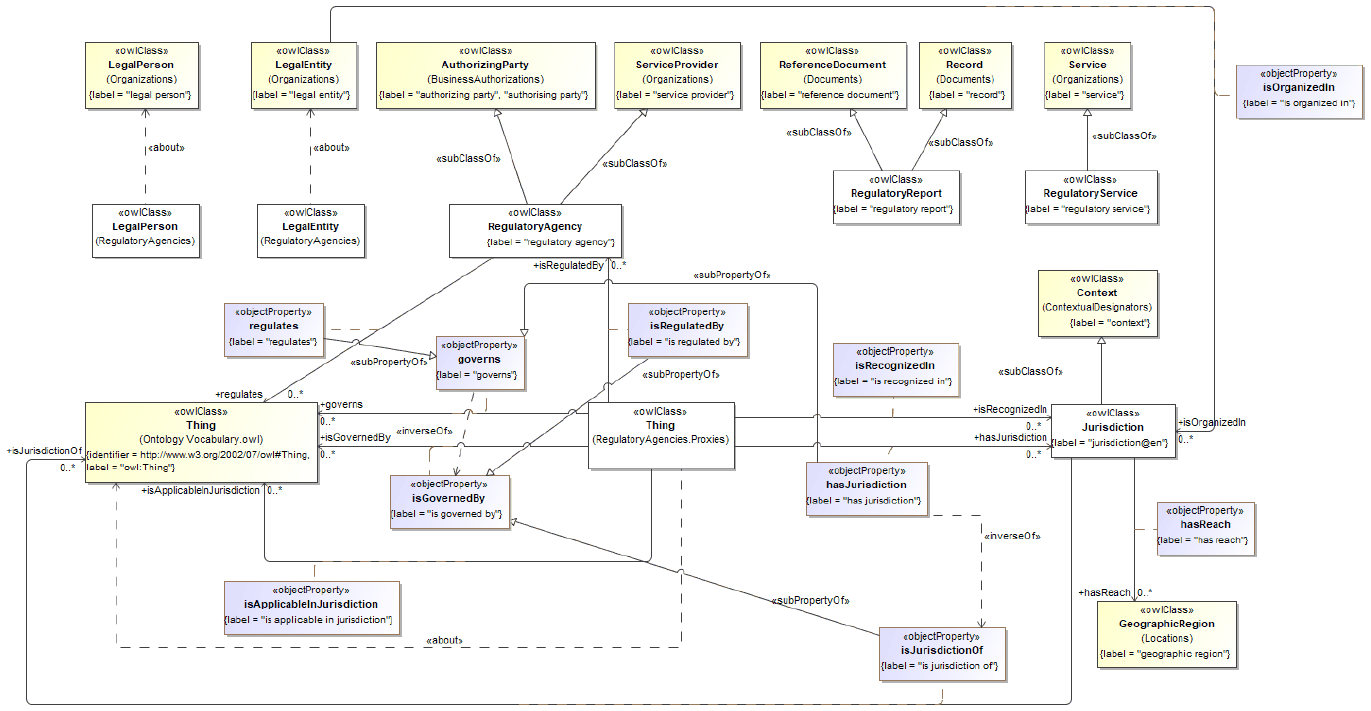
The detailed annotations and axioms that comprise the Commons Regulatory Agencies Ontology are provided in Commons Regulatory Agencies Ontology Details, below.
Classes
| Name | Annotations | Class Expressions |
|---|---|---|
|
cmns-org:LegalEntity |
Property Restriction: = 1 isOrganizedIn.Jurisdiction | |
|
cmns-org:LegalPerson |
Property Restriction: ≥ 0 isRecognizedIn.Jurisdiction | |
|
Jurisdiction (jurisdiction@en) |
Definition: power of a court or regulatory agency to adjudicate cases, issue orders, and interpret and apply the law with respect to some specific geographic area Adapted from: https://www.law.cornell.edu/wex/jurisdiction |
Parent Class: cmns-cxtdsg:Context Property Restriction: ∃ hasReach.cmns-loc:GeographicRegion |
|
RegulatoryAgency (regulatory agency) |
Definition: public authority or government agency responsible for exercising authority over something in a regulatory or supervisory capacity Synonym: regulator Synonym: regulatory authority Synonym: regulatory body Example: See http://www.finra.org/AboutFINRA/ for an example describing a regulatory agency. Explanatory note: Typically, a regulatory agency is chartered to protect some constituancy, (e.g., investors in the financial industry, consumers with respect to product safety), to ensure the fairness and integrity of some market, and fair and safe business practices among the service providers in that market. |
Parent Class: cmns-bauth:AuthorizingParty, cmns-org:ServiceProvider Property Restriction: ≥ 0 regulates Property Restriction: ∃ hasJurisdiction.Jurisdiction Property Restriction: ≥ 0 cmns-org:provides.RegulatoryService |
|
RegulatoryReport (regulatory report) |
Definition: document required to support operational transparency that demonstrates compliance with some specification, law, policy, restriction, or other rule specified by a regulatory agency Explanatory note: Such a report may be needed for licensing, monitoring, taxation, or for other purposes that demonstrate the integrity, fairness, safety, or other capacity of a given industry, organization, or product. |
Parent Class: cmns-doc:Record, cmns-doc:ReferenceDocument |
|
RegulatoryService (regulatory service) |
Definition: service provided by a regulatory agency, which may include, but not be limited to, examination, monitoring, supervision, testing, or other capabilities required to ensure the integrity, fairness, safety, or other capacity of a given industry, organization, or product |
Parent Class: cmns-org:Service Property Restriction: ∃ cmns-org:isProvidedBy.RegulatoryAgency |
Properties
| Name | Annotations | Property Axioms |
|---|---|---|
|
governs (governs) |
Definition: has and exercises authority over |
|
|
hasJurisdiction (has jurisdiction) |
Definition: relates a polity, government entity or regulatory agency to a jurisdiction over which it has some level of legal authority |
Parent Property: governs Range: Jurisdiction |
|
hasReach (has reach) |
Definition: indicates the geographic region covered by the jurisdiction |
Parent Property: cmns-cxtdsg:isApplicableIn Domain: Jurisdiction Range: cmns-loc:GeographicRegion |
|
isApplicableInJurisdiction (is applicable in jurisdiction) |
Definition: indicates the geopolitical region identifier for the jurisdiction in which something is applicable |
Property Chain: cmns-cxtdsg:isApplicableIn ∘ hasReach ∘ cmns-id:isIdentifiedBy |
|
isGovernedBy (is governed by) |
Definition: relates a contract, agreement, jurisdiction, or other legal construct and the regulation, policy, procedure, or legal person that regulates or oversees (governs) it |
Inverse: governs |
|
isJurisdictionOf (is jurisdiction of) |
Definition: relates a jurisdiction to a polity or other government entity or court that has some level of legal authority over it |
Parent Property: isGovernedBy Domain: Jurisdiction Inverse: hasJurisdiction |
|
isOrganizedIn (is organized in) |
Definition: indicates the jurisdiction whose laws a legal entity is organized under |
Parent Property: isRecognizedIn Domain: cmns-org:LegalEntity Range: Jurisdiction |
|
isRecognizedIn (is recognized in) |
Definition: indicates the jurisdiction in which a legal person is considered competent to enter into a contract, conduct business, or participate in other activities, or in which an agreement may be acknowledged and possibly enforceable |
Parent Property: isGovernedBy Range: Jurisdiction |
|
isRegulatedBy (is regulated by) |
Definition: specifies a regulatory agency that has regulatory authority for something |
Parent Property: cmns-pts:hasPartyRole, isGovernedBy Range: RegulatoryAgency |
|
regulates (regulates) |
Definition: has regulatory authority over or directs according to rule or law, typically an industry, organization, or product Adapted from: http://www.merriam-webster.com/dictionary/regulate |
Parent Property: governs Domain: RegulatoryAgency |
9.21. Commons Roles and Compositions Ontology§
This ontology defines the high-level things defining roles, which enable specification of the various participants in something, and the notion of a composition, i.e., relating something that is a specification for a 'whole', such as a product or recipe, to its ingredients or constituents, potentially with respect to some context-specific requirements.
Metadata for the Commons Roles and Compositions Ontology is given in Commons Roles and Compositions Ontology Metadata.
| Metadata Term | Value |
|---|---|
|
Ontology IRI |
|
|
|
Commons Roles and Compositions Ontology |
|
|
This ontology defines the high-level things defining roles, which enable specification of the various participants in something, and the notion of a composition, i.e., relating something that is a specification for a 'whole', such as a product or recipe, to its ingredients or constituents, potentially with respect to some context-specific requirements. |
|
|
Dean Allemang, Working Ontologist |
|
|
Elisa Kendall, Thematix Partners LLC |
|
|
Copyright (c) 2020-2023 EDM Council, Inc. |
|
|
Copyright (c) 2020-2023 Thematix Partners LLC |
|
|
Copyright (c) 2020-2023 Working Ontologist LLC |
|
|
Copyright (c) 2022-2023 Pistoia Alliance, Inc. |
|
|
Copyright (c) 2023 Object Management Group, Inc. |
|
|
https://opensource.org/licenses/MIT |
|
|
https://www.omg.org/spec/Commons/20230801/RolesAndCompositions/ |
|
|
This ontology was derived from the Financial Industry Business Ontology (FIBO) and extended based on usage in other projects, such as the Pistoia Alliance Identification of Medicinal Products (IDMP) ontology project. |
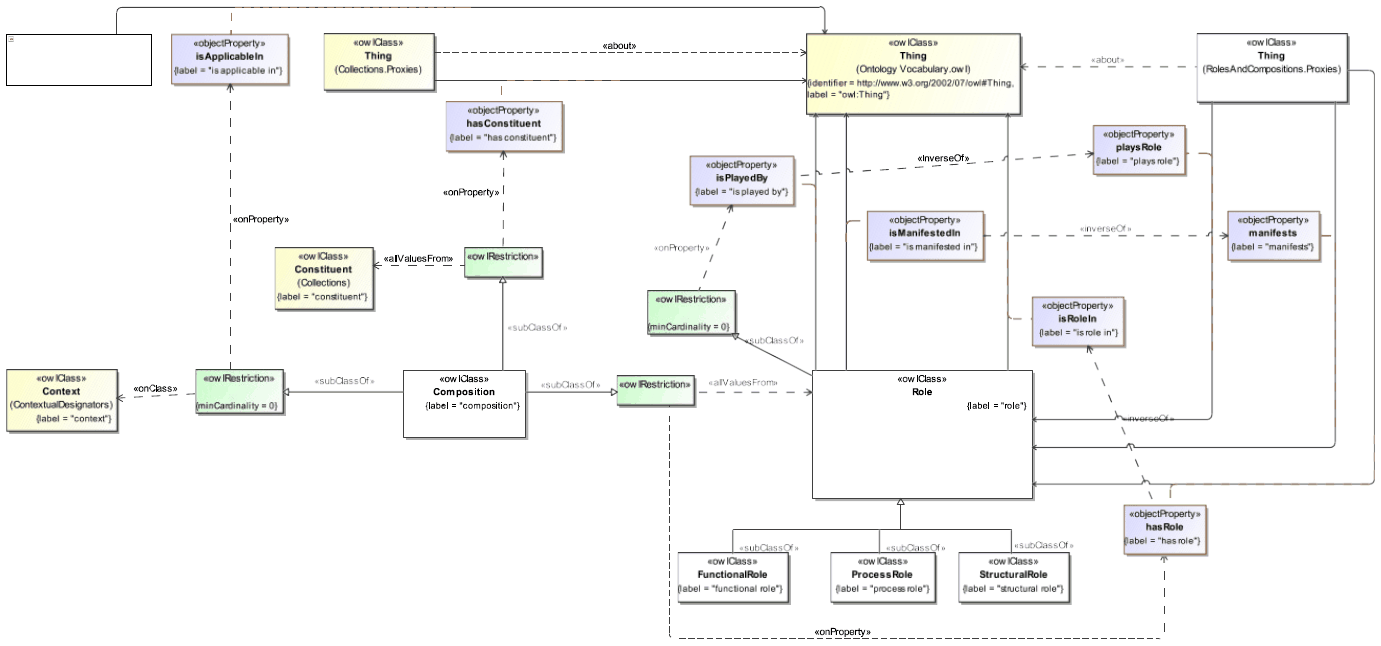
The detailed annotations and axioms that comprise the Commons Roles and Compositions Ontology are provided in Commons Roles and Compositions Ontology Details, below.
Classes
| Name | Annotations | Class Expressions |
|---|---|---|
|
Composition (composition) |
Definition: distinct thing resulting from bringing together other things, possibly in specific roles, for a particular purpose Explanatory note: The composition may be specified based on the roles that the things play in the composition, such as the roles that various ingredients play in a recipe or pharmaceutical product, and such things may or may not be transformed in some way through the process of combining them. Quantification including the nature and amount of each thing, potentially including the ratio of the quantities, may be required depending kind of composition. Usage note: The properties hasConstituent and hasRole are included in value restrictions rather than via number restrictions to facilitate their use in complex property chains and other axioms as needed for some applications. Adapted from: ISO/IEC 18384-1:2016, Information technology - Reference Architecture for Service Oriented Architecture (SOA RA) - Part 1: Terminology and concepts for SOA, clause 2.5 and ISO/IEC 18384-3:2016, Information technology - Reference Architecture for Service Oriented Architecture (SOA RA) - Part 3: Service Oriented Architecture ontology, clause 8.2 Adapted from: ISO/TS 19807-1:2019(en), Nanotechnologies - Magnetic nanomaterials - Part 1: Specification of characteristics and measurements for magnetic nanosuspensions, clause 3.4 |
Property Restriction: ∀ cmns-col:hasConstituent.cmns-col:Constituent Property Restriction: ∀ hasRole.Role Property Restriction: ≥ 0 cmns-cxtdsg:isApplicableIn.cmns-cxtdsg:Context |
|
FunctionalRole (functional role) |
Definition: role representing an underlying functionality that something, such as a person, organization, process, or service, is expected to perform or deliver Note: Functional roles can be assigned to be performed during an act. Adapted from: ISO 21298:2017(en), Health informatics - Functional and structural roles, clause 3.9 Adapted from: ISO/IEC 19763-8:2015(en), Information technology - Metamodel framework for interoperability (MFI) - Part 8: Metamodel for role and goal model registration, clause 3.1.2 |
Parent Class: Role |
|
ProcessRole (process role) |
Definition: role that associates resources and participants to a structured set of activities involving various enterprise entities, that is designed and organised for a given purpose Adapted from: ISO 12651-2:2014(en), Electronic document management - Vocabulary - Part 2: Workflow management, clause 3.33 Adapted from: ISO 18629-1:2004(en), Industrial automation systems and integration - Process specification language - Part 1: Overview and basic principles |
Parent Class: Role |
|
Role (role) |
Definition: named specific behavior of something participating in a particular context Adapted from: ISO/IEC 19763-8:2015(en), Information technology - Metamodel framework for interoperability (MFI) - Part 8: Metamodel for role and goal model registration, clause 3.1.7 |
Property Restriction: ≥ 0 isPlayedBy |
|
StructuralRole (structural role) |
Definition: role specifying relations between entities in the sense of competence, often reflecting organizational or structural relations (hierarchies) Source: ISO 21298:2017(en), Health informatics - Functional and structural roles, clause 3.26 |
Parent Class: Role |
Properties
| Name | Annotations | Property Axioms |
|---|---|---|
|
hasRole (has role) |
Definition: identifies something or someone playing a part in something, such as a composition |
Range: Role |
|
isManifestedIn (is manifested in) |
Definition: indicates something in which the role is realized, appears, or occurs |
Domain: Role Inverse: manifests |
|
isPlayedBy (is played by) |
Definition: indicates something or someone, such as a person, organization, or other thing filling a role Example: A party, counterparty, or third party to a contract is played by an organization or person; an issuer of a financial instrument is typically played by an organization; an ingredient in a recipe may be played by a substance. |
Domain: Role Inverse: playsRole |
|
isRoleIn (is role in) |
Definition: identifies something, such as a composition, situation, or contract, involving the role |
Domain: Role Inverse: hasRole |
|
manifests (manifests) |
Definition: indicates a role that realizes, displays, or shows something, typically in some context |
Range: Role |
|
playsRole (plays role) |
Definition: indicates a part that someone or something plays under some circumstance Example: an organization may play the role of employer, issuer, regulatory agency, bank, custodian, manufacturer, vendor, etc.; a person may play the role of employee, examiner, banker, seller, buyer, etc. |
Range: Role |
9.22. Commons Sites and Facilities Ontology§
This ontology provides high-level concepts related to facilities, both virtual and physical, including sites that provide the context for various facilities.
Metadata for the Commons Sites and Facilities Ontology is given in Commons Sites and Facilities Ontology Metadata.
| Metadata Term | Value |
|---|---|
|
Ontology IRI |
|
|
|
Commons Sites and Facilities Ontology |
|
|
This ontology provides high-level concepts related to facilities, both virtual and physical, including sites that provide the context for various facilities. |
|
|
Elisa Kendall, Thematix Partners LLC |
|
|
Copyright (c) 2011-2025 Thematix Partners LLC |
|
|
Copyright (c) 2013-2025 EDM Council, Inc. |
|
|
Copyright (c) 2013-2025 Object Management Group, Inc. |
|
|
Copyright (c) 2011-2025 Thematix Partners LLC Permission is hereby granted, free of charge, to any person obtaining a copy of this software and associated documentation files (the 'Software'), to deal in the Software without restriction, including without limitation the rights to use, copy, modify, merge, publish, distribute, sublicense, and/or sell copies of the Software, and to permit persons to whom the Software is furnished to do so, subject to the following conditions: The above copyright notice and this permission notice shall be included in all copies or substantial portions of the Software. THE SOFTWARE IS PROVIDED 'AS IS', WITHOUT WARRANTY OF ANY KIND, EXPRESS OR IMPLIED, INCLUDING BUT NOT LIMITED TO THE WARRANTIES OF MERCHANTABILITY, FITNESS FOR A PARTICULAR PURPOSE AND NONINFRINGEMENT. IN NO EVENT SHALL THE AUTHORS OR COPYRIGHT HOLDERS BE LIABLE FOR ANY CLAIM, DAMAGES OR OTHER LIABILITY, WHETHER IN AN ACTION OF CONTRACT, TORT OR OTHERWISE, ARISING FROM, OUT OF OR IN CONNECTION WITH THE SOFTWARE OR THE USE OR OTHER DEALINGS IN THE SOFTWARE. See https://opensource.org/licenses/MIT. |
|
|
Commons Sites and Facilities Ontology |
|
|
|
|
|
This ontology was derived, in part, from the Financial Industry Business Ontology (FIBO) and tested extensively on the Pistoia Alliance Identification of Medicinal Products Ontology (IDMP-O) project, among others. |
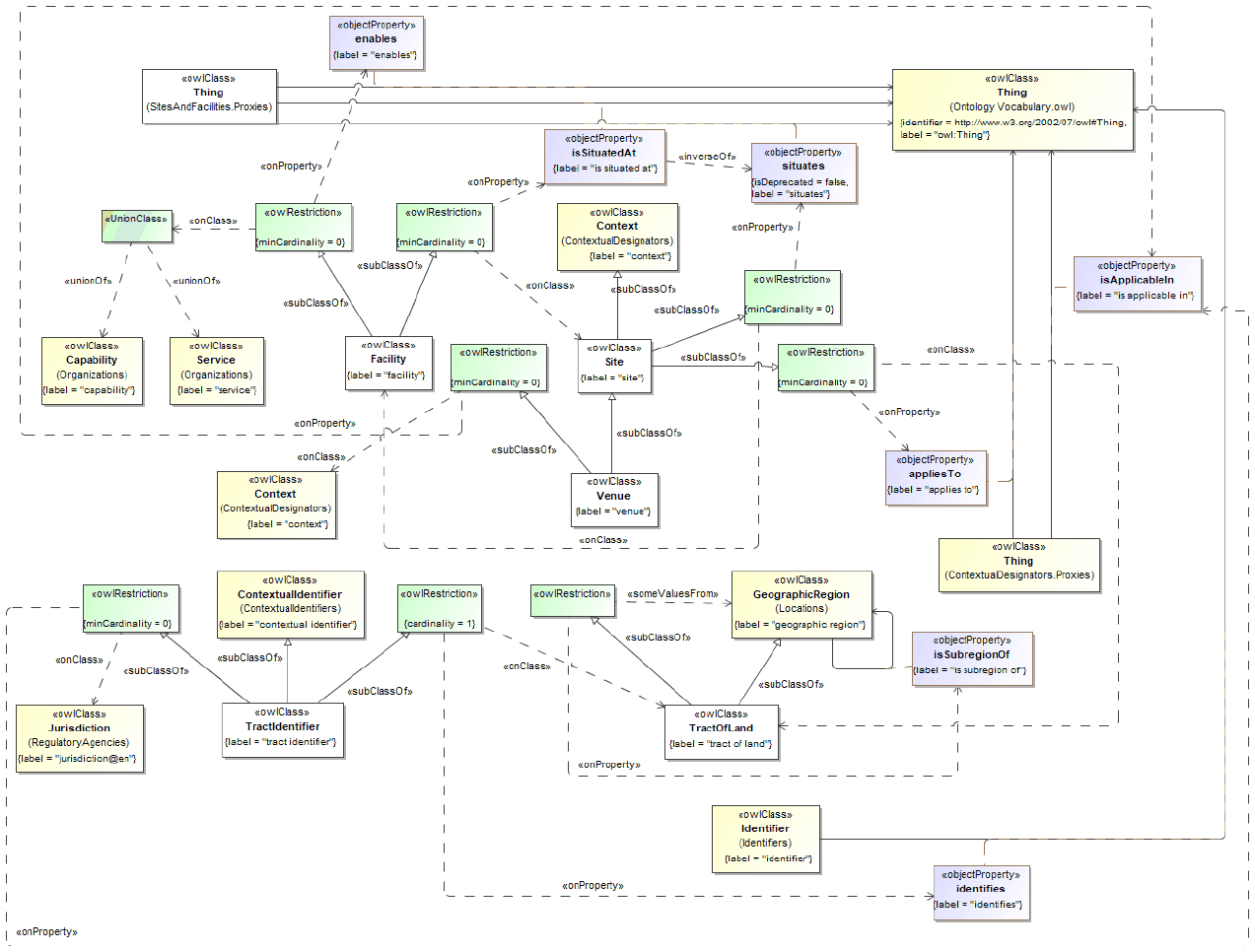
The detailed annotations and axioms that comprise the Commons Sites and Facilities Ontology are provided in Commons Sites and Facilities Ontology Details, below.
Classes
| Name | Annotations | Class Expressions |
|---|---|---|
|
cmns-org:Capability |
Property Restriction: ≥ 0 isEnabledBy.Facility | |
|
Facility (facility) |
Definition: something established to serve a particular purpose, make some course of action or operation easier, or provide some capability or service Explanatory note: A facility may be concrete (as in a manufacturing facility) or abstract. Concrete facilities may be permanent, semi-permanent, or temporary structures, providing one or more capabilities at a given site. A single site may include multiple facilities and a given facility may span multiple sites. |
Property Restriction: ≥ 0 enables (cmns-org:Capability ⊔ cmns-org:Service) Property Restriction: ≥ 0 isSituatedAt.Site |
|
Site (site) |
Definition: place, setting, or context in which something, such as a facility, is situated Example: Example facilities that may situated at some site include structures and buildings, an archeological dig, the landing location for an aircraft or spacecraft, and the site of a wound. A given site may accommodate multiple facilities. Explanatory note: A physical site has certain characteristics that contribute to the context it provides, including area, shape, accessibility, and in the case of a geographic site, landforms, soil and ground conditions, climate, and so forth. |
Parent Class: cmns-cxtdsg:Context Property Restriction: ≥ 0 cmns-cxtdsg:appliesTo.TractOfLand |
|
TractIdentifier (tract identifier) |
Definition: unique identifier for a parcel issued for use in some jurisdiction |
Parent Class: cmns-cxtid:ContextualIdentifier Property Restriction: ≥ 0 cmns-cxtdsg:isApplicableIn.cmns-rga:Jurisdiction Property Restriction: = 1 cmns-id:identifies.TractOfLand |
|
TractOfLand (tract of land@en) |
Definition: geographic region that is a contiguous parcel or area of land within a larger region on the surface of the earth, typically defined by its boundaries as described in a deed, survey, or legal document Explanatory note: In some cases, such as in the case of unimproved land that may be owned by a government but without improvements, there may not be an address. Explanatory note: Such a description typically includes a detailed, quantitative specification for that region specified using a prescribed coordinate and/or mapping system and/or a narrative description, such as 'metes and bounds', which provides a qualitative, but less precise, legal description of the location. The system(s) used to describe the tract are specified in local, regional, and national law. |
Parent Class: cmns-loc:GeographicRegion Property Restriction: ∃ cmns-loc:isSubregionOf.cmns-loc:GeographicRegion |
|
Venue (venue) |
Definition: site where something happens, described in the context of an event, activity, or something else that occurs there |
Parent Class: Site Property Restriction: ≥ 0 cmns-cxtdsg:isApplicableIn.cmns-cxtdsg:Context |
Properties
| Name | Annotations | Property Axioms |
|---|---|---|
|
enables (enables) |
Definition: creates an environment or situation where something can occur or function efficiently |
|
|
isEnabledBy (is enabled by) |
Definition: indicates something that occurs or functions efficiently due to |
Inverse: enables |
|
isSituatedAt (is situated at) |
Definition: is placed at Explanatory note: Something may be situated at some site, or in some setting, situation, or context. |
|
|
situates (situates) |
Definition: indicates the place, setting, or context in which something is placed |
Inverse: isSituatedAt |
9.23. Commons Structured Collections Ontology§
This ontology extends the concept of a structured collection to include sets, lists, and collections whose elements are ordered chronologically or are indexed.
Metadata for the Commons Structured Collections Ontology is given in Commons Structured Collections Ontology Metadata.
| Metadata Term | Value |
|---|---|
|
Ontology IRI |
|
|
|
Commons Structured Collections Ontology |
|
|
This ontology extends the concept of a structured collection to include sets, lists, and collections whose elements are ordered chronologically or are indexed. |
|
|
Copyright (c) 2019-2025 Thematix Partners LLC |
|
|
Copyright (c) 2021-2025 EDM Council, Inc. |
|
|
Copyright (c) 2024-2025 Dassault Systèmes |
|
|
Copyright (c) 2024-2025 Object Management Group, Inc. |
|
|
Copyright (c) 2019-2024 Thematix Partners LLC The above copyright notice and this permission notice shall be included in all copies or substantial portions of the Software. THE SOFTWARE IS PROVIDED 'AS IS', WITHOUT WARRANTY OF ANY KIND, EXPRESS OR IMPLIED, INCLUDING BUT NOT LIMITED TO THE WARRANTIES OF MERCHANTABILITY, FITNESS FOR A PARTICULAR PURPOSE AND NONINFRINGEMENT. IN NO EVENT SHALL THE AUTHORS OR COPYRIGHT HOLDERS BE LIABLE FOR ANY CLAIM, DAMAGES OR OTHER LIABILITY, WHETHER IN AN ACTION OF CONTRACT, TORT OR OTHERWISE, ARISING FROM, OUT OF OR IN CONNECTION WITH THE SOFTWARE OR THE USE OR OTHER DEALINGS IN THE SOFTWARE. See https://opensource.org/licenses/MIT. |
|
|
https://www.omg.org/spec/Commons/20250801/StructuredCollections/ |
|
|
The https://www.omg.org/spec/Commons/20240801/Collections.rdf version of this ontology was modified to clarify the definition of list (COMMONS13-8) and replace the property hasConstituent with hasMember due to a semantics mismatch (COMMONS13-4). |
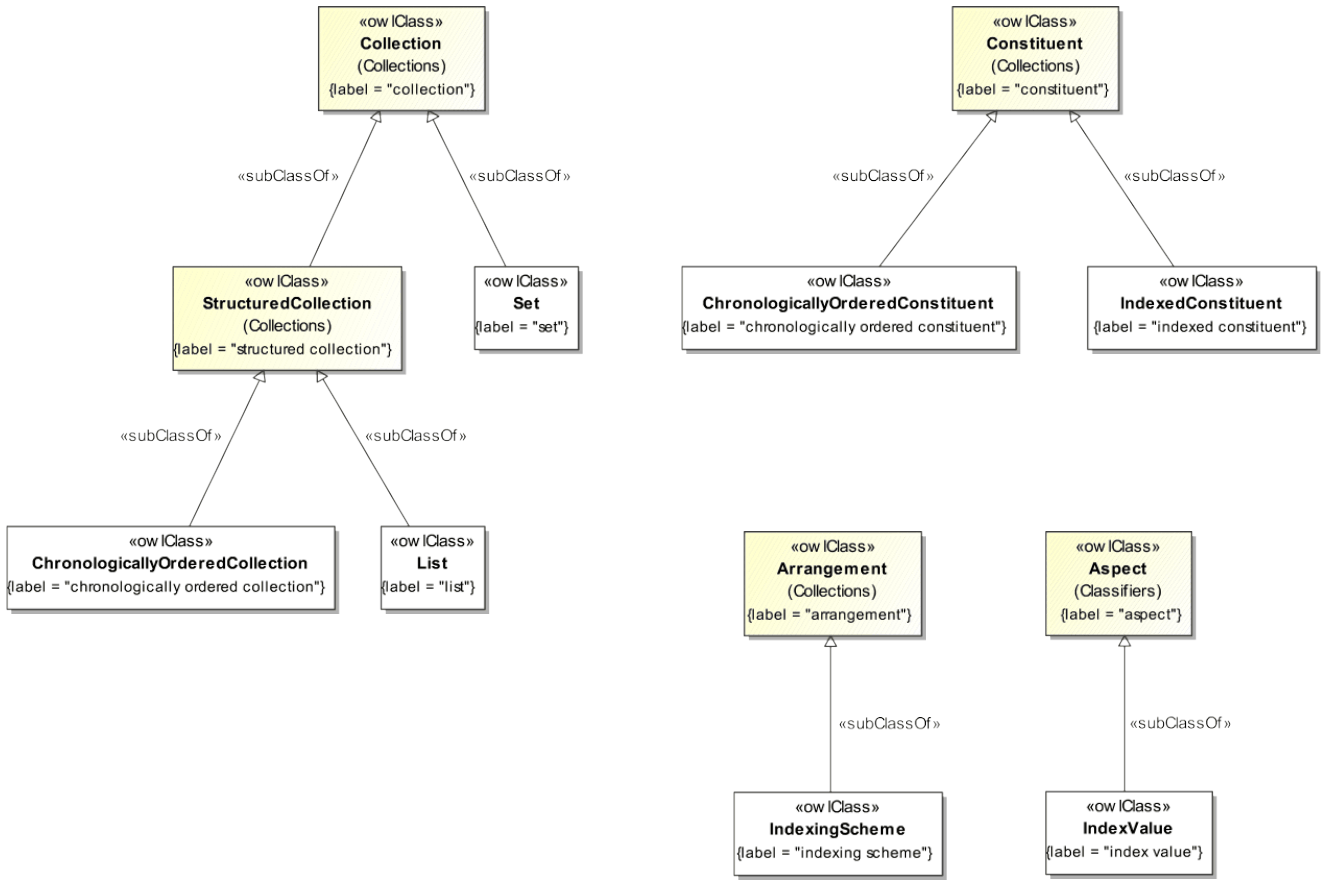
The detailed annotations and axioms that comprise the Commons Structured Collections Ontology are provided in Commons Structured Collections Ontology Details, below.
Classes
| Name | Annotations | Class Expressions |
|---|---|---|
|
ChronologicallyOrderedCollection (chronologically ordered collection) |
Definition: structured collection whose elements are ordered by time Explanatory note: Examples include simple schedules, bank statements, and other records that are ordered by time. Adapted from: ISO 5127 Information and documentation - Foundation and vocabulary, Second edition, 2017-05 |
Parent Class: cmns-col:StructuredCollection Property Restriction: ∃ cmns-col:hasMember.ChronologicallyOrderedConstituent |
|
ChronologicallyOrderedConstituent (chronologically ordered constituent) |
Definition: element of a collection that is ordered within a collection with respect to time Explanatory note: Note that the use of several options for the representation of a date and time stamp enables extensions for milliseconds, nanoseconds using an xsd:string that has the format of an xsd:dateTime datatype but extends the level of granularity consistently. An example of where this is required is to represent records that are ordered by date and time and security prices that change multiple times in a given day. Adapted from: ISO 5127 Information and documentation - Foundation and vocabulary, Second edition, 2017-05 |
Parent Class: cmns-col:Constituent Property Restriction: ≥ 0 cmns-dt:hasObservedDateTime.cmns-dt:CombinedDateTime |
|
cmns-col:Constituent |
Synonym: element Explanatory note: An element is an object constituting part of a set, and can be a concept. Adapted from: ISO 5127 Information and documentation - Foundation and vocabulary, Second edition, 2017-05 |
|
|
IndexedConstituent (indexed constituent) |
Definition: element of a collection that is ordered within that collection with respect to an index Adapted from: ISO 5127 Information and documentation - Foundation and vocabulary, Second edition, 2017-05 |
Parent Class: cmns-col:Constituent Property Restriction: ∃ cmns-col:comprises.IndexValue |
|
IndexingScheme (indexing scheme) |
Definition: system for indexing values, data, information, or knowledge |
Parent Class: cmns-col:Arrangement Property Restriction: ∀ cmns-dsg:defines.IndexValue |
|
IndexValue (index value) |
Definition: aspect of a collection or retrieval system indicating the address within a record, list, or document where that element can be found Explanatory note: An index may be an indirect shortcut derived from and pointing into, a collection of values, data, information or knowledge or a simple ordinal number. Usage note: For index values that are numeric, use hasNumericValue from the Commons Quantities and Units ontology to specify the value itself. For a more complex string-valued index, use hasTextValue from the Commons TextDatatype ontology to specify the value. Adapted from: ISO 5127 Information and documentation - Foundation and vocabulary, Second edition, 2017-05 |
Parent Class: cmns-cls:Aspect Property Restriction: ≥ 0 cmns-doc:refersTo Property Restriction: ∀ cmns-dsg:isDefinedIn.IndexingScheme |
|
List (list) |
Definition: finite, linearly ordered collection of items, where the same item may occur more than once Adapted from: ISO 5127 Information and documentation - Foundation and vocabulary, Second edition, 2017-05 |
Parent Class: cmns-col:StructuredCollection Property Restriction: ≥ 0 cmns-col:hasMember.IndexedConstituent |
|
Set (set) |
Definition: assembly of distinct objects or concepts considered as a whole Adapted from: ISO 5127 Information and documentation - Foundation and vocabulary, Second edition, 2017-05 |
Parent Class: cmns-col:Collection |
9.24. Commons Text Datatype Ontology§
The text datatype ontology defines a custom datatype that combines language tagged and plain string values. This text datatype is useful in cases where it is not clear whether string values will be tagged or not, but where it is anticipated that multilingual strings might be appropriate.
Metadata for the Commons Text Datatype Ontology is given in Commons Text Datatype Ontology Metadata.
| Metadata Term | Value |
|---|---|
|
Ontology IRI |
|
|
|
Commons Text Datatype Ontology |
|
|
The text datatype ontology defines a custom datatype that combines language tagged and plain string values. This text datatype is useful in cases where it is not clear whether string values will be tagged or not, but where it is anticipated that multilingual strings might be appropriate. |
|
|
Elisa Kendall, Thematix Partners LLC |
|
|
Evren Sirin, Stardog Union |
|
|
Copyright (c) 2020-2022 Stardog Union |
|
|
Copyright (c) 2020-2022 Thematix Partners LLC |
|
|
Copyright (c) 2022 Object Management Group, Inc. |
|
|
http://opensource.org/licenses/MIT |
|
|
|
|
|
Note that custom datatypes are outside the OWL 2 RL profile and so its usage in applications may need to be commented out. |
|
|
The https://www.omg.org/spec/Commons/20220501/TextDatatype.rdf version of this ontology was modified to add a note to the Text datatype that makes a stronger statement about potential adverse reasoning consequences if used (COMMONS-18). |
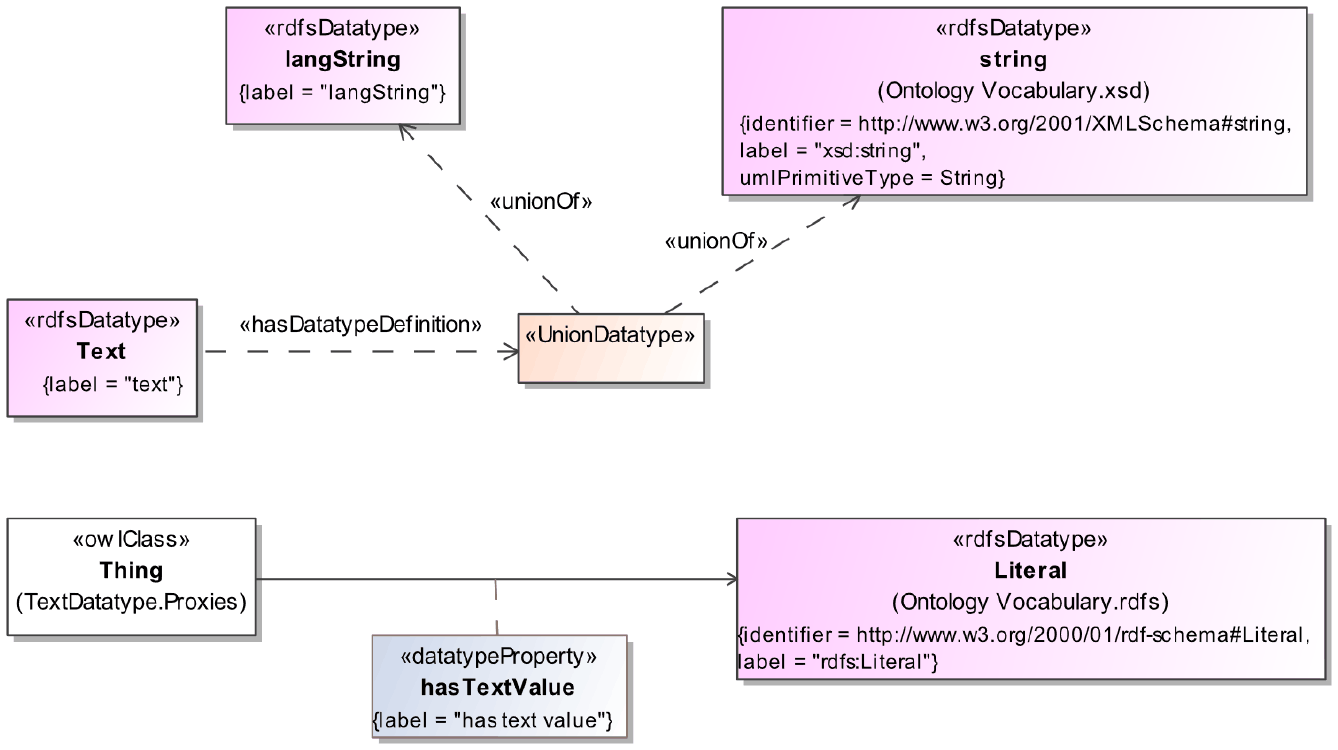
The detailed annotations and axioms that comprise the Commons Text Datatype Ontology are provided in Commons Text Datatype Ontology Details, below.
Datatypes
| Name | Annotations | Class Expressions |
|---|---|---|
|
rdf:langString (langString) |
Definition: literal with a non-empty language tag Note: This datatype declaration is included to support language-tagged strings, as defined in RDF 1.1. The rdf:langString datatype has not been incorporated directly in OWL 2 to date, and so it must be declared in order to enable its inclusion in the declaration of the Text datatype. Language-tagged strings must be well-formed according to section 2.2.9 of [BCP47]. Source: BCP 47: Tags for Identifying Languages, available at https://tools.ietf.org/search/bcp47 Source: https://www.w3.org/TR/rdf11-concepts/#section-Datatypes |
|
|
Text (text) |
Definition: datatype that maps to xsd:string and rdf:langString base types for string-valued data properties and annotations Note: Text is data in the form of characters, symbols, words, phrases, paragraphs, sentences, tables, or other character arrangements, intended to convey a meaning, and whose interpretation is essentially based upon the reader's knowledge of some natural language or artificial language. Note: There are cases where the representation of certain features of something, such as a name, which might be multilingual or might not, defaults to rdfs:Literal when left unspecified, although it should be limited to plain strings or language-typed strings (i.e., exclude numbers, binary types, and so forth). There is no combined datatype available in RDF or OWL, however, which is the role that this datatype is intended to fulfill. Usage note: Commons users that depend on tools that lack support for rdf:langString may not want to use this datatype in their applications. Testing with specific reasoners, for example, is advised. Scope note: This composite datatype should be used in cases where a standard representation using one of the options in the union for string values does not work. Note that certain tools may not support rdf:langString, including, but not limited to some versions of Protege, and that custom datatypes are not supported in OWL 2 RL so it may need to be ignored or commented out in OWL 2 RL applications. Source: ISO/IEC 11179-3 Information technology - Metadata registries (MDR) - Registry metamodel and basic attributes, Third edition, 2013-02-15 |
Equivalent Datatype: xsd:string ⊔ rdf:langString |
Properties
| Name | Annotations | Property Axioms |
|---|---|---|
|
hasTextValue (has text value) |
Definition: provides a string value for something, with or without a language tag Note: Note that although the intended range for this property is Text, we have left the range undefined so that it can be used with tools that do not support rdf:langString. |
A. Documentation coverage§
24 ontologies; 387 documented named resources. 0 resources have no English source definition.
Missing annotations are shown explicitly and recorded as KG diagnostics. No inferred definitions or external imports are added.
B. Deliverables§
The Commons ontologies are delivered as (1) RDF/XML serialized OWL (normative and definitive), and (2) Turtle serialized OWL (normative and definitive).
Each of the ontologies included in the Commons Ontology Library makes normative reference to the DCMI Dublin Core Metadata Terms [Dublin Core] and W3C Simple Knowledge Organization System (SKOS) Recommendation [SKOS], which are not part of this specification.
The individual RDF/XML files are UTF-8 conformant XML files that are also OWL 2 compliant, and may be examined using any text editor, XML editor, or RDF or OWL editor. They have been verified for syntactic correctness via the W3C RDF Validator and pass a series of unit-level tests provided by the EDM Council in its Data Innovation Laboratory (DIL) tools that cover a range of syntactic and modeling pattern issues. They have also been checked for logical consistency using the HermiT OWL 2 reasoner from Oxford University.
C. Examples§
The ontologies included in the Commons Ontology Library leverage modeling patterns found in many data management and knowledge graph based applications. Some of these patterns are reused in more specific parts of the library, such as many of the annotation properties given in the Annotation Vocabulary. Examples for cases that are not provided in the library itself may be helpful to implementers and a number of such examples that we hope will clarify how to use the ontologies are given below.
C.1 Classifiers and Classification Schemes§
From an ontological perspective, a classification scheme is typically used to ‘put things in buckets’ – a controlled vocabulary, organizing scheme, set of categories to support faceted searching and the like. ISO/IEC 11179-3:2013 Information technology – Metadata registries (MDR) – Part 3: Registry metamodel and basic attributes1 provides a pattern for representing classification schemes and the classifiers defined in such schemes, which the ontology follows. In finance, the set of ‘asset classes’ used to classify financial instruments, such as those specified in ISO 10962, Securities and related financial instruments – Classification of financial instruments (CFI) code2, represent examples of both classifiers and codes at the same time. Another such scheme is the North American Industry Classification System (NAICS), used by federal statistical agencies in classifying business establishments for the purpose of collecting, analyzing, and publishing statistical data related to the U.S. business economy3 Recently published ISO standards for the identification of medicinal products include several classification schemes. For example, in the ISO 11238:2018 Health informatics – Identification of medicinal products – Data elements and structures for the unique identification and exchange of regulated information on substances4, taxonomic structures for classifying substances as polymers, proteins, structurally diverse substances, and mixtures are derived from biological matrices. The example that follows shows a kind of classifier for substance names, specified in the ISO 11238 standard for describing and identifying substances, and includes a controlled vocabulary of valid values. Thus, the class ‘substance name classifier’ is a subclass of ‘classifier’, and each of the valid values is modeled as a named individual whose type is ‘substance name classifier’. Note that the use of ‘min 0’ in a restriction is quite useful to show users that while the main ontology for substances does not require a value for all possible substance names it classifies, since new substances are added to various repositories on a regular basis, using inverse reasoning on individuals of type substance name for the property “is classified by” would yield that information.
<owl:Class rdf:about="&idmp-sub;SubstanceNameClassifier">
    <rdfs:subClassOf rdf:resource="&cmns-cls;Classifier"/>
    <rdfs:subClassOf>
        <owl:Restriction>
            <owl:onProperty rdf:resource="&cmns-cls;classifies"/>
            <owl:onClass rdf:resource="&idmp-sub;SubstanceName"/>
            <owl:minQualifiedCardinality
                rdf:datatype="&xsd;nonNegativeInteger">0</owl:minQualifiedCardinality>
        </owl:Restriction>
    </rdfs:subClassOf>
    <rdfs:label>substance name classifier</rdfs:label>
    <dct:source>ISO 11238:2018 Health informatics - Identification of medicinal
        products (IDMP) - Data elements and structures for the unique identification and
        exchange of regulated information on substances, clause 6.4</dct:source>
    <dct:source>ISO/TS 19844:2018(E) Health informatics - Identification of medicinal
        products (IDMP) - Implementation guidelines for ISO 11238 for data elements and
        structures for the unique identification and exchange of regulated information on
        substances, clause 6.3.2</dct:source>
    <skos:definition>classifier that describes the nature of the substance name from a
        pre-defined ISO 19844 code set</skos:definition>
    <cmns-av:synonym>substance name type</cmns-av:synonym>
</owl:Class>
Two of the named individuals that are specified in the standard and enumerated in the ISO 19844 implementation guide as a part of this scheme include:
<owl:NamedIndividual rdf:about="&idmp-sub;SubstanceNameClassifier-BrandName">
    <rdf:type rdf:resource="&idmp-sub;SubstanceNameClassifier"/>
    <rdfs:label>substance name classifier - brand name</rdfs:label>
    <dct:source>ISO 11238:2018 Health informatics - Identification of medicinal
        products (IDMP) - Data elements and structures for the unique identification and
        exchange of regulated information on substances, clause 6.4</dct:source>
    <dct:source>ISO/TS 19844:2018(E) Health informatics - Identification of medicinal
        products (IDMP) - Implementation guidelines for ISO 11238 for data elements and
        structures for the unique identification and exchange of regulated information on
        substances, clause 6.3.2</dct:source>
    <skos:definition>substance name classifier for a name by which a company
        identifies a given substance typically for marketing purposes</skos:definition>
    <cmns-dsg:isDefinedIn rdf:resource="&idmp-sub;ISO11238ClassificationScheme"/>
    <cmns-txt:hasTextValue>Brand Name</cmns-txt:hasTextValue>
</owl:NamedIndividual>
<owl:NamedIndividual rdf:about="&idmp-sub;SubstanceNameClassifier-OfficialName">
    <rdf:type rdf:resource="&idmp-sub;SubstanceNameClassifier"/>
    <rdfs:label>substance name classifier - official name</rdfs:label>
    <dct:source>ISO 11238:2018 Health informatics - Identification of medicinal
        products (IDMP) - Data elements and structures for the unique identification and
        exchange of regulated information on substances, clause 6.4</dct:source>
    <dct:source>ISO/TS 19844:2018(E) Health informatics - Identification of medicinal
        products (IDMP) - Implementation guidelines for ISO 11238 for data elements and
        structures for the unique identification and exchange of regulated information on
        substances, clause 6.3.2, B.4.27</dct:source>
    <skos:definition>substance name classifier for a name that is typically
        nonproprietary used in a given jurisdiction and domain to refer to a specific
        substance</skos:definition>
    <skos:example>INN: International Nonproprietary Name, also known as rINN,
        recommended International Nonproprietary Name or pINN, proposed International
        Nonproprietary Name or INNM, Modified International Nonproprietary Name published
        by WHO: World Health Organization: in accordance with rules.</skos:example>
    <skos:note>The domain, jurisdiction, and authority that assigned the name (USAN,
        INN, JAN etc.) and the language of the name are also captured.</skos:note>
    <cmns-dsg:isDefinedIn rdf:resource="&idmp-sub;ISO11238ClassificationScheme"/>
    <cmns-txt:hasTextValue>Official</cmns-txt:hasTextValue>
</owl:NamedIndividual>
The representation of the scheme for the set of classifiers defined by ISO 11238 to which these substance name classifiers conform is shown below.
<owl:NamedIndividual rdf:about="&idmp-sub;ISO11238-ClassificationScheme">
    <rdf:type rdf:resource="&cmns-cls;ClassificationScheme"/>
    <rdfs:label>ISO 11238 classification scheme</rdfs:label>
    <rdfs:seeAlso
        rdf:datatype="&xsd;anyURI">https://www.iso.org/standard/71965.html</rdfs:seeAlso>
    <skos:definition>system for classifying substances and substance-related
        information specified in the ISO 11238 specification</skos:definition>
</owl:NamedIndividual>
C.2 Codes and Code Sets§
A similar pattern is defined in the library for the representation of codes and code sets, also following the pattern provided in ISO 11179-3. A code set, also called a code system, typically includes a finite number of codes at any point in time, such as the set of codes specified in ISO 10383:2012 Securities and related financial instruments – Codes for exchanges and market identification (MIC), which are revised on a monthly basis by the registration authority. Each MIC code represents a single, unique market, and as such is also an identifier, whereas the NAICS codes mentioned above are both classifiers and codes. The distinction between being an identifier and being a classifier is that the latter is used to characterize a group of things rather than an individual thing. Some code sets are versioned on a regular basis, such as the International Statistical Classification of Diseases and Related Health Problems (ICD), published by the World Health Organization (WHO). The ICD is revised periodically and is currently in its 11th revision. The example provided below defines the concept of a substance code. Certain codes that are also classifiers are used in the IDMP standards as controlled vocabularies. A controlled vocabulary, as defined in ISO 11238, is a “finite set of values that represent the only allowed values for a data item”. Such a vocabulary can include codes, text values, or numeric values according to the standard. One example is used in the implementation guide for ISO 11238 to indicate whether a certain characteristic is required or optional, depending on the kind of substance.
<owl:Class rdf:about="&idmp-sub;ConformanceLevel">
    <rdfs:subClassOf rdf:resource="&cmns-cls;Classifier"/>
    <rdfs:subClassOf rdf:resource="&cmns-cds;CodeElement"/>
    <rdfs:label>conformance level</rdfs:label>
    <dct:source>ISO/TS 19844:2018(E) Health informatics - Identification of medicinal
        products (IDMP) - Implementation guidelines for ISO 11238 for data elements and
        structures for the unique identification and exchange of regulated information on
        substances, clause 5</dct:source>
    <owl:equivalentClass>
        <owl:Class>
            <owl:oneOf rdf:parseType="Collection">
                <rdf:Description rdf:about="&idmp-sub;ConformanceLevelMandatory">
                </rdf:Description>
                <rdf:Description rdf:about="&idmp-sub;ConformanceLevelConditional">
                </rdf:Description>
                <rdf:Description rdf:about="&idmp-sub;ConformanceLevel-Optional">
                </rdf:Description>
            </owl:oneOf>
        </owl:Class>
    </owl:equivalentClass>
    <skos:definition>classifier that describes whether an element is required for a
        given substance type or a specified substance group</skos:definition>
    <skos:scopeNote>Conformance is not meant to be applied globally. Conformance will
        be expressed based on the following terminology: Mandatory, Conditional and
        Optional. Whether a data element is conditional by data, by process or by regional
        rule will be defined within regional implementation guides.</skos:scopeNote>
</owl:Class>
An example individual code defined as a member of this controlled vocabulary is given below.
<owl:NamedIndividual rdf:about="&idmp-sub;ConformanceLevel-Conditional">
    <rdf:type rdf:resource="&idmp-sub;ConformanceLevel"/>
    <rdfs:label>conformance level - conditional</rdfs:label>
    <dct:source>ISO 11238:2018 Health informatics - Identification of medicinal
        products (IDMP) - Data elements and structures for the unique identification and
        exchange of regulated information on substances, clause 5.9</dct:source>
    <dct:source>ISO/TS 19844:2018(E) Health informatics - Identification of medicinal
        products (IDMP) - Implementation guidelines for ISO 11238 for data elements and
        structures for the unique identification and exchange of regulated information on
        substances, clause 5</dct:source>
    <skos:definition>conformance level that applies to data elements ‘within a
        category’ as applicable, that are subject to business rules and may become
        required by: data rules; process rules; regional rules</skos:definition>
    <skos:note>Conditional applies when there are alternative data sources for a given
        data element(s) to identify a Substance/Specified Substance. Regional
        implementation of the ISO 11238 and ISO/TS 19844 may elevate the conditional
        conformance categories to mandatory per regional requirements.</skos:note>
    <cmns-col:isMemberOf rdf:resource="&idmp-sub;ISO19844-CodeSet"/>
    <cmns-txt:hasTextValue>CONDITIONAL</cmns-txt:hasTextValue>
</owl:NamedIndividual>
The corresponding code set is defined as follows.
<owl:NamedIndividual rdf:about="&idmp-sub;ISO19844-CodeSet">
    <rdf:type rdf:resource="&cmns-cds;CodeSet"/>
    <rdfs:label>ISO 19844 code set</rdfs:label>
    <rdfs:seeAlso
        rdf:datatype="&xsd;anyURI">https://www.iso.org/standard/71965.html</rdfs:seeAlso>
    <skos:definition>set of controlled vocabularies and codes for reporting of
        substance-related information specified in the ISO/TS 19844
        guidelines</skos:definition>
</owl:NamedIndividual>
C.3 Identifiers and Identification Schemes§
Another pattern is defined in the library for the representation of identifiers and identification schemes, again following the pattern provided in ISO 11179-3. Chemical substances typically are assigned numerous codes and identifiers world-wide, which may be minted by some regulatory agency or organization such as a pharmaceutical company. Reconciliation of such codes is a difficult process and can be near impossible to do without having an unambiguous representation of the molecular formula for the substance.
Although the intent is to assign a registration authority to create a globally unique substance identifier per the definition of substance identifier given in the ISO 11238 standard, none has been established to date. The definition of the more general substance code, which is both a code element and identifier, is given below.
<owl:Class rdf:about="&idmp-sub;SubstanceCode">
    <rdfs:subClassOf rdf:resource="&cmns-cds;CodeElement"/>
    <rdfs:subClassOf rdf:resource="&cmns-id;Identifier"/>
    <rdfs:subClassOf>
        <owl:Restriction>
            <owl:onProperty rdf:resource="&idmp-sub;hasComment"/>
            <owl:maxCardinality
                rdf:datatype="&xsd;nonNegativeInteger">1</owl:maxCardinality>
        </owl:Restriction>
    </rdfs:subClassOf>
    <rdfs:subClassOf>
        <owl:Restriction>
            <owl:onProperty rdf:resource="&idmp-sub;hasChangeDate"/>
            <owl:maxQualifiedCardinality
                rdf:datatype="&xsd;nonNegativeInteger">1</owl:maxQualifiedCardinality>
            <owl:onDataRange rdf:resource="&cmns-dt;CombinedDateTime"/>
        </owl:Restriction>
    </rdfs:subClassOf>
    <rdfs:subClassOf>
        <owl:Restriction>
            <owl:onProperty rdf:resource="&cmns-id;identifies"/>
            <owl:onClass rdf:resource="&idmp-sub;Substance"/>
            <owl:qualifiedCardinality
                rdf:datatype="&xsd;nonNegativeInteger">1</owl:qualifiedCardinality>
        </owl:Restriction>
    </rdfs:subClassOf>
    <rdfs:label>substance code</rdfs:label>
    <skos:definition>sequence of characters denoting a registered code for a given
        substance that is associated with a publicly recognized code
        system</skos:definition>
    <skos:example>CAS Registry numbers, EC numbers, FDA UNII codes, EMA XEVMPD codes,
        ASK numbers, EPA Pesticide codes</skos:example>
    <skos:example>These codes include Chemical Abstract Service (CAS) Registry
        Numbers, European Inventory of Existing Commercial Chemical Substances (EINECS),
        European Drug Codes (XEVMPD) and Japanese Drug Codes.</skos:example>
    <skos:note>Codes typically facilitate mapping and linking of substances to a
        variety of information sources.</skos:note>
    <skos:note>The actual code shall be captured using the same format that is used in
        the code system. Only codes associated with a code system shall be captured. The
        code shall be specifically associated with a given substance. Many public and
        non-public databases identify substances with a code, and these codes can be very
        helpful in mapping substances to various systems. Codes shall always be verified
        against the source system. Different jurisdictions may require a code from a code
        system or multiple code systems to be associated and submitted with a
        substance.</skos:note>
    <cmns-av:adaptedFrom>ISO 11238:2018 Health informatics - Identification of
        medicinal products (IDMP) - Data elements and structures for the unique
        identification and exchange of regulated information on substances, clause
        7.2.8</cmns-av:adaptedFrom>
    <cmns-av:adaptedFrom>ISO/TS 19844:2018(E) Health informatics - Identification of
        medicinal products (IDMP) - Implementation guidelines for ISO 11238 for data
        elements and structures for the unique identification and exchange of regulated
        information on substances, clause 6.5</cmns-av:adaptedFrom>
</owl:Class>
For example, a UNII is a unique code and identifier for a substance that has been registered by the U.S. Food and Drug Administration.
<owl:Class rdf:about="&idmp-ra;UniqueIngredientNumber">
    <rdfs:subClassOf rdf:resource="&idmp-sub;SubstanceCode"/>
    <rdfs:label>unique ingredient number</rdfs:label>
    <skos:definition>10-character, randomly generated alpha-numeric string that is
        used to identify substances in medicinal products in the FDA Global Substance
        Registration System (G-SRS)</skos:definition>
    <skos:note>The first nine characters are randomly generated followed by a check
        character. The integrity check on the UNII is stronger than both the EC# and the
        CAS Registry Number because of the random generation from a large number of
        potential UNIIs and the fact that there are 36 possible check characters compared
        to 10 with both the EC# and CAS Registry Number.</skos:note>
    <skos:scopeNote>The UNII is freely available for use and there is a mechanism
        whereby a manufacturer can petition for the generation of a UNII through the FDA.
        The system has the capability for both public and restricted access to information
        and can be adapted to produce specified substance identifiers.</skos:scopeNote>
    <cmns-av:abbreviation>UNII</cmns-av:abbreviation>
    <cmns-av:directSource>ISO 11238:2018 Health informatics - Identification of
        medicinal products (IDMP) - Data elements and structures for the unique
        identification and exchange of regulated information on substances, clause
        A.1.5</cmns-av:directSource>
</owl:Class>
Note that some additional details, such as the registration authority and registry have been elided for the sake of simplifying the example. The corresponding code set and identification scheme is defined as follows.
<owl:NamedIndividual rdf:about="&idmp-ra;UniqueIngredientNumber-CodeSet">
    <rdf:type rdf:resource="&cmns-cds;CodeSet"/>
    <rdf:type rdf:resource="&cmns-id;IdentificationScheme"/>
    <rdfs:label>unique ingredient number code set</rdfs:label>
    <skos:definition>code set and identification scheme that specifies the rules for
        generating the 10-character alpha-numeric string used to identify substances in
        medicinal products in the FDA Global Substance Registration System
        (G-SRS)</skos:definition>
</owl:NamedIndividual>
An example individual UNII for the substance, amlodipine, is given below.
<owl:NamedIndividual rdf:about="&idmp-amp;UNII-1J444QC288">
    <rdf:type rdf:resource="&idmp-ra;UniqueIngredientNumber"/>
    <rdfs:label>1J444QC288</rdfs:label>
    <dct:source
        rdf:resource="https://precision.fda.gov/uniisearch/srs/unii/1J444QC288"/>
    <cmns-id:identifies
        rdf:resource="https://gsrs.ncats.nih.gov/api/v1/substances/1J444QC288"/>
    <cmns-id:identifies rdf:resource="&idmp-amp;Amlodipine"/>
    <cmns-txt:hasTextValue>1J444QC288</cmns-txt:hasTextValue>
</owl:NamedIndividual>
Details with respect to the registry and registration authority have been elided to simplify the example.
C.4 Role and Composition§
The notion of a composition is widely used in UML modeling but is not provided “out of the box” in the Web Ontology Language (OWL). Ontologists frequently need to reify relationships, for example to represent ternary relations, without having a single pattern built into the language for doing so, although several options are described in ‘Defining N-ary Relations on the Semantic Web’5.
The model described herein provides a pattern for representing roles and compositions and incorporates three restrictions on composition that are optional: (1) inclusion of constituents – parts of something, (2) inclusion of roles, and (3) context.
One common kind of composition is that of a recipe. A recipe has ingredients, each of which may have some amount, and possibly other properties associated with them. In the case of pharmaceutical ingredients which are substances playing the role of ingredients, for example, each has an amount and a strength as well as certain jurisdiction-specific details.
Figure 25, below, provides a partial, high-level diagram from an explanatory wiki page for the Identification of Medicinal Products (IDMP-O)6 ontology project for a pharmaceutical product composition, showing the relationships between the composition and its ingredients.
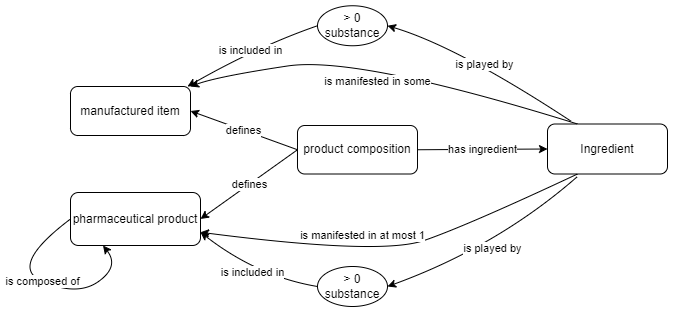
In the diagram, the ‘has ingredient’ property is a subproperty of ‘has role’ in the Commons Roles and Compositions ontology.
A turtle representation of the OWL definitions for product composition, has ingredient and the ingredient class are given below.
idmp-mprd:ProductComposition
    a owl:Class ;
    rdfs:subClassOf
        cmns-rlcmp:Composition ,
        [
            a owl:Restriction ;
            owl:onProperty idmp-mprd:hasReferenceStrength ;
            owl:onClass idmp-mprd:ReferenceStrength ;
            owl:minQualifiedCardinality "0"^^xsd:nonNegativeInteger ;
        ] ,
        [
            a owl:Restriction ;
            owl:onProperty idmp-sub:hasIngredient ;
            owl:someValuesFrom idmp-sub:Ingredient ;
        ] ,
        [
            a owl:Restriction ;
            owl:onProperty cmns-dsg:defines ;
            owl:someValuesFrom [
                a owl:Class ;
                owl:unionOf (
                    idmp-sub:ManufacturedItem
                    idmp-mprd:MedicinalProduct
                    idmp-mprd:PharmaceuticalProduct
                ) ;
            ] ;
        ]
        ;
    rdfs:label "product composition" ;
    skos:definition "composition that defines some product based on its
        relationship(s) to some other substance(s) (ingredient(s)), potentially with a
        given strength, in some context" ;
    cmns-av:usageNote "From an implementation (mapping) perspective, this product
        composition class provides the basis for a (blank) node in the relationship
        'product realizes ingredient role played by some substance', where the ingredient
        role may be that of an active ingredient which, in turn, may have some basis of
        strength in some context. The same product composition could be used to link
        inactive ingredients to a product in which they are realized. A given product may
        include multiple active ingredients, each of which may have a different basis of
        strength." ;
    .

idmp-sub:hasIngredient
    a owl:ObjectProperty ;
    rdfs:subPropertyOf cmns-rlcmp:manifests ;
    rdfs:label "has ingredient" ;
    rdfs:range idmp-sub:Ingredient ;
    skos:definition "relates a substance or product composition to an ingredient of
        that composition" ;
    cmns-av:usageNote "This property should be used primarily in a manufacturing
        context where differentiation of substances or pharmaceutical products in a
        product from other elements that play roles in the manufacturing context is
        important." ;
    .

idmp-sub:Ingredient
    a owl:Class ;
    rdfs:subClassOf
        cmns-rlcmp:FunctionalRole ,
        [
            a owl:Restriction ;
            owl:onProperty cmns-rlcmp:isPlayedBy ;
            owl:onClass [
                a owl:Restriction ;
                owl:onProperty cmns-col:isIncludedIn ;
                owl:onClass idmp-sub:ManufacturedItem ;
                owl:minQualifiedCardinality "0"^^xsd:nonNegativeInteger ;
            ] ;
            owl:minQualifiedCardinality "0"^^xsd:nonNegativeInteger ;
        ]
        [
            a owl:Restriction ;
            owl:onProperty cmns-rlcmp:isManifestedIn ;
            owl:onClass idmp-mprd:PharmaceuticalProduct ;
            owl:maxQualifiedCardinality "1"^^xsd:nonNegativeInteger ;
        ] ,
        [
            a owl:Restriction ;
            owl:onProperty cmns-rlcmp:isManifestedIn ;
            owl:onClass idmp-sub:ManufacturedItem ;
            owl:minQualifiedCardinality "0"^^xsd:nonNegativeInteger ;
        ] ,
        [
            a owl:Restriction ;
            owl:onProperty idmp-mprd:hasStrength ;
            owl:onClass idmp-mprd:Strength ;
            owl:minQualifiedCardinality "0"^^xsd:nonNegativeInteger ;
        ] ,
        [
            a owl:Restriction ;
            owl:onProperty cmns-rlcmp:isPlayedBy ;
            owl:onClass [
                a owl:Restriction ;
                owl:onProperty cmns-col:isIncludedIn ;
                owl:onClass idmp-mprd:PharmaceuticalProduct ;
                owl:minQualifiedCardinality "0"^^xsd:nonNegativeInteger ;
            ] ;
            owl:minQualifiedCardinality "0"^^xsd:nonNegativeInteger ;
        ]
        ;
    rdfs:label "ingredient" ;
    dct:source "ISO/TS 20443:2017(E) Health informatics - Identification of medicinal
        products (IDMP) - Implementation guidelines for ISO 11615 data elements and
        structures for the unique identification and exchange of regulated medicinal
        product information, table D.1, clause D.2.1" ;
    dct:source "ISO 11615:2017 Health informatics - Identification of medicinal
        products (IDMP) - Data elements and structures for the unique identification and
        exchange of regulated information on substances, clauses 3.1.28 and 9.7, Figure
        12" ;
    skos:note "An ingredient is part of a medicinal product, either alone or in
        combination with other ingredients. The ingredient is also a component of a
        pharmaceutical product. Ingredient is equal to a substance with the indication of
        the specific role it is playing in the product." ;
    skos:definition "role of a substance that is specifically part of or used in the
        preparation of some manufactured item, pharmaceutical product, medication, or
        drug" ;
    idmp-cmpl:hasConformanceToISOLevel idmp-cmpl:ConformanceToISOLevelNamingConformant
        ;
    cmns-av:synonym "pharmacological role" ;
    cmns-av:usageNote
        "An ingredient is defined as a material in the ISO 11238 standard rather than
            as a role, which would make the model inconsistent. Thus, this concept is
            consistent in terms of its name but not in terms of its definition." ,
        "Note that any inactive ingredient that is described as 'ingredient not
            otherwise specified' in the ISO/TS 20443 implementation guide will simply be
            classified as an ingredient at this level in the hierarchy in the ontology, or
            as an inactive ingredient without other differentiation."
        ;
    .
D. Document provenance§
This record identifies the generator and the source revisions collected for this publication.
| Generator | GraphArch 0.2.29 (build 412) |
|---|---|
| Generator commit | 8908a9610d77 |
No Git repository revision was recorded for these sources.