
Commons Collections Ontology
OMG GraphArch rendering of the Commons 1.3 formal specification
- Copyright © 2024-2025, Adaptive Analytics, Inc.
- Copyright © 2022-2025, agnos.ai U.K. Ltd.
- Copyright © 2024-2025, Airbus Group
- Copyright © 2024-2025, Boeing
- Copyright © 2024-2025, Dassault Systèmes
- Copyright © 2024-2025, DEKonsult
- Copyright © 2022-2026, EDM Council, Inc. d/b/a EDM Association
- Copyright © 2024-2025, 88Solutions
- Copyright © 2022-2025, Federated Knowledge, LLC
- Copyright © 2024-2025, GfSE e.V.
- Copyright © 2024-2025, Mayo Clinic
- Copyright © 2022-2025, OntoAge
- Copyright © 2024-2025, Ontogenesis Solutions, LLC
- Copyright © 2023-2025, Pistoia Alliance
- Copyright © 2024-2025, ProSTEP iViP Association
- Copyright © 2024-2025, Raytheon Technologies
- Copyright © 2022, QuoteWell, Inc.
- Copyright © 2024-2025, Sparx Systems Pty Ltd
- Copyright © 2022-2025, Stardog Union
- Copyright © 2022-2025, Thematix Partners LLC
- Copyright © 2022-2025, University of North Florida
- Copyright © 2022-2025, Working Ontologist
- Copyright © 2022-2026, Object Management Group, Inc.
USE OF SPECIFICATION – TERMS, CONDITIONS & NOTICES
The material in this document details an Object Management Group specification in accordance with the terms, conditions and notices set forth below. This document does not represent a commitment to implement any portion of this specification in any company's products. The information contained in this document is subject to change without notice.
LICENSES
The companies listed above have granted to the Object Management Group, Inc. (OMG) a nonexclusive, royalty-free, paid up, worldwide license to copy and distribute this document and to modify this document and distribute copies of the modified version. Each of the copyright holders listed above has agreed that no person shall be deemed to have infringed the copyright in the included material of any such copyright holder by reason of having used the specification set forth herein or having conformed any computer software to the specification.
Subject to all of the terms and conditions below, the owners of the copyright in this specification hereby grant you a fully-paid up, non-exclusive, nontransferable, perpetual, worldwide license (without the right to sublicense), to use this specification to create and distribute software and special purpose specifications that are based upon this specification, and to use, copy, and distribute this specification as provided under the Copyright Act; provided that: (1) both the copyright notice identified above and this permission notice appear on any copies of this specification; (2) the use of the specifications is for informational purposes and will not be copied or posted on any network computer or broadcast in any media and will not be otherwise resold or transferred for commercial purposes; and (3) no modifications are made to this specification. This limited permission automatically terminates without notice if you breach any of these terms or conditions. Upon termination, you will destroy immediately any copies of the specifications in your possession or control.
PATENTS
The attention of adopters is directed to the possibility that compliance with or adoption of OMG specifications may require use of an invention covered by patent rights. OMG shall not be responsible for identifying patents for which a license may be required by any OMG specification, or for conducting legal inquiries into the legal validity or scope of those patents that are brought to its attention. OMG specifications are prospective and advisory only. Prospective users are responsible for protecting themselves against liability for infringement of patents.
GENERAL USE RESTRICTIONS
Any unauthorized use of this specification may violate copyright laws, trademark laws, and communications regulations and statutes. This document contains information which is protected by copyright. All Rights Reserved. No part of this work covered by copyright herein may be reproduced or used in any form or by any means--graphic, electronic, or mechanical, including photocopying, recording, taping, or information storage and retrieval systems--without permission of the copyright owner.
DISCLAIMER OF WARRANTY
WHILE THIS PUBLICATION IS BELIEVED TO BE ACCURATE, IT IS PROVIDED "AS IS" AND MAY CONTAIN ERRORS OR MISPRINTS. THE OBJECT MANAGEMENT GROUP AND THE COMPANIES LISTED ABOVE MAKE NO WARRANTY OF ANY KIND, EXPRESS OR IMPLIED, WITH REGARD TO THIS PUBLICATION, INCLUDING BUT NOT LIMITED TO ANY WARRANTY OF TITLE OR OWNERSHIP, IMPLIED WARRANTY OF MERCHANTABILITY OR WARRANTY OF FITNESS FOR A PARTICULAR PURPOSE OR USE. IN NO EVENT SHALL THE OBJECT MANAGEMENT GROUP OR ANY OF THE COMPANIES LISTED ABOVE BE LIABLE FOR ERRORS CONTAINED HEREIN OR FOR DIRECT, INDIRECT, INCIDENTAL, SPECIAL, CONSEQUENTIAL, RELIANCE OR COVER DAMAGES, INCLUDING LOSS OF PROFITS, REVENUE, DATA OR USE, INCURRED BY ANY USER OR ANY THIRD PARTY IN CONNECTION WITH THE FURNISHING, PERFORMANCE, OR USE OF THIS MATERIAL, EVEN IF ADVISED OF THE POSSIBILITY OF SUCH DAMAGES.
The entire risk as to the quality and performance of software developed using this specification is borne by you. This disclaimer of warranty constitutes an essential part of the license granted to you to use this specification.
RESTRICTED RIGHTS LEGEND
Use, duplication or disclosure by the U.S. Government is subject to the restrictions set forth in subparagraph (c) (1) (ii) of The Rights in Technical Data and Computer Software Clause at DFARS 252.227-7013 or in subparagraph (c)(1) and (2) of the Commercial Computer Software - Restricted Rights clauses at 48 C.F.R. 52.227-19 or as specified in 48 C.F.R. 227-7202-2 of the DoD F.A.R. Supplement and its successors, or as specified in 48 C.F.R. 12.212 of the Federal Acquisition Regulations and its successors, as applicable. The specification copyright owners are as indicated above and may be contacted through the Object Management Group, 9C Medway Road, PMB 274, Milford, MA 01757, U.S.A.
TRADEMARKS
CORBA®, CORBA logos®, FIBO®, Financial Industry Business Ontology®, FINANCIAL INSTRUMENT GLOBAL IDENTIFIER®, IIOP®, IMM®, Model Driven Architecture®, MDA®, Object Management Group®, OMG®, OMG Logo®, SoaML®, SOAML®, SysML®, UAF®, Unified Modeling Language®, UML®, UML Cube Logo®, VSIPL®, and XMI® are registered trademarks of the Object Management Group, Inc.
For a complete list of trademarks, see: https://www.omg.org/legal/tm_list.htm. All other products or company names mentioned are used for identification purposes only, and may be trademarks of their respective owners.
COMPLIANCE
The copyright holders listed above acknowledge that the Object Management Group (acting itself or through its designees) is and shall at all times be the sole entity that may authorize developers, suppliers and sellers of computer software to use certification marks, trademarks or other special designations to indicate compliance with these materials.
Software developed under the terms of this license may claim compliance or conformance with this specification if and only if the software compliance is of a nature fully matching the applicable compliance points as stated in the specification. Software developed only partially matching the applicable compliance points may claim only that the software was based on this specification but may not claim compliance or conformance with this specification. In the event that testing suites are implemented or approved by Object Management Group, Inc., software developed using this specification may claim compliance or conformance with the specification only if the software satisfactorily completes the testing suites.
OMG’s Issue Reporting Procedure
All OMG specifications are subject to continuous review and improvement. As part of this process, we encourage readers to report any ambiguities, inconsistencies, or inaccuracies they may find by completing the Issue Reporting Form listed on the main web page https://www.omg.org, under Specifications, Report a Bug/Issue (https://issues.omg.org/issues/create-new-issue).
1. Commons Collections Ontology§
The collections ontology defines commonly used concepts for arrangements and schemes for organizing information and collections of things, such as structured collections that may be organized according to some scheme, and related very high level mereology relations to enable association of things with such collections and schemes.
Metadata for the Commons Collections Ontology is given in Commons Collections Ontology Metadata.
| Metadata Term | Value |
|---|---|
|
Ontology IRI |
|
|
|
Commons Collections Ontology |
|
|
The collections ontology defines commonly used concepts for arrangements and schemes for organizing information and collections of things, such as structured collections that may be organized according to some scheme, and related very high level mereology relations to enable association of things with such collections and schemes. |
|
|
Davide Sottara, Mayo Clinic |
|
|
Elisa Kendall, Thematix Partners LLC |
|
|
Pete Rivett, agnos.ai |
|
|
Copyright (c) 2019-2022 Thematix Partners LLC |
|
|
Copyright (c) 2021-2022 EDM Council, Inc. |
|
|
Copyright (c) 2021-2022 Mayo Clinic |
|
|
Copyright (c) 2021-2022 agnos.ai U.K. Ltd |
|
|
Copyright (c) 2022 Object Management Group, Inc. |
|
|
http://opensource.org/licenses/MIT |
|
|
|
|
|
The collections ontology conforms with the OWL 2 DL semantics, and is outside of OWL 2 RL due to the inclusion of a min 0 cardinality constraint. This restriction may be removed as needed to support OWL RL rule-based applications that cannot be extended to support it. |
|
|
This ontology was originally designed for use in the OMG Languages, Countries and Codes (LCC) specification as part of the broader LanguageRepresentation ontology. The concepts have also been used in the Financial Industry Business Ontology (FIBO) for representing collections such as baskets, portfolios records, statistical universes and populations. |
|
|
The https://www.omg.org/spec/Commons/20220501/Collections.rdf version of this ontology was modified to better differentiate some of the properties that are subproperties of comprises to aid in user understanding, add new properties that allow for taxonomic parthood, and add a property allowing users to describe the intended method used with respect to arrangement (COMMONS-12). |
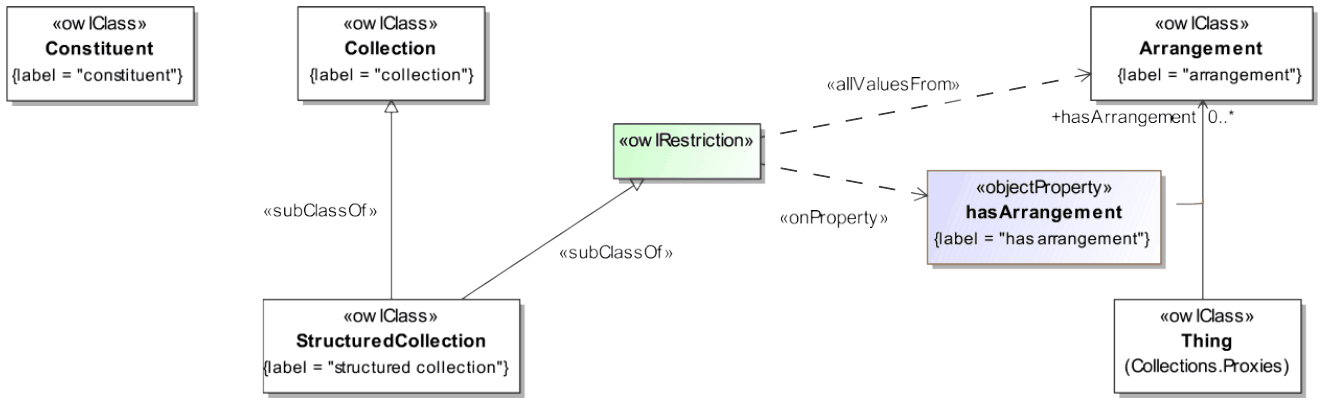
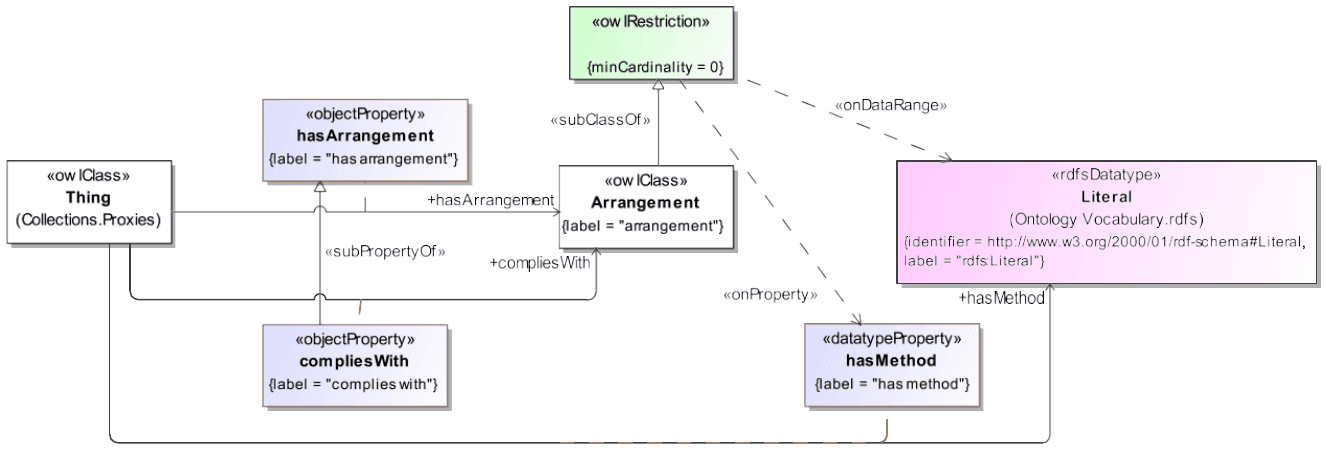
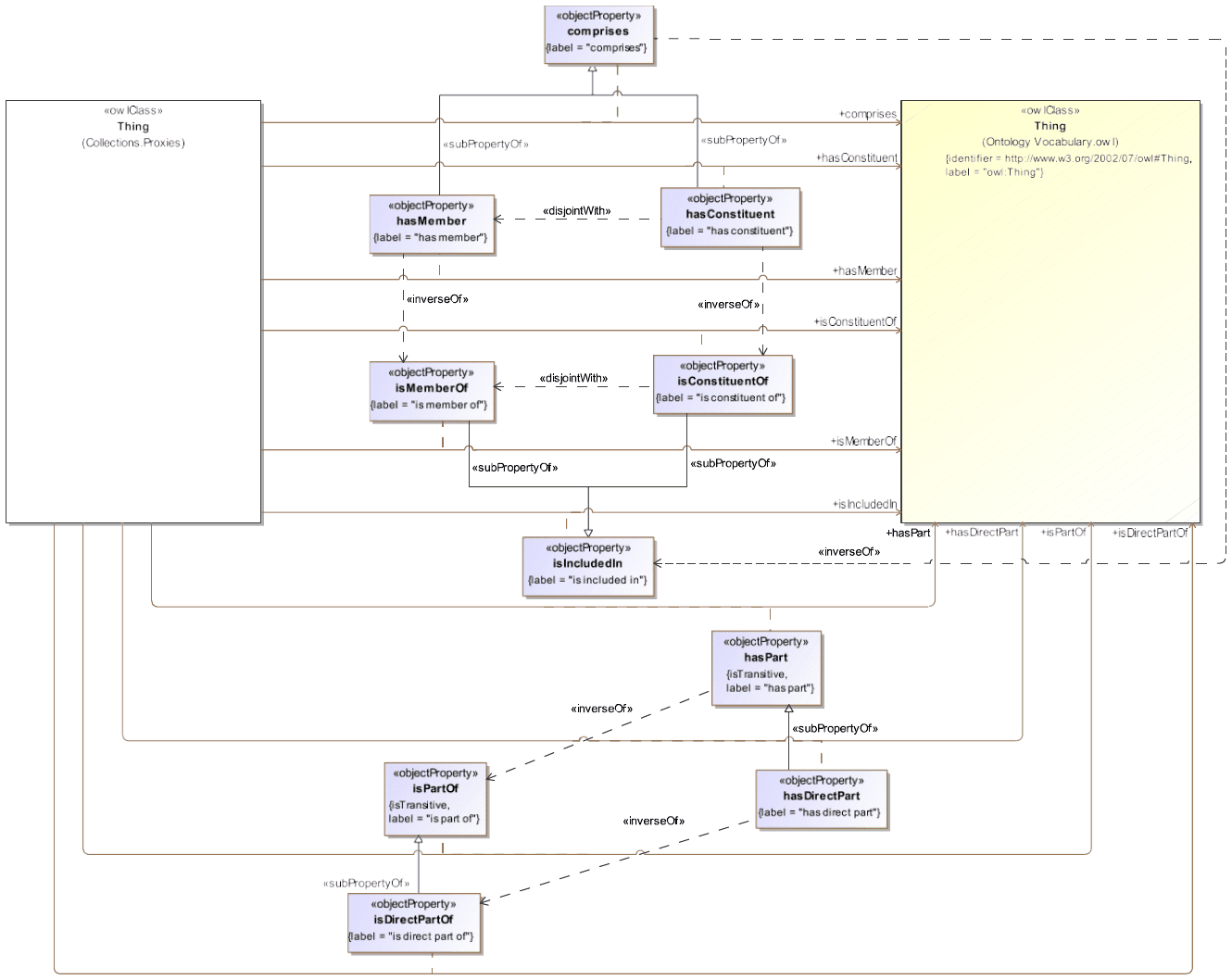
The detailed annotations and axioms that comprise the Commons Collections Ontology are provided in Commons Collections Ontology Details, below.
Classes
| Name | Annotations | Class Expressions |
|---|---|---|
|
Arrangement (arrangement) |
Definition: systematic plan, manner, or method for making, doing, achieving, or organizing something Example: Examples include designs, schema, models, methodologies, alphabetical or numeric ordering, and the like. |
Property Restriction: ≥ 0 hasMethod |
|
Collection (collection) |
Definition: grouping of things (may be zero) that have some shared significance Usage note: Users should use either comprises or hasPart, or one of their respective subproperties, to include things in a collection. |
|
|
Constituent (constituent) |
Definition: component of a collection or combination of things Usage note: Users should use either isIncludedIn or isPartOf, or one of their respective subproperties, to include a constituent in a collection. |
|
|
StructuredCollection (structured collection) |
Definition: collection that has a clearly defined structure or organization Example: Examples include collections organized thematically, alphabetically, by method used to develop them, according to time and/or version, or based on encoding schemes such as the Dewey Decimal System or Library of Congress Subject Headings. Usage note: Users should use the hasMethod property on arrangement to describe the methodology for structuring the collection. |
Parent Class: Collection Property Restriction: ∀ hasArrangement.Arrangement |
Properties
| Name | Annotations | Property Axioms |
|---|---|---|
|
compliesWith (complies with) |
Definition: adheres to policies or rules specified in |
Parent Property: hasArrangement Range: Arrangement |
|
comprises (comprises) |
Definition: includes, consists of, or contains, especially within a particular scope Note: Note that something can be comprised of something(s) that may or may not be understood as separable parts. In other words, comprises does not imply countability or uniqueness. Whole-part relations are transitive, whereas comprises is not defined to be transitive, so this property is useful in cases where cardinality constraints are needed. comprises and hasPart are not explicitly declared as disjoint to avoid reasoning issues, but should be considered as such. |
|
|
hasArrangement (has arrangement) |
Definition: is structured or organized according to |
Range: Arrangement |
|
hasConstituent (has constituent) |
Definition: consists of or contains Usage note: This property is disjoint with hasMember, and should be used in cases where the constituents of something are not considered discrete elements of whatever they are included in, such as a substance or composite. |
Parent Property: comprises Property Axiom: ¬ hasMember |
|
hasDirectPart (has direct part) |
Definition: indicates an immediate 'child' part of something Usage note: This property is useful in cases where one is interested in the direct relationships between parts of things, for example to build a tree view. |
Parent Property: hasPart |
|
hasMember (has member) |
Definition: includes, as a discrete element Note: Note that the domain of hasMember should be some sort of collection, aggregate, or group. In the Financial Industry Business Ontology (FIBO), hasMember is used in the case of parties (people and organizations), whereas comprises can have anything in its range. |
Parent Property: comprises |
|
hasMethod (has method) |
Definition: provides a text description of an approach or method used to accomplish something Example: This property can be used to describe an arrangement or ordering applied to a collection. |
Parent Property: cmns-txt:hasTextValue |
|
hasPart (has part) |
Definition: indicates any portion of something, regardless of whether the portion itself is attached to the remainder or detached; cognitively salient or arbitrarily demarcated; self-connected or disconnected; homogeneous or gerrymandered; material or immaterial; extended or unextended; spatial or temporal Note: Note that 'has part' is not a subproperty of 'comprises' in order to enable transitivity for whole-part relationships without limiting the use of cardinality constraints on comprises and membership. Source: Stanford Encyclopedia of Philosophy at http://plato.stanford.edu/entries/mereology/ |
Type: owl:TransitiveProperty |
|
isConstituentOf (is constituent of) |
Definition: is a component of something else |
Parent Property: isIncludedIn Inverse: hasConstituent Property Axiom: ¬ isMemberOf |
|
isDirectPartOf (is direct part of) |
Definition: indicates an immediate 'parent' of this part Usage note: This property is useful in cases where one is interested in the direct relationships between parts of things, for example to build a tree view. |
Parent Property: isPartOf Inverse: hasDirectPart |
|
isIncludedIn (is included in) |
Definition: is contained in or an element of Note: Something that is included in something else may be an independently identifiable, discrete element or may be an indistinguishable element once it is combined with the target. |
Inverse: comprises |
|
isMemberOf (is member of) |
Definition: is a discrete element of |
Parent Property: isIncludedIn Inverse: hasMember |
|
isPartOf (is part of) |
Definition: relates something to another thing that it is some component or portion of, regardless of how that whole-part relationship is manifested Note: Note that 'is part of' is not a subproperty of 'isIncludedIn' in order to enable transitivity for whole-part relationships without limiting the use of cardinality constraints on inclusion and membership. Source: Stanford Encyclopedia of Philosophy at http://plato.stanford.edu/entries/mereology/ |
Type: owl:TransitiveProperty Inverse: hasPart |