
Commons Dates and Times Ontology
OMG GraphArch rendering of the Commons 1.3 formal specification
- Copyright © 2024-2025, Adaptive Analytics, Inc.
- Copyright © 2022-2025, agnos.ai U.K. Ltd.
- Copyright © 2024-2025, Airbus Group
- Copyright © 2024-2025, Boeing
- Copyright © 2024-2025, Dassault Systèmes
- Copyright © 2024-2025, DEKonsult
- Copyright © 2022-2026, EDM Council, Inc. d/b/a EDM Association
- Copyright © 2024-2025, 88Solutions
- Copyright © 2022-2025, Federated Knowledge, LLC
- Copyright © 2024-2025, GfSE e.V.
- Copyright © 2024-2025, Mayo Clinic
- Copyright © 2022-2025, OntoAge
- Copyright © 2024-2025, Ontogenesis Solutions, LLC
- Copyright © 2023-2025, Pistoia Alliance
- Copyright © 2024-2025, ProSTEP iViP Association
- Copyright © 2024-2025, Raytheon Technologies
- Copyright © 2022, QuoteWell, Inc.
- Copyright © 2024-2025, Sparx Systems Pty Ltd
- Copyright © 2022-2025, Stardog Union
- Copyright © 2022-2025, Thematix Partners LLC
- Copyright © 2022-2025, University of North Florida
- Copyright © 2022-2025, Working Ontologist
- Copyright © 2022-2026, Object Management Group, Inc.
USE OF SPECIFICATION – TERMS, CONDITIONS & NOTICES
The material in this document details an Object Management Group specification in accordance with the terms, conditions and notices set forth below. This document does not represent a commitment to implement any portion of this specification in any company's products. The information contained in this document is subject to change without notice.
LICENSES
The companies listed above have granted to the Object Management Group, Inc. (OMG) a nonexclusive, royalty-free, paid up, worldwide license to copy and distribute this document and to modify this document and distribute copies of the modified version. Each of the copyright holders listed above has agreed that no person shall be deemed to have infringed the copyright in the included material of any such copyright holder by reason of having used the specification set forth herein or having conformed any computer software to the specification.
Subject to all of the terms and conditions below, the owners of the copyright in this specification hereby grant you a fully-paid up, non-exclusive, nontransferable, perpetual, worldwide license (without the right to sublicense), to use this specification to create and distribute software and special purpose specifications that are based upon this specification, and to use, copy, and distribute this specification as provided under the Copyright Act; provided that: (1) both the copyright notice identified above and this permission notice appear on any copies of this specification; (2) the use of the specifications is for informational purposes and will not be copied or posted on any network computer or broadcast in any media and will not be otherwise resold or transferred for commercial purposes; and (3) no modifications are made to this specification. This limited permission automatically terminates without notice if you breach any of these terms or conditions. Upon termination, you will destroy immediately any copies of the specifications in your possession or control.
PATENTS
The attention of adopters is directed to the possibility that compliance with or adoption of OMG specifications may require use of an invention covered by patent rights. OMG shall not be responsible for identifying patents for which a license may be required by any OMG specification, or for conducting legal inquiries into the legal validity or scope of those patents that are brought to its attention. OMG specifications are prospective and advisory only. Prospective users are responsible for protecting themselves against liability for infringement of patents.
GENERAL USE RESTRICTIONS
Any unauthorized use of this specification may violate copyright laws, trademark laws, and communications regulations and statutes. This document contains information which is protected by copyright. All Rights Reserved. No part of this work covered by copyright herein may be reproduced or used in any form or by any means--graphic, electronic, or mechanical, including photocopying, recording, taping, or information storage and retrieval systems--without permission of the copyright owner.
DISCLAIMER OF WARRANTY
WHILE THIS PUBLICATION IS BELIEVED TO BE ACCURATE, IT IS PROVIDED "AS IS" AND MAY CONTAIN ERRORS OR MISPRINTS. THE OBJECT MANAGEMENT GROUP AND THE COMPANIES LISTED ABOVE MAKE NO WARRANTY OF ANY KIND, EXPRESS OR IMPLIED, WITH REGARD TO THIS PUBLICATION, INCLUDING BUT NOT LIMITED TO ANY WARRANTY OF TITLE OR OWNERSHIP, IMPLIED WARRANTY OF MERCHANTABILITY OR WARRANTY OF FITNESS FOR A PARTICULAR PURPOSE OR USE. IN NO EVENT SHALL THE OBJECT MANAGEMENT GROUP OR ANY OF THE COMPANIES LISTED ABOVE BE LIABLE FOR ERRORS CONTAINED HEREIN OR FOR DIRECT, INDIRECT, INCIDENTAL, SPECIAL, CONSEQUENTIAL, RELIANCE OR COVER DAMAGES, INCLUDING LOSS OF PROFITS, REVENUE, DATA OR USE, INCURRED BY ANY USER OR ANY THIRD PARTY IN CONNECTION WITH THE FURNISHING, PERFORMANCE, OR USE OF THIS MATERIAL, EVEN IF ADVISED OF THE POSSIBILITY OF SUCH DAMAGES.
The entire risk as to the quality and performance of software developed using this specification is borne by you. This disclaimer of warranty constitutes an essential part of the license granted to you to use this specification.
RESTRICTED RIGHTS LEGEND
Use, duplication or disclosure by the U.S. Government is subject to the restrictions set forth in subparagraph (c) (1) (ii) of The Rights in Technical Data and Computer Software Clause at DFARS 252.227-7013 or in subparagraph (c)(1) and (2) of the Commercial Computer Software - Restricted Rights clauses at 48 C.F.R. 52.227-19 or as specified in 48 C.F.R. 227-7202-2 of the DoD F.A.R. Supplement and its successors, or as specified in 48 C.F.R. 12.212 of the Federal Acquisition Regulations and its successors, as applicable. The specification copyright owners are as indicated above and may be contacted through the Object Management Group, 9C Medway Road, PMB 274, Milford, MA 01757, U.S.A.
TRADEMARKS
CORBA®, CORBA logos®, FIBO®, Financial Industry Business Ontology®, FINANCIAL INSTRUMENT GLOBAL IDENTIFIER®, IIOP®, IMM®, Model Driven Architecture®, MDA®, Object Management Group®, OMG®, OMG Logo®, SoaML®, SOAML®, SysML®, UAF®, Unified Modeling Language®, UML®, UML Cube Logo®, VSIPL®, and XMI® are registered trademarks of the Object Management Group, Inc.
For a complete list of trademarks, see: https://www.omg.org/legal/tm_list.htm. All other products or company names mentioned are used for identification purposes only, and may be trademarks of their respective owners.
COMPLIANCE
The copyright holders listed above acknowledge that the Object Management Group (acting itself or through its designees) is and shall at all times be the sole entity that may authorize developers, suppliers and sellers of computer software to use certification marks, trademarks or other special designations to indicate compliance with these materials.
Software developed under the terms of this license may claim compliance or conformance with this specification if and only if the software compliance is of a nature fully matching the applicable compliance points as stated in the specification. Software developed only partially matching the applicable compliance points may claim only that the software was based on this specification but may not claim compliance or conformance with this specification. In the event that testing suites are implemented or approved by Object Management Group, Inc., software developed using this specification may claim compliance or conformance with the specification only if the software satisfactorily completes the testing suites.
OMG’s Issue Reporting Procedure
All OMG specifications are subject to continuous review and improvement. As part of this process, we encourage readers to report any ambiguities, inconsistencies, or inaccuracies they may find by completing the Issue Reporting Form listed on the main web page https://www.omg.org, under Specifications, Report a Bug/Issue (https://issues.omg.org/issues/create-new-issue).
1. Commons Dates and Times Ontology§
The dates and times ontology defines commonly used temporal concepts that cover those most frequently needed across domains, with a focus on terminology that is used in business applications. It is designed to be mappable to other date and time ontologies and specifications, such as the W3C Time Ontology in OWL (available at https://www.w3.org/TR/owl-time/), certain temporal elements in BFO 2020 (see https://basic-formal-ontology.org/bfo-2020.html), time concepts defined in schema.org, and the Object Management Group's Date Time Vocabulary (DTV) specification (available at https://www.omg.org/spec/DTV/), without the corresponding overhead or in some cases, issues. The concepts were originally derived from a number of date and time standards including ISO 8601:2004 Representation of Dates and Times. The ontology itself was derived from the Financial Industry Business Ontology (FIBO) Financial Dates ontology, with minor revisions to better reflect requirements for mapping to other ontologies.
Metadata for the Commons Dates and Times Ontology is given in Commons Dates and Times Ontology Metadata.
| Metadata Term | Value |
|---|---|
|
Ontology IRI |
|
|
|
Commons Dates and Times Ontology |
|
|
The dates and times ontology defines commonly used temporal concepts that cover those most frequently needed across domains, with a focus on terminology that is used in business applications. It is designed to be mappable to other date and time ontologies and specifications, such as the W3C Time Ontology in OWL (available at https://www.w3.org/TR/owl-time/), certain temporal elements in BFO 2020 (see https://basic-formal-ontology.org/bfo-2020.html), time concepts defined in schema.org, and the Object Management Group's Date Time Vocabulary (DTV) specification (available at https://www.omg.org/spec/DTV/), without the corresponding overhead or in some cases, issues. The concepts were originally derived from a number of date and time standards including ISO 8601:2004 Representation of Dates and Times. The ontology itself was derived from the Financial Industry Business Ontology (FIBO) Financial Dates ontology, with minor revisions to better reflect requirements for mapping to other ontologies. |
|
|
Elisa Kendall, Thematix Partners LLC |
|
|
Mark Linehan, Thematix Partners LLC |
|
|
Pete Rivett, Federated Knowledge LLC |
|
|
Copyright (c) 2014-2025 EDM Council, Inc. |
|
|
Copyright (c) 2014-2025 Object Management Group, Inc. |
|
|
Copyright (c) 2014-2025 Thematix Partners LLC |
|
|
Copyright (c) 2021-2025 agnos.ai U.K. Ltd |
|
|
Copyright (c) 2023-2025 Federated Knowledge LLC |
|
|
Copyright (c) 2014-2025 EDM Council, Inc. Permission is hereby granted, free of charge, to any person obtaining a copy of this software and associated documentation files (the 'Software'), to deal in the Software without restriction, including without limitation the rights to use, copy, modify, merge, publish, distribute, sublicense, and/or sell copies of the Software, and to permit persons to whom the Software is furnished to do so, subject to the following conditions: The above copyright notice and this permission notice shall be included in all copies or substantial portions of the Software. THE SOFTWARE IS PROVIDED 'AS IS', WITHOUT WARRANTY OF ANY KIND, EXPRESS OR IMPLIED, INCLUDING BUT NOT LIMITED TO THE WARRANTIES OF MERCHANTABILITY, FITNESS FOR A PARTICULAR PURPOSE AND NONINFRINGEMENT. IN NO EVENT SHALL THE AUTHORS OR COPYRIGHT HOLDERS BE LIABLE FOR ANY CLAIM, DAMAGES OR OTHER LIABILITY, WHETHER IN AN ACTION OF CONTRACT, TORT OR OTHERWISE, ARISING FROM, OUT OF OR IN CONNECTION WITH THE SOFTWARE OR THE USE OR OTHER DEALINGS IN THE SOFTWARE. See https://opensource.org/licenses/MIT. |
|
|
|
|
|
The dates and times ontology conforms with the OWL 2 DL semantics, and is outside of OWL 2 RL due to the inclusion of exact cardinality constraints on explicit date, explicit duration and time of day. These constraints can be changed to maximum cardinality constraints if needed to support OWL RL rule-based applications that cannot be extended to support them. |
|
|
https://www.omg.org/spec/Commons/20220501/DatesAndTimes.rdf version of this ontology was modified to eliminate a double space in the scope note on CombinedDateTime (COMMONS-6). |
|
|
https://www.omg.org/spec/Commons/20221101/DatesAndTimes.rdf version of this ontology was revised to add properties supporting start and end time and related concepts (COMMONS-11-8). |
|
|
https://www.omg.org/spec/Commons/20230801/DatesAndTimes.rdf version of this ontology was revised to correct an annotation on DateTime (COMMONS-13-20) and to revise the notes on DatePeriod to allow for cases where a date period, such as 5 days, is known but the start and end of that period are not known (COMMONS-13-19). |
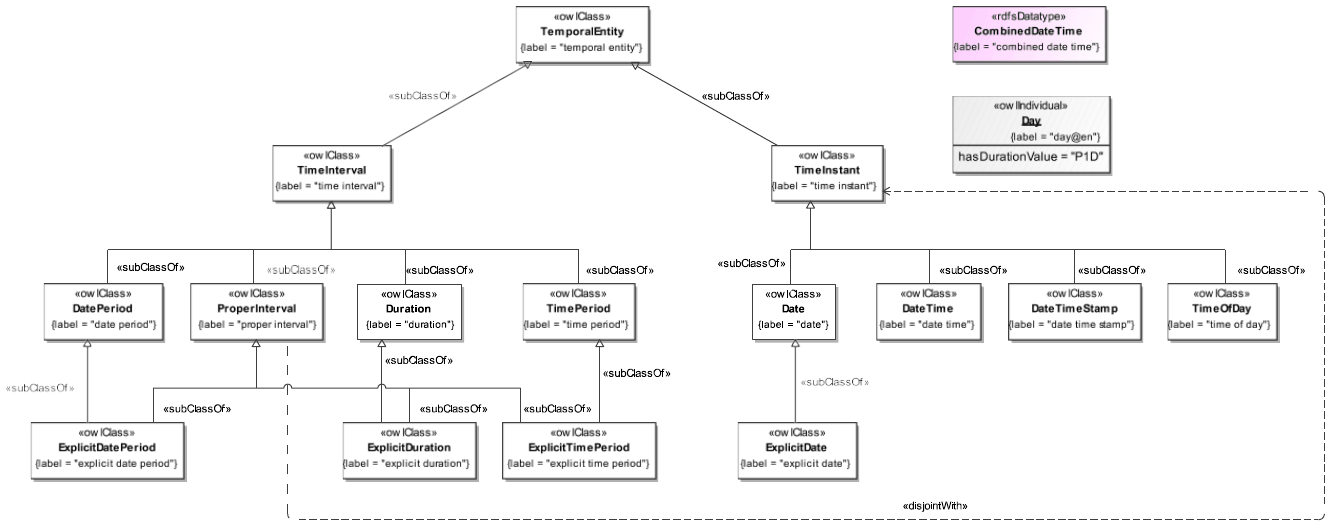
The detailed annotations and axioms that comprise the Commons Dates and Times Ontology are provided in Commons Dates and Times Ontology Details, below.
Classes
| Name | Annotations | Class Expressions |
|---|---|---|
|
Date (date) |
Definition: calendar day on some calendar Note: A date may or may not have a value, and may be explicit or calculated. A date that has a value is one that is either explicitly set as a literal when it is created, or is some form of 'calculated date'. In an instance of date, the existence of the 'has date value' property both indicates that the date is known, and gives the value of the date. A date that does not have a value is likely one that is some form of 'calculated date, in which the actual date has not (yet) been established. |
Parent Class: TimeInstant Property Restriction: ≤ 1 hasDateValue.xsd:string |
|
DatePeriod (date period) |
Definition: time span over one or more calendar days Note: A date period is considered unknown or incomplete if either the start date or the end date has no value. There may be cases, however, when the length of time is known, such as a 4-day work week, but the precise start and end of that week are not known. Note: A date period is typically defined by at least two of three properties: (1) a start date, (2) an end date, and (3) a duration. If more than one of these properties is missing, the date period may be invalid, incomplete, or unknown. |
Parent Class: TimeInterval Property Restriction: ≤ 1 hasStartDate.Date Property Restriction: ≤ 1 hasEndDate.Date Property Restriction: ≤ 1 hasDuration.Duration |
|
DateTime (date time) |
Definition: time point including a date and a time, optionally including a time zone offset Note: 'has date time value' is omitted if the 'date time' is not (yet) known. The time zone is implicitly UTC. |
Parent Class: TimeInstant Property Restriction: ≤ 1 hasDateTimeValue.xsd:dateTime |
|
DateTimeStamp (date time stamp) |
Definition: time point including a date and a time that requires a time zone offset Synonym: time stamp Note: 'has date time stamp value' is omitted if the 'date time stamp' is not (yet) established. |
Parent Class: TimeInstant Property Restriction: ≤ 1 hasDateTimeStampValue.xsd:dateTimeStamp |
|
Duration (duration) |
Definition: interval of time of some specific length Note: The 'has duration value' property is absent if the duration is not (yet) known. |
Parent Class: TimeInterval Property Restriction: ≤ 1 hasDurationValue.xsd:string |
|
ExplicitDate (explicit date) |
Definition: date in which the 'has date value' property is required |
Parent Class: Date Property Restriction: = 1 hasDateValue.xsd:string |
|
ExplicitDatePeriod (explicit date period) |
Definition: date period for which the start date, end date, and/or duration are required Note: As with 'date period', any one of {start date, end date, duration} may be omitted because the missing property can be inferred from the other two. |
Parent Class: DatePeriod, ProperInterval Property Restriction: ≤ 1 hasStartDate.ExplicitDate Property Restriction: ≤ 1 hasDuration.ExplicitDuration Property Restriction: ≤ 1 hasEndDate.ExplicitDate |
|
ExplicitDuration (explicit duration) |
Definition: duration for which the 'has duration value' property must have a value Note: This class is used when a duration is guaranteed to be known when it is created. |
Parent Class: Duration, ProperInterval Property Restriction: = 1 hasDurationValue.xsd:string |
|
ExplicitTimePeriod (explicit time period) |
Definition: time period for which the starting time, ending time, and/or duration are required Note: As with 'time period', any one of {start time, end time, duration} may be omitted because the missing property can be inferred from the other two. |
Parent Class: ProperInterval, TimePeriod Property Restriction: ≤ 1 hasDuration.ExplicitDuration Property Restriction: ≤ 1 hasStartTime.TimeOfDay Property Restriction: ≤ 1 hasEndTime.TimeOfDay |
|
ProperInterval (proper interval) |
Definition: time interval with a non-zero extent or duration Note: Proper interval is included explicitly to enable mapping to the same term in the Time Ontology in OWL for use with the Allen intervals encoded therein. Source: https://www.w3.org/TR/owl-time/#time:ProperInterval |
Parent Class: TimeInterval Class Axiom: ¬ TimeInstant |
|
TemporalEntity (temporal entity) |
Definition: time interval or instant See also: time:TemporalEntity |
|
|
TimeInstant (time instant) |
Definition: temporal entity that is a member of a time scale, with no extent or duration Synonym: instant in time Synonym: time point Example: The Battle of Hastings was on '14 October 1066'. (This gives the Julian date of the battle at a granularity of 'day'. If desired, the battle could be given more precisely as a time period within that calendar day.) Note: For scales that have a granularity specified in days, a date is a time point; for scales down to the seconds, the equivalent of an xsd:dateTime or xsd:dateTimeStamp is a time point. Note: The duration of each time interval that is an instance of the time point is the granularity of the time scale of the time point. Adapted from: https://www.omg.org/spec/DTV/ Adapted from: https://www.w3.org/TR/owl-time/#time:Instant |
Parent Class: TemporalEntity |
|
TimeInterval (time interval) |
Definition: segment of the time axis, a location in time, with an extent or duration Example: the day whose Gregorian calendar date is September 11, 2001 Example: the lifetime of Henry V Note: Every time interval has a beginning, an end, and a duration, even if not known. Every time interval is 'finite', a bounded segment of the time axis. The beginning or end of a time interval may be defined by reference to events that occur for a time interval that is not known. Note: Time intervals may be indefinite, meaning that their beginning is primordiality or their end is perpetuity, or both (eternity). This vocabulary assumes that indefinite time intervals exist and have some duration, but their duration is unknown. Adapted from: https://www.omg.org/spec/DTV/ Adapted from: https://www.w3.org/TR/owl-time/#time:Interval |
Parent Class: TemporalEntity |
|
TimeOfDay (time of day) |
Definition: explicit time, according to a clock Note: The representation similar to xsd:dateTime, but should exclude the date component and time zone. The value of the has time value property roughly corresponds to xsd:time in XML schema datatypes, which is prohibited from use in OWL due to ambiguity in its definition. |
Parent Class: TimeInstant Property Restriction: = 1 hasTimeValue.xsd:string |
|
TimePeriod (time period) |
Definition: time span over some finite window Note: A time period is defined by at least two of three properties: (1) a start time, (2) an end time, and (3) a duration. If more than one of these properties is missing, the time period may be invalid or unknown. Note: A time period is unknown if either the starting or ending time has no value. If a time period is unknown, then the duration should either be omitted or unknown (have no value). |
Parent Class: TimeInterval Property Restriction: ≤ 1 hasDuration.Duration Property Restriction: ≤ 1 hasStartTime.TimeOfDay Property Restriction: ≤ 1 hasEndTime.TimeOfDay |
Datatypes
| Name | Annotations | Class Expressions |
|---|---|---|
|
CombinedDateTime (combined date time) |
Definition: datatype that maps to several base types for dates and times Note: Valid values must use the ISO 8601 representation for a date, or the corresponding XML Schema Datatypes representation for a date and time, or date and time including the time zone. Scope note: There are many cases where the representation of a date may or may not include a time, and where the underlying data representation varies. This composite datatype should only be used in cases where a standard representation using one of the options in the union for date or date and time value specification does not work. |
Equivalent Datatype: xsd:string ⊔ xsd:dateTime ⊔ xsd:dateTimeStamp |
Individuals
| Name | Annotations | Individual Axioms |
|---|---|---|
|
Day (day@en) |
Definition: explicit period of 24 hours |
Type: ExplicitDuration hasDurationValue = "P1D" |
Properties
| Name | Annotations | Property Axioms |
|---|---|---|
|
hasDate (has date) |
Definition: identifies a calendar day, month and year |
Parent Property: hasTime Range: Date |
|
hasDateOfIssuance (has date of issuance) |
Definition: links something, such as an agreement, contract, license, or report, to the date it was made available |
Type: owl:FunctionalProperty Parent Property: hasStartDate Range: Date |
|
hasDatePeriod (has date period) |
Definition: identifies a specific window of time, including a start date, end date and/or duration |
Parent Property: hasTime Range: DatePeriod |
|
hasDateTime (has date time) |
Definition: identifies a specific date and time of day, possibly excluding the time zone |
Parent Property: hasTime Range: DateTime |
|
hasDateTimeStamp (has date time stamp) |
Definition: identifies a specific date and time of day, explicitly including the time zone |
Parent Property: hasTime Range: DateTimeStamp |
|
hasDateTimeStampValue (has date time stamp value) |
Definition: specifies an actual literal (explicit) date and time, including the time zone |
Range: xsd:dateTimeStamp |
|
hasDateTimeValue (has date time value) |
Definition: specifies an actual literal (explicit) date and time |
Range: xsd:dateTime |
|
hasDateValue (has date value) |
Definition: specifies an actual literal (explicit) date captured in the format specified for xsd:date (i.e., ISO 8601 format), WITHOUT the time or timezone information; the semantics are identical to those of xsd:date Example: 2002-10-10 means October 10, 2002 Note: In the Finance domain, for consistency with FpML (reference FpML Coding Schemes 30 June 2014, Version 1.56, section 2.1.1), the year MUST be specified as 4 digits, and the month and day MUST be specified as 2 digits with a leading zero if needed. Times and timezones should NOT be specified. |
Range: xsd:string |
|
hasDuration (has duration) |
Definition: specifies the time during which something continues Note: This duration may be omitted or unknown if either the start or end Date of the DatePeriod is an ExplicitDate. |
Parent Property: hasTime Range: Duration |
|
hasDurationValue (has duration value) |
Definition: specifies a literal (explicit) duration (amount of time) captured in the format specified for xsd:duration (i.e., ISO 8601 format); the semantics are identical to those of xsd:duration Example: -P3D means negative 3 days duration. This is used with OffsetDates to specify 3 days before (prior) to some other Date. Example: P1Y means 1 year Example: P1Y2M3DT4H5M6S means 1 year, 2 months, 3 days, 4 hours, 5 minutes, 6 seconds Example: P2M means 2 months Example: P3D means 3 days Example: PT4H means 4 hours Example: PT5M means 5 minutes Example: PT6S means 6 seconds Note: Negative durations are used to indicate relative dates that are before (rather than after) some other Date. |
Domain: Duration Range: xsd:string |
|
hasEnd (has end) |
Definition: indicates the final or ending time point associated with something |
Parent Property: hasTime Range: TimeInstant |
|
hasEndDate (has end date) |
Definition: indicates the final or ending date associated with something |
Parent Property: hasDate, hasEnd Range: Date |
|
hasEndTime (has end time) |
Definition: indicates the final or ending time associated with something Usage note: Use of the property 'hasTimeValue' as a property of the TimeOfDay to record the actual time, or use either the DateTime or DateTimeStamp class with the date zeroed out if the date is not relevant but with the time included. |
Parent Property: hasEnd Range: TimeOfDay |
|
hasExplicitDate (has explicit date) |
Definition: indicates a stated date, as opposed to a calculated or unknown date, associated with something |
Parent Property: hasDate Range: ExplicitDate |
|
hasObservedDateTime (has observed date and time) |
Definition: indicates a date and time associated with an event, measurement, record, or observation |
Range: CombinedDateTime |
|
hasStart (has start) |
Definition: indicates the initial time point associated with something |
Parent Property: hasTime Range: TimeInstant |
|
hasStartDate (has start date) |
Definition: indicates the initial date associated with something |
Parent Property: hasDate, hasStart Range: Date |
|
hasStartTime (has start time) |
Definition: indicates the initial or starting time associated with something Usage note: Use of the property 'hasTimeValue' as a property of the TimeOfDay to record the actual time, or use either the DateTime or DateTimeStamp class with the date zeroed out if the date is not relevant but with the time included. |
Parent Property: hasStart Range: TimeOfDay |
|
hasTime (has time) |
Definition: specifies a general time that can be associated with any element Note: This property corresponds to the property of the same name in the W3C Time Ontology, and can be used to support mapping. |
Range: TemporalEntity |
|
hasTimePeriod (has time period) |
Definition: identifies a specific window of time, including a starting time, ending time and/or duration |
Parent Property: hasTime Range: TimePeriod |
|
hasTimeValue (has time value) |
Definition: specifies an explicit time, captured in the format specified for xsd:time (i.e., ISO 8601 format), WITHOUT the date or timezone information |
Range: xsd:string |
|
precedes (precedes) |
Definition: associates based on prior spatial or temporal proximity; occurs before in a logical order or sequence Source: ISO 1087 Terminology work and terminology science - Vocabulary, Second edition, 2019-09, clause 3.2.24 |
|
|
succeeds (succeeds) |
Definition: associates based on subsequent spatial or temporal proximity; follows in a logical order or sequence Source: ISO 1087 Terminology work and terminology science - Vocabulary, Second edition, 2019-09, clause 3.2.24 |
Inverse: precedes |