
Examples
OMG GraphArch rendering of the Commons 1.3 formal specification
- Copyright © 2024-2025, Adaptive Analytics, Inc.
- Copyright © 2022-2025, agnos.ai U.K. Ltd.
- Copyright © 2024-2025, Airbus Group
- Copyright © 2024-2025, Boeing
- Copyright © 2024-2025, Dassault Systèmes
- Copyright © 2024-2025, DEKonsult
- Copyright © 2022-2026, EDM Council, Inc. d/b/a EDM Association
- Copyright © 2024-2025, 88Solutions
- Copyright © 2022-2025, Federated Knowledge, LLC
- Copyright © 2024-2025, GfSE e.V.
- Copyright © 2024-2025, Mayo Clinic
- Copyright © 2022-2025, OntoAge
- Copyright © 2024-2025, Ontogenesis Solutions, LLC
- Copyright © 2023-2025, Pistoia Alliance
- Copyright © 2024-2025, ProSTEP iViP Association
- Copyright © 2024-2025, Raytheon Technologies
- Copyright © 2022, QuoteWell, Inc.
- Copyright © 2024-2025, Sparx Systems Pty Ltd
- Copyright © 2022-2025, Stardog Union
- Copyright © 2022-2025, Thematix Partners LLC
- Copyright © 2022-2025, University of North Florida
- Copyright © 2022-2025, Working Ontologist
- Copyright © 2022-2026, Object Management Group, Inc.
USE OF SPECIFICATION – TERMS, CONDITIONS & NOTICES
The material in this document details an Object Management Group specification in accordance with the terms, conditions and notices set forth below. This document does not represent a commitment to implement any portion of this specification in any company's products. The information contained in this document is subject to change without notice.
LICENSES
The companies listed above have granted to the Object Management Group, Inc. (OMG) a nonexclusive, royalty-free, paid up, worldwide license to copy and distribute this document and to modify this document and distribute copies of the modified version. Each of the copyright holders listed above has agreed that no person shall be deemed to have infringed the copyright in the included material of any such copyright holder by reason of having used the specification set forth herein or having conformed any computer software to the specification.
Subject to all of the terms and conditions below, the owners of the copyright in this specification hereby grant you a fully-paid up, non-exclusive, nontransferable, perpetual, worldwide license (without the right to sublicense), to use this specification to create and distribute software and special purpose specifications that are based upon this specification, and to use, copy, and distribute this specification as provided under the Copyright Act; provided that: (1) both the copyright notice identified above and this permission notice appear on any copies of this specification; (2) the use of the specifications is for informational purposes and will not be copied or posted on any network computer or broadcast in any media and will not be otherwise resold or transferred for commercial purposes; and (3) no modifications are made to this specification. This limited permission automatically terminates without notice if you breach any of these terms or conditions. Upon termination, you will destroy immediately any copies of the specifications in your possession or control.
PATENTS
The attention of adopters is directed to the possibility that compliance with or adoption of OMG specifications may require use of an invention covered by patent rights. OMG shall not be responsible for identifying patents for which a license may be required by any OMG specification, or for conducting legal inquiries into the legal validity or scope of those patents that are brought to its attention. OMG specifications are prospective and advisory only. Prospective users are responsible for protecting themselves against liability for infringement of patents.
GENERAL USE RESTRICTIONS
Any unauthorized use of this specification may violate copyright laws, trademark laws, and communications regulations and statutes. This document contains information which is protected by copyright. All Rights Reserved. No part of this work covered by copyright herein may be reproduced or used in any form or by any means--graphic, electronic, or mechanical, including photocopying, recording, taping, or information storage and retrieval systems--without permission of the copyright owner.
DISCLAIMER OF WARRANTY
WHILE THIS PUBLICATION IS BELIEVED TO BE ACCURATE, IT IS PROVIDED "AS IS" AND MAY CONTAIN ERRORS OR MISPRINTS. THE OBJECT MANAGEMENT GROUP AND THE COMPANIES LISTED ABOVE MAKE NO WARRANTY OF ANY KIND, EXPRESS OR IMPLIED, WITH REGARD TO THIS PUBLICATION, INCLUDING BUT NOT LIMITED TO ANY WARRANTY OF TITLE OR OWNERSHIP, IMPLIED WARRANTY OF MERCHANTABILITY OR WARRANTY OF FITNESS FOR A PARTICULAR PURPOSE OR USE. IN NO EVENT SHALL THE OBJECT MANAGEMENT GROUP OR ANY OF THE COMPANIES LISTED ABOVE BE LIABLE FOR ERRORS CONTAINED HEREIN OR FOR DIRECT, INDIRECT, INCIDENTAL, SPECIAL, CONSEQUENTIAL, RELIANCE OR COVER DAMAGES, INCLUDING LOSS OF PROFITS, REVENUE, DATA OR USE, INCURRED BY ANY USER OR ANY THIRD PARTY IN CONNECTION WITH THE FURNISHING, PERFORMANCE, OR USE OF THIS MATERIAL, EVEN IF ADVISED OF THE POSSIBILITY OF SUCH DAMAGES.
The entire risk as to the quality and performance of software developed using this specification is borne by you. This disclaimer of warranty constitutes an essential part of the license granted to you to use this specification.
RESTRICTED RIGHTS LEGEND
Use, duplication or disclosure by the U.S. Government is subject to the restrictions set forth in subparagraph (c) (1) (ii) of The Rights in Technical Data and Computer Software Clause at DFARS 252.227-7013 or in subparagraph (c)(1) and (2) of the Commercial Computer Software - Restricted Rights clauses at 48 C.F.R. 52.227-19 or as specified in 48 C.F.R. 227-7202-2 of the DoD F.A.R. Supplement and its successors, or as specified in 48 C.F.R. 12.212 of the Federal Acquisition Regulations and its successors, as applicable. The specification copyright owners are as indicated above and may be contacted through the Object Management Group, 9C Medway Road, PMB 274, Milford, MA 01757, U.S.A.
TRADEMARKS
CORBA®, CORBA logos®, FIBO®, Financial Industry Business Ontology®, FINANCIAL INSTRUMENT GLOBAL IDENTIFIER®, IIOP®, IMM®, Model Driven Architecture®, MDA®, Object Management Group®, OMG®, OMG Logo®, SoaML®, SOAML®, SysML®, UAF®, Unified Modeling Language®, UML®, UML Cube Logo®, VSIPL®, and XMI® are registered trademarks of the Object Management Group, Inc.
For a complete list of trademarks, see: https://www.omg.org/legal/tm_list.htm. All other products or company names mentioned are used for identification purposes only, and may be trademarks of their respective owners.
COMPLIANCE
The copyright holders listed above acknowledge that the Object Management Group (acting itself or through its designees) is and shall at all times be the sole entity that may authorize developers, suppliers and sellers of computer software to use certification marks, trademarks or other special designations to indicate compliance with these materials.
Software developed under the terms of this license may claim compliance or conformance with this specification if and only if the software compliance is of a nature fully matching the applicable compliance points as stated in the specification. Software developed only partially matching the applicable compliance points may claim only that the software was based on this specification but may not claim compliance or conformance with this specification. In the event that testing suites are implemented or approved by Object Management Group, Inc., software developed using this specification may claim compliance or conformance with the specification only if the software satisfactorily completes the testing suites.
OMG’s Issue Reporting Procedure
All OMG specifications are subject to continuous review and improvement. As part of this process, we encourage readers to report any ambiguities, inconsistencies, or inaccuracies they may find by completing the Issue Reporting Form listed on the main web page https://www.omg.org, under Specifications, Report a Bug/Issue (https://issues.omg.org/issues/create-new-issue).
A. Examples§
The ontologies included in the Commons Ontology Library leverage modeling patterns found in many data management and knowledge graph based applications. Some of these patterns are reused in more specific parts of the library, such as many of the annotation properties given in the Annotation Vocabulary. Examples for cases that are not provided in the library itself may be helpful to implementers and a number of such examples that we hope will clarify how to use the ontologies are given below.
A.1 Classifiers and Classification Schemes§
From an ontological perspective, a classification scheme is typically used to ‘put things in buckets’ – a controlled vocabulary, organizing scheme, set of categories to support faceted searching and the like. ISO/IEC 11179-3:2013 Information technology – Metadata registries (MDR) – Part 3: Registry metamodel and basic attributes1 provides a pattern for representing classification schemes and the classifiers defined in such schemes, which the ontology follows. In finance, the set of ‘asset classes’ used to classify financial instruments, such as those specified in ISO 10962, Securities and related financial instruments – Classification of financial instruments (CFI) code2, represent examples of both classifiers and codes at the same time. Another such scheme is the North American Industry Classification System (NAICS), used by federal statistical agencies in classifying business establishments for the purpose of collecting, analyzing, and publishing statistical data related to the U.S. business economy3 Recently published ISO standards for the identification of medicinal products include several classification schemes. For example, in the ISO 11238:2018 Health informatics – Identification of medicinal products – Data elements and structures for the unique identification and exchange of regulated information on substances4, taxonomic structures for classifying substances as polymers, proteins, structurally diverse substances, and mixtures are derived from biological matrices. The example that follows shows a kind of classifier for substance names, specified in the ISO 11238 standard for describing and identifying substances, and includes a controlled vocabulary of valid values. Thus, the class ‘substance name classifier’ is a subclass of ‘classifier’, and each of the valid values is modeled as a named individual whose type is ‘substance name classifier’. Note that the use of ‘min 0’ in a restriction is quite useful to show users that while the main ontology for substances does not require a value for all possible substance names it classifies, since new substances are added to various repositories on a regular basis, using inverse reasoning on individuals of type substance name for the property “is classified by” would yield that information.
<owl:Class rdf:about="&idmp-sub;SubstanceNameClassifier">
    <rdfs:subClassOf rdf:resource="&cmns-cls;Classifier"/>
    <rdfs:subClassOf>
        <owl:Restriction>
            <owl:onProperty rdf:resource="&cmns-cls;classifies"/>
            <owl:onClass rdf:resource="&idmp-sub;SubstanceName"/>
            <owl:minQualifiedCardinality
                rdf:datatype="&xsd;nonNegativeInteger">0</owl:minQualifiedCardinality>
        </owl:Restriction>
    </rdfs:subClassOf>
    <rdfs:label>substance name classifier</rdfs:label>
    <dct:source>ISO 11238:2018 Health informatics - Identification of medicinal
        products (IDMP) - Data elements and structures for the unique identification and
        exchange of regulated information on substances, clause 6.4</dct:source>
    <dct:source>ISO/TS 19844:2018(E) Health informatics - Identification of medicinal
        products (IDMP) - Implementation guidelines for ISO 11238 for data elements and
        structures for the unique identification and exchange of regulated information on
        substances, clause 6.3.2</dct:source>
    <skos:definition>classifier that describes the nature of the substance name from a
        pre-defined ISO 19844 code set</skos:definition>
    <cmns-av:synonym>substance name type</cmns-av:synonym>
</owl:Class>
Two of the named individuals that are specified in the standard and enumerated in the ISO 19844 implementation guide as a part of this scheme include:
<owl:NamedIndividual rdf:about="&idmp-sub;SubstanceNameClassifier-BrandName">
    <rdf:type rdf:resource="&idmp-sub;SubstanceNameClassifier"/>
    <rdfs:label>substance name classifier - brand name</rdfs:label>
    <dct:source>ISO 11238:2018 Health informatics - Identification of medicinal
        products (IDMP) - Data elements and structures for the unique identification and
        exchange of regulated information on substances, clause 6.4</dct:source>
    <dct:source>ISO/TS 19844:2018(E) Health informatics - Identification of medicinal
        products (IDMP) - Implementation guidelines for ISO 11238 for data elements and
        structures for the unique identification and exchange of regulated information on
        substances, clause 6.3.2</dct:source>
    <skos:definition>substance name classifier for a name by which a company
        identifies a given substance typically for marketing purposes</skos:definition>
    <cmns-dsg:isDefinedIn rdf:resource="&idmp-sub;ISO11238ClassificationScheme"/>
    <cmns-txt:hasTextValue>Brand Name</cmns-txt:hasTextValue>
</owl:NamedIndividual>
<owl:NamedIndividual rdf:about="&idmp-sub;SubstanceNameClassifier-OfficialName">
    <rdf:type rdf:resource="&idmp-sub;SubstanceNameClassifier"/>
    <rdfs:label>substance name classifier - official name</rdfs:label>
    <dct:source>ISO 11238:2018 Health informatics - Identification of medicinal
        products (IDMP) - Data elements and structures for the unique identification and
        exchange of regulated information on substances, clause 6.4</dct:source>
    <dct:source>ISO/TS 19844:2018(E) Health informatics - Identification of medicinal
        products (IDMP) - Implementation guidelines for ISO 11238 for data elements and
        structures for the unique identification and exchange of regulated information on
        substances, clause 6.3.2, B.4.27</dct:source>
    <skos:definition>substance name classifier for a name that is typically
        nonproprietary used in a given jurisdiction and domain to refer to a specific
        substance</skos:definition>
    <skos:example>INN: International Nonproprietary Name, also known as rINN,
        recommended International Nonproprietary Name or pINN, proposed International
        Nonproprietary Name or INNM, Modified International Nonproprietary Name published
        by WHO: World Health Organization: in accordance with rules.</skos:example>
    <skos:note>The domain, jurisdiction, and authority that assigned the name (USAN,
        INN, JAN etc.) and the language of the name are also captured.</skos:note>
    <cmns-dsg:isDefinedIn rdf:resource="&idmp-sub;ISO11238ClassificationScheme"/>
    <cmns-txt:hasTextValue>Official</cmns-txt:hasTextValue>
</owl:NamedIndividual>
The representation of the scheme for the set of classifiers defined by ISO 11238 to which these substance name classifiers conform is shown below.
<owl:NamedIndividual rdf:about="&idmp-sub;ISO11238-ClassificationScheme">
    <rdf:type rdf:resource="&cmns-cls;ClassificationScheme"/>
    <rdfs:label>ISO 11238 classification scheme</rdfs:label>
    <rdfs:seeAlso
        rdf:datatype="&xsd;anyURI">https://www.iso.org/standard/71965.html</rdfs:seeAlso>
    <skos:definition>system for classifying substances and substance-related
        information specified in the ISO 11238 specification</skos:definition>
</owl:NamedIndividual>
A.2 Codes and Code Sets§
A similar pattern is defined in the library for the representation of codes and code sets, also following the pattern provided in ISO 11179-3. A code set, also called a code system, typically includes a finite number of codes at any point in time, such as the set of codes specified in ISO 10383:2012 Securities and related financial instruments – Codes for exchanges and market identification (MIC), which are revised on a monthly basis by the registration authority. Each MIC code represents a single, unique market, and as such is also an identifier, whereas the NAICS codes mentioned above are both classifiers and codes. The distinction between being an identifier and being a classifier is that the latter is used to characterize a group of things rather than an individual thing. Some code sets are versioned on a regular basis, such as the International Statistical Classification of Diseases and Related Health Problems (ICD), published by the World Health Organization (WHO). The ICD is revised periodically and is currently in its 11th revision. The example provided below defines the concept of a substance code. Certain codes that are also classifiers are used in the IDMP standards as controlled vocabularies. A controlled vocabulary, as defined in ISO 11238, is a “finite set of values that represent the only allowed values for a data item”. Such a vocabulary can include codes, text values, or numeric values according to the standard. One example is used in the implementation guide for ISO 11238 to indicate whether a certain characteristic is required or optional, depending on the kind of substance.
<owl:Class rdf:about="&idmp-sub;ConformanceLevel">
    <rdfs:subClassOf rdf:resource="&cmns-cls;Classifier"/>
    <rdfs:subClassOf rdf:resource="&cmns-cds;CodeElement"/>
    <rdfs:label>conformance level</rdfs:label>
    <dct:source>ISO/TS 19844:2018(E) Health informatics - Identification of medicinal
        products (IDMP) - Implementation guidelines for ISO 11238 for data elements and
        structures for the unique identification and exchange of regulated information on
        substances, clause 5</dct:source>
    <owl:equivalentClass>
        <owl:Class>
            <owl:oneOf rdf:parseType="Collection">
                <rdf:Description rdf:about="&idmp-sub;ConformanceLevelMandatory">
                </rdf:Description>
                <rdf:Description rdf:about="&idmp-sub;ConformanceLevelConditional">
                </rdf:Description>
                <rdf:Description rdf:about="&idmp-sub;ConformanceLevel-Optional">
                </rdf:Description>
            </owl:oneOf>
        </owl:Class>
    </owl:equivalentClass>
    <skos:definition>classifier that describes whether an element is required for a
        given substance type or a specified substance group</skos:definition>
    <skos:scopeNote>Conformance is not meant to be applied globally. Conformance will
        be expressed based on the following terminology: Mandatory, Conditional and
        Optional. Whether a data element is conditional by data, by process or by regional
        rule will be defined within regional implementation guides.</skos:scopeNote>
</owl:Class>
An example individual code defined as a member of this controlled vocabulary is given below.
<owl:NamedIndividual rdf:about="&idmp-sub;ConformanceLevel-Conditional">
    <rdf:type rdf:resource="&idmp-sub;ConformanceLevel"/>
    <rdfs:label>conformance level - conditional</rdfs:label>
    <dct:source>ISO 11238:2018 Health informatics - Identification of medicinal
        products (IDMP) - Data elements and structures for the unique identification and
        exchange of regulated information on substances, clause 5.9</dct:source>
    <dct:source>ISO/TS 19844:2018(E) Health informatics - Identification of medicinal
        products (IDMP) - Implementation guidelines for ISO 11238 for data elements and
        structures for the unique identification and exchange of regulated information on
        substances, clause 5</dct:source>
    <skos:definition>conformance level that applies to data elements ‘within a
        category’ as applicable, that are subject to business rules and may become
        required by: data rules; process rules; regional rules</skos:definition>
    <skos:note>Conditional applies when there are alternative data sources for a given
        data element(s) to identify a Substance/Specified Substance. Regional
        implementation of the ISO 11238 and ISO/TS 19844 may elevate the conditional
        conformance categories to mandatory per regional requirements.</skos:note>
    <cmns-col:isMemberOf rdf:resource="&idmp-sub;ISO19844-CodeSet"/>
    <cmns-txt:hasTextValue>CONDITIONAL</cmns-txt:hasTextValue>
</owl:NamedIndividual>
The corresponding code set is defined as follows.
<owl:NamedIndividual rdf:about="&idmp-sub;ISO19844-CodeSet">
    <rdf:type rdf:resource="&cmns-cds;CodeSet"/>
    <rdfs:label>ISO 19844 code set</rdfs:label>
    <rdfs:seeAlso
        rdf:datatype="&xsd;anyURI">https://www.iso.org/standard/71965.html</rdfs:seeAlso>
    <skos:definition>set of controlled vocabularies and codes for reporting of
        substance-related information specified in the ISO/TS 19844
        guidelines</skos:definition>
</owl:NamedIndividual>
A.3 Identifiers and Identification Schemes§
Another pattern is defined in the library for the representation of identifiers and identification schemes, again following the pattern provided in ISO 11179-3. Chemical substances typically are assigned numerous codes and identifiers world-wide, which may be minted by some regulatory agency or organization such as a pharmaceutical company. Reconciliation of such codes is a difficult process and can be near impossible to do without having an unambiguous representation of the molecular formula for the substance.
Although the intent is to assign a registration authority to create a globally unique substance identifier per the definition of substance identifier given in the ISO 11238 standard, none has been established to date. The definition of the more general substance code, which is both a code element and identifier, is given below.
<owl:Class rdf:about="&idmp-sub;SubstanceCode">
    <rdfs:subClassOf rdf:resource="&cmns-cds;CodeElement"/>
    <rdfs:subClassOf rdf:resource="&cmns-id;Identifier"/>
    <rdfs:subClassOf>
        <owl:Restriction>
            <owl:onProperty rdf:resource="&idmp-sub;hasComment"/>
            <owl:maxCardinality
                rdf:datatype="&xsd;nonNegativeInteger">1</owl:maxCardinality>
        </owl:Restriction>
    </rdfs:subClassOf>
    <rdfs:subClassOf>
        <owl:Restriction>
            <owl:onProperty rdf:resource="&idmp-sub;hasChangeDate"/>
            <owl:maxQualifiedCardinality
                rdf:datatype="&xsd;nonNegativeInteger">1</owl:maxQualifiedCardinality>
            <owl:onDataRange rdf:resource="&cmns-dt;CombinedDateTime"/>
        </owl:Restriction>
    </rdfs:subClassOf>
    <rdfs:subClassOf>
        <owl:Restriction>
            <owl:onProperty rdf:resource="&cmns-id;identifies"/>
            <owl:onClass rdf:resource="&idmp-sub;Substance"/>
            <owl:qualifiedCardinality
                rdf:datatype="&xsd;nonNegativeInteger">1</owl:qualifiedCardinality>
        </owl:Restriction>
    </rdfs:subClassOf>
    <rdfs:label>substance code</rdfs:label>
    <skos:definition>sequence of characters denoting a registered code for a given
        substance that is associated with a publicly recognized code
        system</skos:definition>
    <skos:example>CAS Registry numbers, EC numbers, FDA UNII codes, EMA XEVMPD codes,
        ASK numbers, EPA Pesticide codes</skos:example>
    <skos:example>These codes include Chemical Abstract Service (CAS) Registry
        Numbers, European Inventory of Existing Commercial Chemical Substances (EINECS),
        European Drug Codes (XEVMPD) and Japanese Drug Codes.</skos:example>
    <skos:note>Codes typically facilitate mapping and linking of substances to a
        variety of information sources.</skos:note>
    <skos:note>The actual code shall be captured using the same format that is used in
        the code system. Only codes associated with a code system shall be captured. The
        code shall be specifically associated with a given substance. Many public and
        non-public databases identify substances with a code, and these codes can be very
        helpful in mapping substances to various systems. Codes shall always be verified
        against the source system. Different jurisdictions may require a code from a code
        system or multiple code systems to be associated and submitted with a
        substance.</skos:note>
    <cmns-av:adaptedFrom>ISO 11238:2018 Health informatics - Identification of
        medicinal products (IDMP) - Data elements and structures for the unique
        identification and exchange of regulated information on substances, clause
        7.2.8</cmns-av:adaptedFrom>
    <cmns-av:adaptedFrom>ISO/TS 19844:2018(E) Health informatics - Identification of
        medicinal products (IDMP) - Implementation guidelines for ISO 11238 for data
        elements and structures for the unique identification and exchange of regulated
        information on substances, clause 6.5</cmns-av:adaptedFrom>
</owl:Class>
For example, a UNII is a unique code and identifier for a substance that has been registered by the U.S. Food and Drug Administration.
<owl:Class rdf:about="&idmp-ra;UniqueIngredientNumber">
    <rdfs:subClassOf rdf:resource="&idmp-sub;SubstanceCode"/>
    <rdfs:label>unique ingredient number</rdfs:label>
    <skos:definition>10-character, randomly generated alpha-numeric string that is
        used to identify substances in medicinal products in the FDA Global Substance
        Registration System (G-SRS)</skos:definition>
    <skos:note>The first nine characters are randomly generated followed by a check
        character. The integrity check on the UNII is stronger than both the EC# and the
        CAS Registry Number because of the random generation from a large number of
        potential UNIIs and the fact that there are 36 possible check characters compared
        to 10 with both the EC# and CAS Registry Number.</skos:note>
    <skos:scopeNote>The UNII is freely available for use and there is a mechanism
        whereby a manufacturer can petition for the generation of a UNII through the FDA.
        The system has the capability for both public and restricted access to information
        and can be adapted to produce specified substance identifiers.</skos:scopeNote>
    <cmns-av:abbreviation>UNII</cmns-av:abbreviation>
    <cmns-av:directSource>ISO 11238:2018 Health informatics - Identification of
        medicinal products (IDMP) - Data elements and structures for the unique
        identification and exchange of regulated information on substances, clause
        A.1.5</cmns-av:directSource>
</owl:Class>
Note that some additional details, such as the registration authority and registry have been elided for the sake of simplifying the example. The corresponding code set and identification scheme is defined as follows.
<owl:NamedIndividual rdf:about="&idmp-ra;UniqueIngredientNumber-CodeSet">
    <rdf:type rdf:resource="&cmns-cds;CodeSet"/>
    <rdf:type rdf:resource="&cmns-id;IdentificationScheme"/>
    <rdfs:label>unique ingredient number code set</rdfs:label>
    <skos:definition>code set and identification scheme that specifies the rules for
        generating the 10-character alpha-numeric string used to identify substances in
        medicinal products in the FDA Global Substance Registration System
        (G-SRS)</skos:definition>
</owl:NamedIndividual>
An example individual UNII for the substance, amlodipine, is given below.
<owl:NamedIndividual rdf:about="&idmp-amp;UNII-1J444QC288">
    <rdf:type rdf:resource="&idmp-ra;UniqueIngredientNumber"/>
    <rdfs:label>1J444QC288</rdfs:label>
    <dct:source
        rdf:resource="https://precision.fda.gov/uniisearch/srs/unii/1J444QC288"/>
    <cmns-id:identifies
        rdf:resource="https://gsrs.ncats.nih.gov/api/v1/substances/1J444QC288"/>
    <cmns-id:identifies rdf:resource="&idmp-amp;Amlodipine"/>
    <cmns-txt:hasTextValue>1J444QC288</cmns-txt:hasTextValue>
</owl:NamedIndividual>
Details with respect to the registry and registration authority have been elided to simplify the example.
A.4 Role and Composition§
The notion of a composition is widely used in UML modeling but is not provided “out of the box” in the Web Ontology Language (OWL). Ontologists frequently need to reify relationships, for example to represent ternary relations, without having a single pattern built into the language for doing so, although several options are described in ‘Defining N-ary Relations on the Semantic Web’5.
The model described herein provides a pattern for representing roles and compositions and incorporates three restrictions on composition that are optional: (1) inclusion of constituents – parts of something, (2) inclusion of roles, and (3) context.
One common kind of composition is that of a recipe. A recipe has ingredients, each of which may have some amount, and possibly other properties associated with them. In the case of pharmaceutical ingredients which are substances playing the role of ingredients, for example, each has an amount and a strength as well as certain jurisdiction-specific details.
Figure 25, below, provides a partial, high-level diagram from an explanatory wiki page for the Identification of Medicinal Products (IDMP-O)6 ontology project for a pharmaceutical product composition, showing the relationships between the composition and its ingredients.
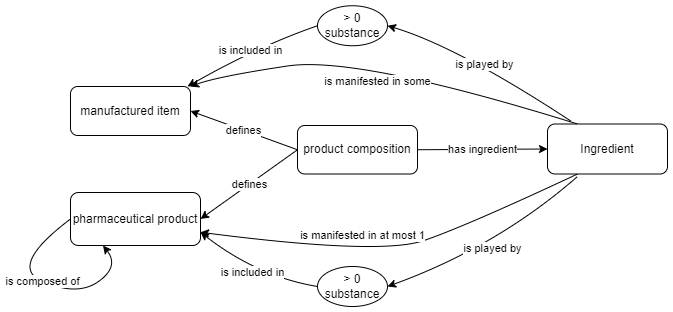
In the diagram, the ‘has ingredient’ property is a subproperty of ‘has role’ in the Commons Roles and Compositions ontology.
A turtle representation of the OWL definitions for product composition, has ingredient and the ingredient class are given below.
idmp-mprd:ProductComposition
    a owl:Class ;
    rdfs:subClassOf
        cmns-rlcmp:Composition ,
        [
            a owl:Restriction ;
            owl:onProperty idmp-mprd:hasReferenceStrength ;
            owl:onClass idmp-mprd:ReferenceStrength ;
            owl:minQualifiedCardinality "0"^^xsd:nonNegativeInteger ;
        ] ,
        [
            a owl:Restriction ;
            owl:onProperty idmp-sub:hasIngredient ;
            owl:someValuesFrom idmp-sub:Ingredient ;
        ] ,
        [
            a owl:Restriction ;
            owl:onProperty cmns-dsg:defines ;
            owl:someValuesFrom [
                a owl:Class ;
                owl:unionOf (
                    idmp-sub:ManufacturedItem
                    idmp-mprd:MedicinalProduct
                    idmp-mprd:PharmaceuticalProduct
                ) ;
            ] ;
        ]
        ;
    rdfs:label "product composition" ;
    skos:definition "composition that defines some product based on its
        relationship(s) to some other substance(s) (ingredient(s)), potentially with a
        given strength, in some context" ;
    cmns-av:usageNote "From an implementation (mapping) perspective, this product
        composition class provides the basis for a (blank) node in the relationship
        'product realizes ingredient role played by some substance', where the ingredient
        role may be that of an active ingredient which, in turn, may have some basis of
        strength in some context. The same product composition could be used to link
        inactive ingredients to a product in which they are realized. A given product may
        include multiple active ingredients, each of which may have a different basis of
        strength." ;
    .

idmp-sub:hasIngredient
    a owl:ObjectProperty ;
    rdfs:subPropertyOf cmns-rlcmp:manifests ;
    rdfs:label "has ingredient" ;
    rdfs:range idmp-sub:Ingredient ;
    skos:definition "relates a substance or product composition to an ingredient of
        that composition" ;
    cmns-av:usageNote "This property should be used primarily in a manufacturing
        context where differentiation of substances or pharmaceutical products in a
        product from other elements that play roles in the manufacturing context is
        important." ;
    .

idmp-sub:Ingredient
    a owl:Class ;
    rdfs:subClassOf
        cmns-rlcmp:FunctionalRole ,
        [
            a owl:Restriction ;
            owl:onProperty cmns-rlcmp:isPlayedBy ;
            owl:onClass [
                a owl:Restriction ;
                owl:onProperty cmns-col:isIncludedIn ;
                owl:onClass idmp-sub:ManufacturedItem ;
                owl:minQualifiedCardinality "0"^^xsd:nonNegativeInteger ;
            ] ;
            owl:minQualifiedCardinality "0"^^xsd:nonNegativeInteger ;
        ]
        [
            a owl:Restriction ;
            owl:onProperty cmns-rlcmp:isManifestedIn ;
            owl:onClass idmp-mprd:PharmaceuticalProduct ;
            owl:maxQualifiedCardinality "1"^^xsd:nonNegativeInteger ;
        ] ,
        [
            a owl:Restriction ;
            owl:onProperty cmns-rlcmp:isManifestedIn ;
            owl:onClass idmp-sub:ManufacturedItem ;
            owl:minQualifiedCardinality "0"^^xsd:nonNegativeInteger ;
        ] ,
        [
            a owl:Restriction ;
            owl:onProperty idmp-mprd:hasStrength ;
            owl:onClass idmp-mprd:Strength ;
            owl:minQualifiedCardinality "0"^^xsd:nonNegativeInteger ;
        ] ,
        [
            a owl:Restriction ;
            owl:onProperty cmns-rlcmp:isPlayedBy ;
            owl:onClass [
                a owl:Restriction ;
                owl:onProperty cmns-col:isIncludedIn ;
                owl:onClass idmp-mprd:PharmaceuticalProduct ;
                owl:minQualifiedCardinality "0"^^xsd:nonNegativeInteger ;
            ] ;
            owl:minQualifiedCardinality "0"^^xsd:nonNegativeInteger ;
        ]
        ;
    rdfs:label "ingredient" ;
    dct:source "ISO/TS 20443:2017(E) Health informatics - Identification of medicinal
        products (IDMP) - Implementation guidelines for ISO 11615 data elements and
        structures for the unique identification and exchange of regulated medicinal
        product information, table D.1, clause D.2.1" ;
    dct:source "ISO 11615:2017 Health informatics - Identification of medicinal
        products (IDMP) - Data elements and structures for the unique identification and
        exchange of regulated information on substances, clauses 3.1.28 and 9.7, Figure
        12" ;
    skos:note "An ingredient is part of a medicinal product, either alone or in
        combination with other ingredients. The ingredient is also a component of a
        pharmaceutical product. Ingredient is equal to a substance with the indication of
        the specific role it is playing in the product." ;
    skos:definition "role of a substance that is specifically part of or used in the
        preparation of some manufactured item, pharmaceutical product, medication, or
        drug" ;
    idmp-cmpl:hasConformanceToISOLevel idmp-cmpl:ConformanceToISOLevelNamingConformant
        ;
    cmns-av:synonym "pharmacological role" ;
    cmns-av:usageNote
        "An ingredient is defined as a material in the ISO 11238 standard rather than
            as a role, which would make the model inconsistent. Thus, this concept is
            consistent in terms of its name but not in terms of its definition." ,
        "Note that any inactive ingredient that is described as 'ingredient not
            otherwise specified' in the ISO/TS 20443 implementation guide will simply be
            classified as an ingredient at this level in the hierarchy in the ontology, or
            as an inactive ingredient without other differentiation."
        ;
    .