
Commons Documents Ontology
OMG GraphArch rendering of the Commons 1.3 formal specification
- Copyright © 2024-2025, Adaptive Analytics, Inc.
- Copyright © 2022-2025, agnos.ai U.K. Ltd.
- Copyright © 2024-2025, Airbus Group
- Copyright © 2024-2025, Boeing
- Copyright © 2024-2025, Dassault Systèmes
- Copyright © 2024-2025, DEKonsult
- Copyright © 2022-2026, EDM Council, Inc. d/b/a EDM Association
- Copyright © 2024-2025, 88Solutions
- Copyright © 2022-2025, Federated Knowledge, LLC
- Copyright © 2024-2025, GfSE e.V.
- Copyright © 2024-2025, Mayo Clinic
- Copyright © 2022-2025, OntoAge
- Copyright © 2024-2025, Ontogenesis Solutions, LLC
- Copyright © 2023-2025, Pistoia Alliance
- Copyright © 2024-2025, ProSTEP iViP Association
- Copyright © 2024-2025, Raytheon Technologies
- Copyright © 2022, QuoteWell, Inc.
- Copyright © 2024-2025, Sparx Systems Pty Ltd
- Copyright © 2022-2025, Stardog Union
- Copyright © 2022-2025, Thematix Partners LLC
- Copyright © 2022-2025, University of North Florida
- Copyright © 2022-2025, Working Ontologist
- Copyright © 2022-2026, Object Management Group, Inc.
USE OF SPECIFICATION – TERMS, CONDITIONS & NOTICES
The material in this document details an Object Management Group specification in accordance with the terms, conditions and notices set forth below. This document does not represent a commitment to implement any portion of this specification in any company's products. The information contained in this document is subject to change without notice.
LICENSES
The companies listed above have granted to the Object Management Group, Inc. (OMG) a nonexclusive, royalty-free, paid up, worldwide license to copy and distribute this document and to modify this document and distribute copies of the modified version. Each of the copyright holders listed above has agreed that no person shall be deemed to have infringed the copyright in the included material of any such copyright holder by reason of having used the specification set forth herein or having conformed any computer software to the specification.
Subject to all of the terms and conditions below, the owners of the copyright in this specification hereby grant you a fully-paid up, non-exclusive, nontransferable, perpetual, worldwide license (without the right to sublicense), to use this specification to create and distribute software and special purpose specifications that are based upon this specification, and to use, copy, and distribute this specification as provided under the Copyright Act; provided that: (1) both the copyright notice identified above and this permission notice appear on any copies of this specification; (2) the use of the specifications is for informational purposes and will not be copied or posted on any network computer or broadcast in any media and will not be otherwise resold or transferred for commercial purposes; and (3) no modifications are made to this specification. This limited permission automatically terminates without notice if you breach any of these terms or conditions. Upon termination, you will destroy immediately any copies of the specifications in your possession or control.
PATENTS
The attention of adopters is directed to the possibility that compliance with or adoption of OMG specifications may require use of an invention covered by patent rights. OMG shall not be responsible for identifying patents for which a license may be required by any OMG specification, or for conducting legal inquiries into the legal validity or scope of those patents that are brought to its attention. OMG specifications are prospective and advisory only. Prospective users are responsible for protecting themselves against liability for infringement of patents.
GENERAL USE RESTRICTIONS
Any unauthorized use of this specification may violate copyright laws, trademark laws, and communications regulations and statutes. This document contains information which is protected by copyright. All Rights Reserved. No part of this work covered by copyright herein may be reproduced or used in any form or by any means--graphic, electronic, or mechanical, including photocopying, recording, taping, or information storage and retrieval systems--without permission of the copyright owner.
DISCLAIMER OF WARRANTY
WHILE THIS PUBLICATION IS BELIEVED TO BE ACCURATE, IT IS PROVIDED "AS IS" AND MAY CONTAIN ERRORS OR MISPRINTS. THE OBJECT MANAGEMENT GROUP AND THE COMPANIES LISTED ABOVE MAKE NO WARRANTY OF ANY KIND, EXPRESS OR IMPLIED, WITH REGARD TO THIS PUBLICATION, INCLUDING BUT NOT LIMITED TO ANY WARRANTY OF TITLE OR OWNERSHIP, IMPLIED WARRANTY OF MERCHANTABILITY OR WARRANTY OF FITNESS FOR A PARTICULAR PURPOSE OR USE. IN NO EVENT SHALL THE OBJECT MANAGEMENT GROUP OR ANY OF THE COMPANIES LISTED ABOVE BE LIABLE FOR ERRORS CONTAINED HEREIN OR FOR DIRECT, INDIRECT, INCIDENTAL, SPECIAL, CONSEQUENTIAL, RELIANCE OR COVER DAMAGES, INCLUDING LOSS OF PROFITS, REVENUE, DATA OR USE, INCURRED BY ANY USER OR ANY THIRD PARTY IN CONNECTION WITH THE FURNISHING, PERFORMANCE, OR USE OF THIS MATERIAL, EVEN IF ADVISED OF THE POSSIBILITY OF SUCH DAMAGES.
The entire risk as to the quality and performance of software developed using this specification is borne by you. This disclaimer of warranty constitutes an essential part of the license granted to you to use this specification.
RESTRICTED RIGHTS LEGEND
Use, duplication or disclosure by the U.S. Government is subject to the restrictions set forth in subparagraph (c) (1) (ii) of The Rights in Technical Data and Computer Software Clause at DFARS 252.227-7013 or in subparagraph (c)(1) and (2) of the Commercial Computer Software - Restricted Rights clauses at 48 C.F.R. 52.227-19 or as specified in 48 C.F.R. 227-7202-2 of the DoD F.A.R. Supplement and its successors, or as specified in 48 C.F.R. 12.212 of the Federal Acquisition Regulations and its successors, as applicable. The specification copyright owners are as indicated above and may be contacted through the Object Management Group, 9C Medway Road, PMB 274, Milford, MA 01757, U.S.A.
TRADEMARKS
CORBA®, CORBA logos®, FIBO®, Financial Industry Business Ontology®, FINANCIAL INSTRUMENT GLOBAL IDENTIFIER®, IIOP®, IMM®, Model Driven Architecture®, MDA®, Object Management Group®, OMG®, OMG Logo®, SoaML®, SOAML®, SysML®, UAF®, Unified Modeling Language®, UML®, UML Cube Logo®, VSIPL®, and XMI® are registered trademarks of the Object Management Group, Inc.
For a complete list of trademarks, see: https://www.omg.org/legal/tm_list.htm. All other products or company names mentioned are used for identification purposes only, and may be trademarks of their respective owners.
COMPLIANCE
The copyright holders listed above acknowledge that the Object Management Group (acting itself or through its designees) is and shall at all times be the sole entity that may authorize developers, suppliers and sellers of computer software to use certification marks, trademarks or other special designations to indicate compliance with these materials.
Software developed under the terms of this license may claim compliance or conformance with this specification if and only if the software compliance is of a nature fully matching the applicable compliance points as stated in the specification. Software developed only partially matching the applicable compliance points may claim only that the software was based on this specification but may not claim compliance or conformance with this specification. In the event that testing suites are implemented or approved by Object Management Group, Inc., software developed using this specification may claim compliance or conformance with the specification only if the software satisfactorily completes the testing suites.
OMG’s Issue Reporting Procedure
All OMG specifications are subject to continuous review and improvement. As part of this process, we encourage readers to report any ambiguities, inconsistencies, or inaccuracies they may find by completing the Issue Reporting Form listed on the main web page https://www.omg.org, under Specifications, Report a Bug/Issue (https://issues.omg.org/issues/create-new-issue).
1. Commons Documents Ontology§
This ontology defines high-level concepts for representation of documents, including legal documents and records, such as a transaction record, purchase history, or payment history. It is deliberately lightweight in order to accommodate mappings to other document and bibliographic ontologies.
Metadata for the Commons Documents Ontology is given in Commons Documents Ontology Metadata.
| Metadata Term | Value |
|---|---|
|
Ontology IRI |
|
|
|
Commons Documents Ontology |
|
|
This ontology defines high-level concepts for representation of documents, including legal documents and records, such as a transaction record, purchase history, or payment history. It is deliberately lightweight in order to accommodate mappings to other document and bibliographic ontologies. |
|
|
Davide Sottara, Mayo Clinic |
|
|
Elisa Kendall, Thematix Partners LLC |
|
|
Evan Wallace, U.S. National Institute of Standards and Technology (NIST) |
|
|
Pete Rivett, Federated Knowledge LLC |
|
|
Copyright (c) 2014-2025 EDM Council, Inc. |
|
|
Copyright (c) 2022-2025 Federated Knowledge LLC |
|
|
Copyright (c) 2022-2025 Mayo Clinic |
|
|
Copyright (c) 2022-2025 Thematix Partners LLC |
|
|
Copyright (c) 2023-2025 Object Management Group, Inc. |
|
|
Copyright (c) 2014-2025 EDM Council, Inc. Permission is hereby granted, free of charge, to any person obtaining a copy of this software and associated documentation files (the 'Software'), to deal in the Software without restriction, including without limitation the rights to use, copy, modify, merge, publish, distribute, sublicense, and/or sell copies of the Software, and to permit persons to whom the Software is furnished to do so, subject to the following conditions: The above copyright notice and this permission notice shall be included in all copies or substantial portions of the Software. THE SOFTWARE IS PROVIDED 'AS IS', WITHOUT WARRANTY OF ANY KIND, EXPRESS OR IMPLIED, INCLUDING BUT NOT LIMITED TO THE WARRANTIES OF MERCHANTABILITY, FITNESS FOR A PARTICULAR PURPOSE AND NONINFRINGEMENT. IN NO EVENT SHALL THE AUTHORS OR COPYRIGHT HOLDERS BE LIABLE FOR ANY CLAIM, DAMAGES OR OTHER LIABILITY, WHETHER IN AN ACTION OF CONTRACT, TORT OR OTHERWISE, ARISING FROM, OUT OF OR IN CONNECTION WITH THE SOFTWARE OR THE USE OR OTHER DEALINGS IN THE SOFTWARE. See https://opensource.org/licenses/MIT. |
|
|
|
|
|
This ontology was derived from the Financial Industry Business Ontology (FIBO), and generalized for use in other domain areas. |
|
|
https://www.omg.org/spec/Commons/20230801/Documents.rdf version of this ontology was revised to add the concept of a document part (COMMONS-13-11). |
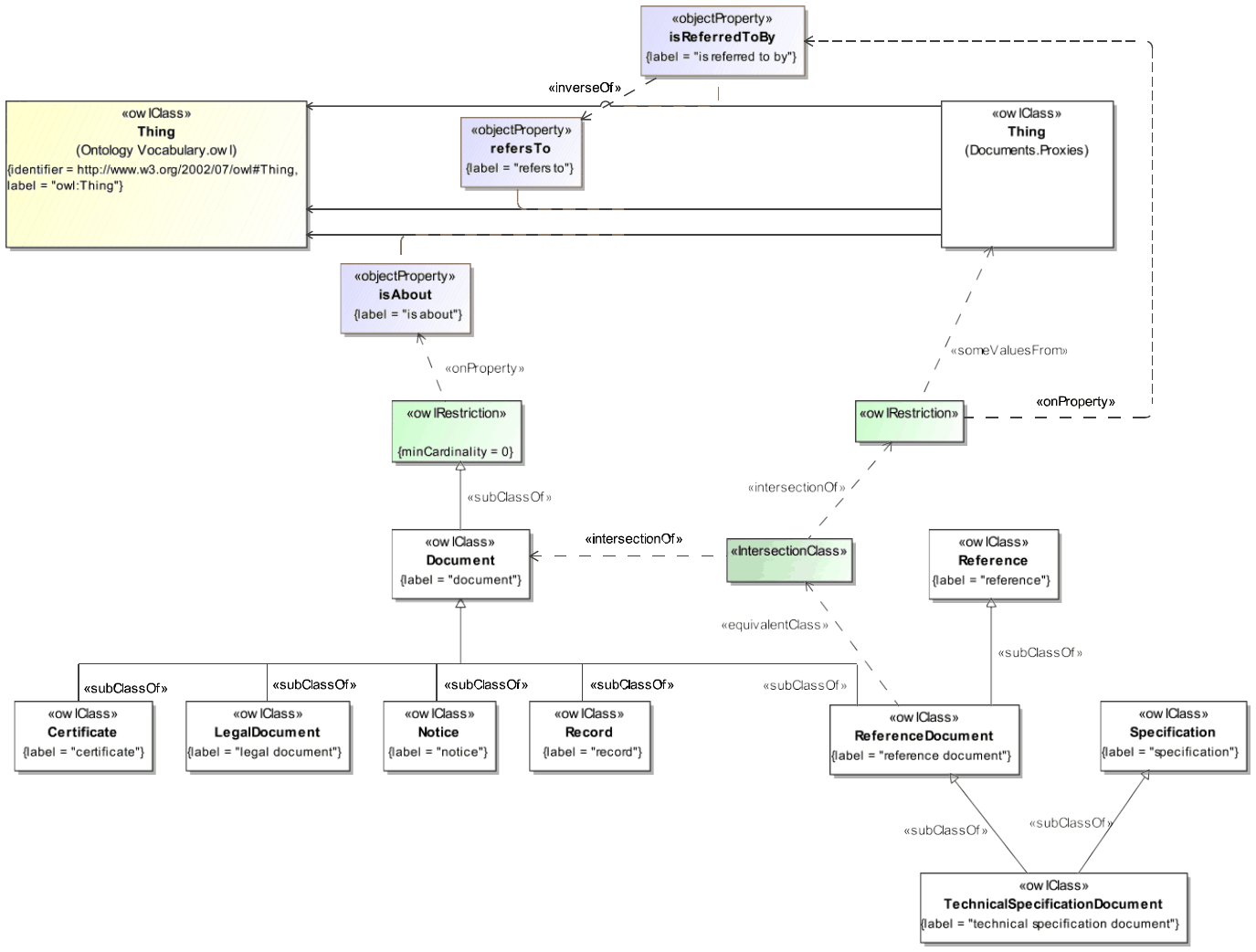
The detailed annotations and axioms that comprise the Commons Documents Ontology are provided in Commons Documents Ontology Details, below.
Classes
| Name | Annotations | Class Expressions |
|---|---|---|
|
Certificate (certificate) |
Definition: document attesting to the truth of some fact or set of facts Explanatory note: A certificate may or may not also be a legal document, depending on the issuing authority and how it can be used. Explanatory note: Certificates, such as electronic certificates, including public keys, may be issued by some certificate authority. Adapted from: ISO 5127 - Information and documentation - Foundation and vocabulary, Second edition, 2017-05, clause 3.1.1.38 |
Parent Class: Document |
|
Document (document) |
Definition: unitary expression of some realization of an intellectual or artistic work Note: See also ISO 25964–1:2011, definition 2.15; ISO 11005:2010, definition 3.1; ISO 15489–1:2016, definition 3.10; IEC 82045–1:2001, definition 3.2.3; ISO 9000:2015, definition 3.7.2 Note: The definition of document provided herein roughly corresponds to the concept of an expression in FRBR. A document is a realization of something that typically takes the form of alpha-numeric, musical, or choreographic notation, sound, image, etc., or any combination of such forms. A manifestation of the document must be inscribed, encoded, engraved, recorded, or otherwise imprinted in some medium. The concept of a manifestation of an expression corresponds to the ISO 5127 notion of a document. Documents can differ extensively in form and characteristics. Note: The manifestation of a document (FRBR expression) refers not only to written and printed materials in paper or microform versions (for example, conventional books, journals, diagrams, maps), but also to non-printed media such as machine-readable and digitized records, Internet and intranet resources, films, sound recordings, buildings, sites, monuments, three-dimensional objects or realia [when used to carry some sort of engraving]; and to collections of such items or parts of such items. (Note taken from ISO 25964–1:2011, definition 2.15.) Also, software, since recorded, can be considered a document. Explanatory note: A document, especially a legal document, may serve to establish one or several facts, and can be relied upon as a proof thereof. Usage note: This definition of document corresponds to a subclass of expression in FRBR. The notion of being a unitary expression is the differentiator between an FRBR expression and document in this sense. Adapted from: 'Functional Requirements for Bibliographic Records', Final Report, IFLA (International Federation of Library Associations and Institutions) Study Group on the Functional Requirements for Bibliographic Records, September 1997 - see https://repository.ifla.org/bitstream/123456789/811/2/ifla-functional-requirements-for-bibliographic-records-frbr.pdf Adapted from: ISO 5127 - Information and documentation - Foundation and vocabulary, Second edition, 2017-05, clause 3.1.1.38 See also: https://www.ifla.org/wp-content/uploads/2019/05/assets/cataloguing/frbr/frbroo_v2.2.pdf |
Property Restriction: ≥ 0 isAbout |
|
DocumentPart (document part) |
Definition: structurally distinct subdivision of a document Note: Parts of documents are typically identified separately based on the function they serve in conveying, organizing, or supporting the content. |
Parent Class: Document Property Restriction: ∃ cmns-col:isMemberOf.Document |
|
LegalDocument (legal document) |
Definition: document specifying the terms of, or provides evidence for, an agreement, attestation, certification, conditions, permissions, and/or decisions of legal persons, government entities, or courts of law, drawn up in accordance with certain rules that apply in the relevant jurisdiction(s) Example: Examples include some certificates, deeds, bonds, business documents (such as articles of incorporation, bylaws, partnership agreements), contracts, certain identity documents, wills, trusts, legislative acts, notarial acts, court writs or processes (such as related complaints and pleadings in the context of litigation as well as other documents relevant to some legal issue), and any law passed by a competent legislative body in municipal (domestic) or international law. Note: A legal document bears the original, official, or legal form of something, that can be fully attributed to its author(s), that records and formally expresses a legally enforceable act, process, or contractual duty, obligation, or right and that can be used to furnish decisive evidence for that act, process, or agreement. Note: Many legal documents only become 'legal' once they are signed and dated, and possibly notarized. Adapted from: ISO 5127 - Information and documentation - Foundation and vocabulary, Second edition, 2017-05, clause 3.4.6.02 |
Parent Class: Document |
|
Notice (notice) |
Definition: announcement, communication, intimation, or advance warning of something, usually, but not necessarily, to allow preparations to be made Example: registered trademark notice, disclaimer, copyright notice, overdue notice, recall notice Note: Although many notices are delivered electronically, certain legal notices must be given given in writing, often by regular mail or hand delivery, with the sender retaining sufficient proof of having given such notice (e.g., through a certificate of service). Adapted from: ISO 5127 - Information and documentation - Foundation and vocabulary, Second edition, 2017-05 |
Parent Class: Document |
|
Record (record) |
Definition: memorialization and objective evidence of activities performed, events occurred, results achieved, or statements made, regardless of its characteristics, media, physical form, or the manner in which it is recorded or stored Note: Records are created or received by an organization in routine transaction of its business or in pursuance of its legal obligations. |
Parent Class: Document |
|
Reference (reference) |
Definition: source that may be used to ascertain, interpret, or understand something Explanatory note: In linguistics, a reference characterizes, provides context for, or specifies the relationship of one linguistic expression to another, i.e., provides the information necessary to interpret the dependent expression. Explanatory note: References may be rendered in the form of a document, but may also take other forms, such as reference materials, scientific equations, and constants, including in some cases physical things, used as the basis for units of measure. |
|
|
ReferenceDocument (reference document) |
Definition: document that is used as a reference for something Explanatory note: A reference document is typically one that provides pertinent details for consultation about a subject. Adapted from: ISO/IEC 11179-3 Information technology - Metadata registries (MDR) - Part 3: Registry metamodel and basic attributes, Third edition, 2013-02-15 |
Parent Class: Document, Reference Class Axiom: ≡ Document ⊓ ∃ isReferredToBy.owl:Thing |
|
Specification (specification) |
Definition: explicit requirement or set of requirements to be satisfied by something, such as a product, material, model, process or system Abbreviation: spec Adapted from: ISO 6707-2:2017 Buildings and civil engineering works - Vocabulary - Part 2: Contract and communication terms, clause 3.2.22 |
|
|
TechnicalSpecificationDocument (technical specification document) |
Definition: document that sets out detailed requirements to be satisfied by a product, material, process or system and the procedures for checking conformity to these requirements Note: Technical specifications may evolve from a functional specification and define the technical requirements for the selected solution as part of a business agreement. Explanatory note: A technical specification is a specification expressing technical requirements, such as one for designing and developing a solution to be implemented. Adapted from: ISO 10795:2019 Space systems - Programme management and quality - Vocabulary, clause 3.238 Adapted from: ISO 6707-2:2017 Buildings and civil engineering works - Vocabulary - Part 2: Contract and communication terms, clause 3.2.22 |
Parent Class: ReferenceDocument, Specification |
Properties
| Name | Annotations | Property Axioms |
|---|---|---|
|
hasDataSource (has data source) |
Definition: relates something, such as an agreement, contract, document, record, report, or process, to a source of data used to analyze, develop, explain, produce, or otherwise create it Usage note: Although in many cases an annotation property, such as dct:source, is sufficient for this purpose, there are occasions when a more complete description of a source is required, such as to meet data lineage requirements, for which this property may be used. |
Parent Property: refersTo |
|
isAbout (is about) |
Definition: indicates the subject or topic of something, such as a document |
|
|
isReferredToBy (is referred to by) |
Definition: indicates something that is referenced as a source for information or explanation |
Inverse: refersTo |
|
isSpecifiedIn (is specified in) |
Definition: indicates the explicit source for some requirement, fact, or set of facts |
Parent Property: refersTo Inverse: specifies |
|
records (records) |
Definition: documents for later reference |
|
|
refersTo (refers to) |
Definition: makes reference to as a source for information or explanation |
|
|
specifies (specifies) |
Definition: mentions, names or states something clearly and definitively Explanatory note: Specifies may be used to refer to a requirement, fact, or set of facts. |