
Commons Roles and Compositions Ontology
OMG GraphArch rendering of the Commons 1.3 formal specification
- Copyright © 2024-2025, Adaptive Analytics, Inc.
- Copyright © 2022-2025, agnos.ai U.K. Ltd.
- Copyright © 2024-2025, Airbus Group
- Copyright © 2024-2025, Boeing
- Copyright © 2024-2025, Dassault Systèmes
- Copyright © 2024-2025, DEKonsult
- Copyright © 2022-2026, EDM Council, Inc. d/b/a EDM Association
- Copyright © 2024-2025, 88Solutions
- Copyright © 2022-2025, Federated Knowledge, LLC
- Copyright © 2024-2025, GfSE e.V.
- Copyright © 2024-2025, Mayo Clinic
- Copyright © 2022-2025, OntoAge
- Copyright © 2024-2025, Ontogenesis Solutions, LLC
- Copyright © 2023-2025, Pistoia Alliance
- Copyright © 2024-2025, ProSTEP iViP Association
- Copyright © 2024-2025, Raytheon Technologies
- Copyright © 2022, QuoteWell, Inc.
- Copyright © 2024-2025, Sparx Systems Pty Ltd
- Copyright © 2022-2025, Stardog Union
- Copyright © 2022-2025, Thematix Partners LLC
- Copyright © 2022-2025, University of North Florida
- Copyright © 2022-2025, Working Ontologist
- Copyright © 2022-2026, Object Management Group, Inc.
USE OF SPECIFICATION – TERMS, CONDITIONS & NOTICES
The material in this document details an Object Management Group specification in accordance with the terms, conditions and notices set forth below. This document does not represent a commitment to implement any portion of this specification in any company's products. The information contained in this document is subject to change without notice.
LICENSES
The companies listed above have granted to the Object Management Group, Inc. (OMG) a nonexclusive, royalty-free, paid up, worldwide license to copy and distribute this document and to modify this document and distribute copies of the modified version. Each of the copyright holders listed above has agreed that no person shall be deemed to have infringed the copyright in the included material of any such copyright holder by reason of having used the specification set forth herein or having conformed any computer software to the specification.
Subject to all of the terms and conditions below, the owners of the copyright in this specification hereby grant you a fully-paid up, non-exclusive, nontransferable, perpetual, worldwide license (without the right to sublicense), to use this specification to create and distribute software and special purpose specifications that are based upon this specification, and to use, copy, and distribute this specification as provided under the Copyright Act; provided that: (1) both the copyright notice identified above and this permission notice appear on any copies of this specification; (2) the use of the specifications is for informational purposes and will not be copied or posted on any network computer or broadcast in any media and will not be otherwise resold or transferred for commercial purposes; and (3) no modifications are made to this specification. This limited permission automatically terminates without notice if you breach any of these terms or conditions. Upon termination, you will destroy immediately any copies of the specifications in your possession or control.
PATENTS
The attention of adopters is directed to the possibility that compliance with or adoption of OMG specifications may require use of an invention covered by patent rights. OMG shall not be responsible for identifying patents for which a license may be required by any OMG specification, or for conducting legal inquiries into the legal validity or scope of those patents that are brought to its attention. OMG specifications are prospective and advisory only. Prospective users are responsible for protecting themselves against liability for infringement of patents.
GENERAL USE RESTRICTIONS
Any unauthorized use of this specification may violate copyright laws, trademark laws, and communications regulations and statutes. This document contains information which is protected by copyright. All Rights Reserved. No part of this work covered by copyright herein may be reproduced or used in any form or by any means--graphic, electronic, or mechanical, including photocopying, recording, taping, or information storage and retrieval systems--without permission of the copyright owner.
DISCLAIMER OF WARRANTY
WHILE THIS PUBLICATION IS BELIEVED TO BE ACCURATE, IT IS PROVIDED "AS IS" AND MAY CONTAIN ERRORS OR MISPRINTS. THE OBJECT MANAGEMENT GROUP AND THE COMPANIES LISTED ABOVE MAKE NO WARRANTY OF ANY KIND, EXPRESS OR IMPLIED, WITH REGARD TO THIS PUBLICATION, INCLUDING BUT NOT LIMITED TO ANY WARRANTY OF TITLE OR OWNERSHIP, IMPLIED WARRANTY OF MERCHANTABILITY OR WARRANTY OF FITNESS FOR A PARTICULAR PURPOSE OR USE. IN NO EVENT SHALL THE OBJECT MANAGEMENT GROUP OR ANY OF THE COMPANIES LISTED ABOVE BE LIABLE FOR ERRORS CONTAINED HEREIN OR FOR DIRECT, INDIRECT, INCIDENTAL, SPECIAL, CONSEQUENTIAL, RELIANCE OR COVER DAMAGES, INCLUDING LOSS OF PROFITS, REVENUE, DATA OR USE, INCURRED BY ANY USER OR ANY THIRD PARTY IN CONNECTION WITH THE FURNISHING, PERFORMANCE, OR USE OF THIS MATERIAL, EVEN IF ADVISED OF THE POSSIBILITY OF SUCH DAMAGES.
The entire risk as to the quality and performance of software developed using this specification is borne by you. This disclaimer of warranty constitutes an essential part of the license granted to you to use this specification.
RESTRICTED RIGHTS LEGEND
Use, duplication or disclosure by the U.S. Government is subject to the restrictions set forth in subparagraph (c) (1) (ii) of The Rights in Technical Data and Computer Software Clause at DFARS 252.227-7013 or in subparagraph (c)(1) and (2) of the Commercial Computer Software - Restricted Rights clauses at 48 C.F.R. 52.227-19 or as specified in 48 C.F.R. 227-7202-2 of the DoD F.A.R. Supplement and its successors, or as specified in 48 C.F.R. 12.212 of the Federal Acquisition Regulations and its successors, as applicable. The specification copyright owners are as indicated above and may be contacted through the Object Management Group, 9C Medway Road, PMB 274, Milford, MA 01757, U.S.A.
TRADEMARKS
CORBA®, CORBA logos®, FIBO®, Financial Industry Business Ontology®, FINANCIAL INSTRUMENT GLOBAL IDENTIFIER®, IIOP®, IMM®, Model Driven Architecture®, MDA®, Object Management Group®, OMG®, OMG Logo®, SoaML®, SOAML®, SysML®, UAF®, Unified Modeling Language®, UML®, UML Cube Logo®, VSIPL®, and XMI® are registered trademarks of the Object Management Group, Inc.
For a complete list of trademarks, see: https://www.omg.org/legal/tm_list.htm. All other products or company names mentioned are used for identification purposes only, and may be trademarks of their respective owners.
COMPLIANCE
The copyright holders listed above acknowledge that the Object Management Group (acting itself or through its designees) is and shall at all times be the sole entity that may authorize developers, suppliers and sellers of computer software to use certification marks, trademarks or other special designations to indicate compliance with these materials.
Software developed under the terms of this license may claim compliance or conformance with this specification if and only if the software compliance is of a nature fully matching the applicable compliance points as stated in the specification. Software developed only partially matching the applicable compliance points may claim only that the software was based on this specification but may not claim compliance or conformance with this specification. In the event that testing suites are implemented or approved by Object Management Group, Inc., software developed using this specification may claim compliance or conformance with the specification only if the software satisfactorily completes the testing suites.
OMG’s Issue Reporting Procedure
All OMG specifications are subject to continuous review and improvement. As part of this process, we encourage readers to report any ambiguities, inconsistencies, or inaccuracies they may find by completing the Issue Reporting Form listed on the main web page https://www.omg.org, under Specifications, Report a Bug/Issue (https://issues.omg.org/issues/create-new-issue).
1. Commons Roles and Compositions Ontology§
This ontology defines the high-level things defining roles, which enable specification of the various participants in something, and the notion of a composition, i.e., relating something that is a specification for a 'whole', such as a product or recipe, to its ingredients or constituents, potentially with respect to some context-specific requirements.
Metadata for the Commons Roles and Compositions Ontology is given in Commons Roles and Compositions Ontology Metadata.
| Metadata Term | Value |
|---|---|
|
Ontology IRI |
|
|
|
Commons Roles and Compositions Ontology |
|
|
This ontology defines the high-level things defining roles, which enable specification of the various participants in something, and the notion of a composition, i.e., relating something that is a specification for a 'whole', such as a product or recipe, to its ingredients or constituents, potentially with respect to some context-specific requirements. |
|
|
Dean Allemang, Working Ontologist |
|
|
Elisa Kendall, Thematix Partners LLC |
|
|
Copyright (c) 2020-2023 EDM Council, Inc. |
|
|
Copyright (c) 2020-2023 Thematix Partners LLC |
|
|
Copyright (c) 2020-2023 Working Ontologist LLC |
|
|
Copyright (c) 2022-2023 Pistoia Alliance, Inc. |
|
|
Copyright (c) 2023 Object Management Group, Inc. |
|
|
https://opensource.org/licenses/MIT |
|
|
https://www.omg.org/spec/Commons/20230801/RolesAndCompositions/ |
|
|
This ontology was derived from the Financial Industry Business Ontology (FIBO) and extended based on usage in other projects, such as the Pistoia Alliance Identification of Medicinal Products (IDMP) ontology project. |
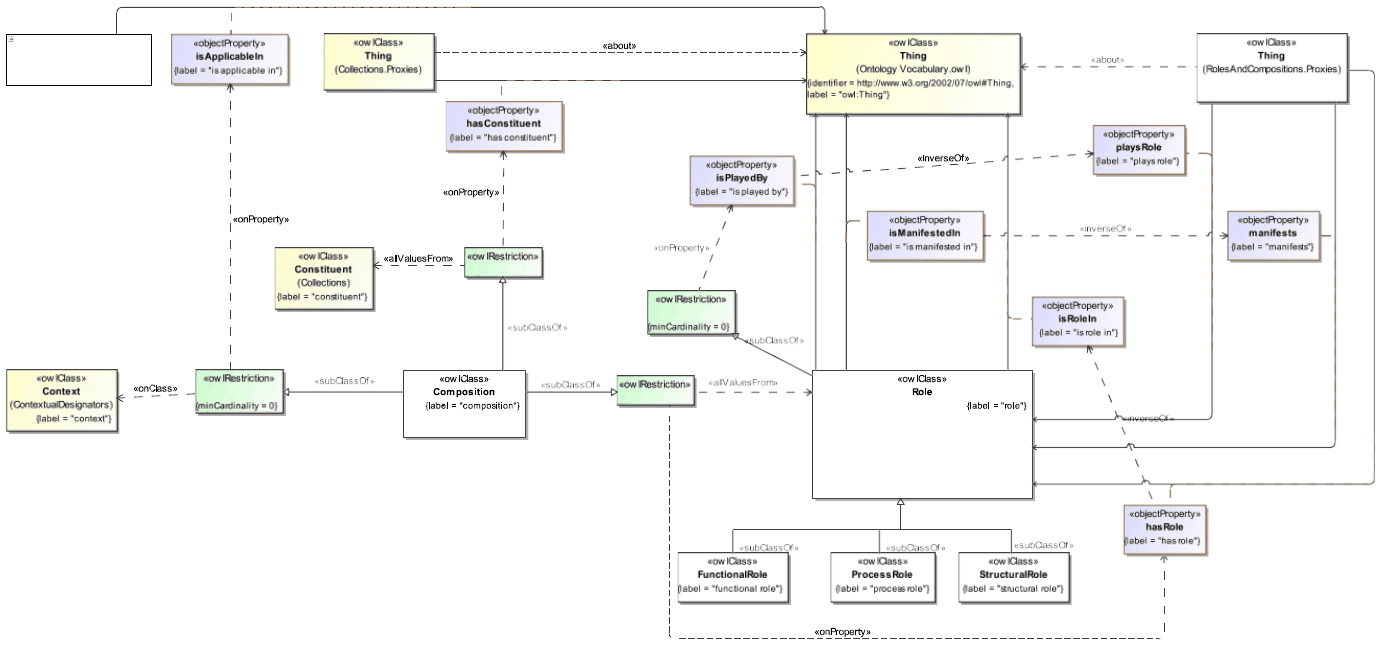
The detailed annotations and axioms that comprise the Commons Roles and Compositions Ontology are provided in Commons Roles and Compositions Ontology Details, below.
Classes
| Name | Annotations | Class Expressions |
|---|---|---|
|
Composition (composition) |
Definition: distinct thing resulting from bringing together other things, possibly in specific roles, for a particular purpose Explanatory note: The composition may be specified based on the roles that the things play in the composition, such as the roles that various ingredients play in a recipe or pharmaceutical product, and such things may or may not be transformed in some way through the process of combining them. Quantification including the nature and amount of each thing, potentially including the ratio of the quantities, may be required depending kind of composition. Usage note: The properties hasConstituent and hasRole are included in value restrictions rather than via number restrictions to facilitate their use in complex property chains and other axioms as needed for some applications. Adapted from: ISO/IEC 18384-1:2016, Information technology - Reference Architecture for Service Oriented Architecture (SOA RA) - Part 1: Terminology and concepts for SOA, clause 2.5 and ISO/IEC 18384-3:2016, Information technology - Reference Architecture for Service Oriented Architecture (SOA RA) - Part 3: Service Oriented Architecture ontology, clause 8.2 Adapted from: ISO/TS 19807-1:2019(en), Nanotechnologies - Magnetic nanomaterials - Part 1: Specification of characteristics and measurements for magnetic nanosuspensions, clause 3.4 |
Property Restriction: ∀ cmns-col:hasConstituent.cmns-col:Constituent Property Restriction: ∀ hasRole.Role Property Restriction: ≥ 0 cmns-cxtdsg:isApplicableIn.cmns-cxtdsg:Context |
|
FunctionalRole (functional role) |
Definition: role representing an underlying functionality that something, such as a person, organization, process, or service, is expected to perform or deliver Note: Functional roles can be assigned to be performed during an act. Adapted from: ISO 21298:2017(en), Health informatics - Functional and structural roles, clause 3.9 Adapted from: ISO/IEC 19763-8:2015(en), Information technology - Metamodel framework for interoperability (MFI) - Part 8: Metamodel for role and goal model registration, clause 3.1.2 |
Parent Class: Role |
|
ProcessRole (process role) |
Definition: role that associates resources and participants to a structured set of activities involving various enterprise entities, that is designed and organised for a given purpose Adapted from: ISO 12651-2:2014(en), Electronic document management - Vocabulary - Part 2: Workflow management, clause 3.33 Adapted from: ISO 18629-1:2004(en), Industrial automation systems and integration - Process specification language - Part 1: Overview and basic principles |
Parent Class: Role |
|
Role (role) |
Definition: named specific behavior of something participating in a particular context Adapted from: ISO/IEC 19763-8:2015(en), Information technology - Metamodel framework for interoperability (MFI) - Part 8: Metamodel for role and goal model registration, clause 3.1.7 |
Property Restriction: ≥ 0 isPlayedBy |
|
StructuralRole (structural role) |
Definition: role specifying relations between entities in the sense of competence, often reflecting organizational or structural relations (hierarchies) Source: ISO 21298:2017(en), Health informatics - Functional and structural roles, clause 3.26 |
Parent Class: Role |
Properties
| Name | Annotations | Property Axioms |
|---|---|---|
|
hasRole (has role) |
Definition: identifies something or someone playing a part in something, such as a composition |
Range: Role |
|
isManifestedIn (is manifested in) |
Definition: indicates something in which the role is realized, appears, or occurs |
Domain: Role Inverse: manifests |
|
isPlayedBy (is played by) |
Definition: indicates something or someone, such as a person, organization, or other thing filling a role Example: A party, counterparty, or third party to a contract is played by an organization or person; an issuer of a financial instrument is typically played by an organization; an ingredient in a recipe may be played by a substance. |
Domain: Role Inverse: playsRole |
|
isRoleIn (is role in) |
Definition: identifies something, such as a composition, situation, or contract, involving the role |
Domain: Role Inverse: hasRole |
|
manifests (manifests) |
Definition: indicates a role that realizes, displays, or shows something, typically in some context |
Range: Role |
|
playsRole (plays role) |
Definition: indicates a part that someone or something plays under some circumstance Example: an organization may play the role of employer, issuer, regulatory agency, bank, custodian, manufacturer, vendor, etc.; a person may play the role of employee, examiner, banker, seller, buyer, etc. |
Range: Role |