
Commons Quantities and Units Ontology
OMG GraphArch rendering of the Commons 1.3 formal specification
- Copyright © 2024-2025, Adaptive Analytics, Inc.
- Copyright © 2022-2025, agnos.ai U.K. Ltd.
- Copyright © 2024-2025, Airbus Group
- Copyright © 2024-2025, Boeing
- Copyright © 2024-2025, Dassault Systèmes
- Copyright © 2024-2025, DEKonsult
- Copyright © 2022-2026, EDM Council, Inc. d/b/a EDM Association
- Copyright © 2024-2025, 88Solutions
- Copyright © 2022-2025, Federated Knowledge, LLC
- Copyright © 2024-2025, GfSE e.V.
- Copyright © 2024-2025, Mayo Clinic
- Copyright © 2022-2025, OntoAge
- Copyright © 2024-2025, Ontogenesis Solutions, LLC
- Copyright © 2023-2025, Pistoia Alliance
- Copyright © 2024-2025, ProSTEP iViP Association
- Copyright © 2024-2025, Raytheon Technologies
- Copyright © 2022, QuoteWell, Inc.
- Copyright © 2024-2025, Sparx Systems Pty Ltd
- Copyright © 2022-2025, Stardog Union
- Copyright © 2022-2025, Thematix Partners LLC
- Copyright © 2022-2025, University of North Florida
- Copyright © 2022-2025, Working Ontologist
- Copyright © 2022-2026, Object Management Group, Inc.
USE OF SPECIFICATION – TERMS, CONDITIONS & NOTICES
The material in this document details an Object Management Group specification in accordance with the terms, conditions and notices set forth below. This document does not represent a commitment to implement any portion of this specification in any company's products. The information contained in this document is subject to change without notice.
LICENSES
The companies listed above have granted to the Object Management Group, Inc. (OMG) a nonexclusive, royalty-free, paid up, worldwide license to copy and distribute this document and to modify this document and distribute copies of the modified version. Each of the copyright holders listed above has agreed that no person shall be deemed to have infringed the copyright in the included material of any such copyright holder by reason of having used the specification set forth herein or having conformed any computer software to the specification.
Subject to all of the terms and conditions below, the owners of the copyright in this specification hereby grant you a fully-paid up, non-exclusive, nontransferable, perpetual, worldwide license (without the right to sublicense), to use this specification to create and distribute software and special purpose specifications that are based upon this specification, and to use, copy, and distribute this specification as provided under the Copyright Act; provided that: (1) both the copyright notice identified above and this permission notice appear on any copies of this specification; (2) the use of the specifications is for informational purposes and will not be copied or posted on any network computer or broadcast in any media and will not be otherwise resold or transferred for commercial purposes; and (3) no modifications are made to this specification. This limited permission automatically terminates without notice if you breach any of these terms or conditions. Upon termination, you will destroy immediately any copies of the specifications in your possession or control.
PATENTS
The attention of adopters is directed to the possibility that compliance with or adoption of OMG specifications may require use of an invention covered by patent rights. OMG shall not be responsible for identifying patents for which a license may be required by any OMG specification, or for conducting legal inquiries into the legal validity or scope of those patents that are brought to its attention. OMG specifications are prospective and advisory only. Prospective users are responsible for protecting themselves against liability for infringement of patents.
GENERAL USE RESTRICTIONS
Any unauthorized use of this specification may violate copyright laws, trademark laws, and communications regulations and statutes. This document contains information which is protected by copyright. All Rights Reserved. No part of this work covered by copyright herein may be reproduced or used in any form or by any means--graphic, electronic, or mechanical, including photocopying, recording, taping, or information storage and retrieval systems--without permission of the copyright owner.
DISCLAIMER OF WARRANTY
WHILE THIS PUBLICATION IS BELIEVED TO BE ACCURATE, IT IS PROVIDED "AS IS" AND MAY CONTAIN ERRORS OR MISPRINTS. THE OBJECT MANAGEMENT GROUP AND THE COMPANIES LISTED ABOVE MAKE NO WARRANTY OF ANY KIND, EXPRESS OR IMPLIED, WITH REGARD TO THIS PUBLICATION, INCLUDING BUT NOT LIMITED TO ANY WARRANTY OF TITLE OR OWNERSHIP, IMPLIED WARRANTY OF MERCHANTABILITY OR WARRANTY OF FITNESS FOR A PARTICULAR PURPOSE OR USE. IN NO EVENT SHALL THE OBJECT MANAGEMENT GROUP OR ANY OF THE COMPANIES LISTED ABOVE BE LIABLE FOR ERRORS CONTAINED HEREIN OR FOR DIRECT, INDIRECT, INCIDENTAL, SPECIAL, CONSEQUENTIAL, RELIANCE OR COVER DAMAGES, INCLUDING LOSS OF PROFITS, REVENUE, DATA OR USE, INCURRED BY ANY USER OR ANY THIRD PARTY IN CONNECTION WITH THE FURNISHING, PERFORMANCE, OR USE OF THIS MATERIAL, EVEN IF ADVISED OF THE POSSIBILITY OF SUCH DAMAGES.
The entire risk as to the quality and performance of software developed using this specification is borne by you. This disclaimer of warranty constitutes an essential part of the license granted to you to use this specification.
RESTRICTED RIGHTS LEGEND
Use, duplication or disclosure by the U.S. Government is subject to the restrictions set forth in subparagraph (c) (1) (ii) of The Rights in Technical Data and Computer Software Clause at DFARS 252.227-7013 or in subparagraph (c)(1) and (2) of the Commercial Computer Software - Restricted Rights clauses at 48 C.F.R. 52.227-19 or as specified in 48 C.F.R. 227-7202-2 of the DoD F.A.R. Supplement and its successors, or as specified in 48 C.F.R. 12.212 of the Federal Acquisition Regulations and its successors, as applicable. The specification copyright owners are as indicated above and may be contacted through the Object Management Group, 9C Medway Road, PMB 274, Milford, MA 01757, U.S.A.
TRADEMARKS
CORBA®, CORBA logos®, FIBO®, Financial Industry Business Ontology®, FINANCIAL INSTRUMENT GLOBAL IDENTIFIER®, IIOP®, IMM®, Model Driven Architecture®, MDA®, Object Management Group®, OMG®, OMG Logo®, SoaML®, SOAML®, SysML®, UAF®, Unified Modeling Language®, UML®, UML Cube Logo®, VSIPL®, and XMI® are registered trademarks of the Object Management Group, Inc.
For a complete list of trademarks, see: https://www.omg.org/legal/tm_list.htm. All other products or company names mentioned are used for identification purposes only, and may be trademarks of their respective owners.
COMPLIANCE
The copyright holders listed above acknowledge that the Object Management Group (acting itself or through its designees) is and shall at all times be the sole entity that may authorize developers, suppliers and sellers of computer software to use certification marks, trademarks or other special designations to indicate compliance with these materials.
Software developed under the terms of this license may claim compliance or conformance with this specification if and only if the software compliance is of a nature fully matching the applicable compliance points as stated in the specification. Software developed only partially matching the applicable compliance points may claim only that the software was based on this specification but may not claim compliance or conformance with this specification. In the event that testing suites are implemented or approved by Object Management Group, Inc., software developed using this specification may claim compliance or conformance with the specification only if the software satisfactorily completes the testing suites.
OMG’s Issue Reporting Procedure
All OMG specifications are subject to continuous review and improvement. As part of this process, we encourage readers to report any ambiguities, inconsistencies, or inaccuracies they may find by completing the Issue Reporting Form listed on the main web page https://www.omg.org, under Specifications, Report a Bug/Issue (https://issues.omg.org/issues/create-new-issue).
1. Commons Quantities and Units Ontology§
This ontology provides a core set of concepts for quantities, units, systems of quantities, and systems of units. The most widely accepted, scrutinized, and globally used system of quantities and system of units are the International System of Quantities (ISQ) and the International System of Units (SI). They are formally standardized through [ISO 31] and [IEC 60027]. The harmonization of these two sets of standards into one new set [ISO/IEC 80000] has been published by ISO in 2009 and 2010. This ontology is based on the Object Management Group (OMG)'s SysML standard and on ISO/IEC 80000-1:2009, which refers normatively to the ISO/IEC Guide 99:2007. It is compatible with and can be mapped directly to the OMG Date Time Vocabulary (DTV) Quantities Ontology, the de-facto QUDT ontology representing Units of Measure, Quantity Kinds, Dimensions and Data Types (see http://www.qudt.org/), the Units of Measurement Ontology (UO) ontology available from the BioPortal (https://bioportal.bioontology.org/ontologies/UO) and others, as well as the quantities and units library in the SysML specification.
Metadata for the Commons Quantities and Units Ontology is given in Commons Quantities and Units Ontology Metadata.
| Metadata Term | Value |
|---|---|
|
Ontology IRI |
|
|
|
Commons Quantities and Units Ontology |
|
|
This ontology provides a core set of concepts for quantities, units, systems of quantities, and systems of units. The most widely accepted, scrutinized, and globally used system of quantities and system of units are the International System of Quantities (ISQ) and the International System of Units (SI). They are formally standardized through [ISO 31] and [IEC 60027]. The harmonization of these two sets of standards into one new set [ISO/IEC 80000] has been published by ISO in 2009 and 2010. This ontology is based on the Object Management Group (OMG)'s SysML standard and on ISO/IEC 80000-1:2009, which refers normatively to the ISO/IEC Guide 99:2007. It is compatible with and can be mapped directly to the OMG Date Time Vocabulary (DTV) Quantities Ontology, the de-facto QUDT ontology representing Units of Measure, Quantity Kinds, Dimensions and Data Types (see http://www.qudt.org/), the Units of Measurement Ontology (UO) ontology available from the BioPortal (https://bioportal.bioontology.org/ontologies/UO) and others, as well as the quantities and units library in the SysML specification. |
|
|
Davide Sottara, Mayo Clinic |
|
|
Elisa Kendall, Thematix Partners LLC |
|
|
Evan Wallace, U.S. National Institute of Standards and Technology (NIST) |
|
|
Hans Peter de Koning, DEKonsult |
|
|
Jim Logan, Ontogenesis Solutions, LLC |
|
|
Michel Sauvage, Airbus Group |
|
|
Roger Burkhart, Thematix Partners LLC |
|
|
Steve Jenkins, Jet Propulsion Laboratory (JPL), California Institute of Technology, National Aeronautics and Space Administration (NASA) |
|
|
Stuart Chalk, University of North Florida |
|
|
Thomas Barre, Airbus Group |
|
|
Copyright (c) 2011-2024 Thematix Partners LLC |
|
|
Copyright (c) 2015-2024 EDM Council, Inc. |
|
|
Copyright (c) 2015-2024 Object Management Group, Inc. |
|
|
Copyright (c) 2023-2024 DEKonsult |
|
|
Copyright (c) 2023-2024 Mayo Clinic |
|
|
Copyright (c) 2023-2024 University of North Florida |
|
|
Copyright (c) 2024 Airbus Group |
|
|
Copyright (c) 2024 Ontogenesis Solutions, LLC |
|
|
Copyright (c) 2011-2024 Thematix Partners LLC Permission is hereby granted, free of charge, to any person obtaining a copy of this software and associated documentation files (the 'Software'), to deal in the Software without restriction, including without limitation the rights to use, copy, modify, merge, publish, distribute, sublicense, and/or sell copies of the Software, and to permit persons to whom the Software is furnished to do so, subject to the following conditions: The above copyright notice and this permission notice shall be included in all copies or substantial portions of the Software. THE SOFTWARE IS PROVIDED 'AS IS', WITHOUT WARRANTY OF ANY KIND, EXPRESS OR IMPLIED, INCLUDING BUT NOT LIMITED TO THE WARRANTIES OF MERCHANTABILITY, FITNESS FOR A PARTICULAR PURPOSE AND NONINFRINGEMENT. IN NO EVENT SHALL THE AUTHORS OR COPYRIGHT HOLDERS BE LIABLE FOR ANY CLAIM, DAMAGES OR OTHER LIABILITY, WHETHER IN AN ACTION OF CONTRACT, TORT OR OTHERWISE, ARISING FROM, OUT OF OR IN CONNECTION WITH THE SOFTWARE OR THE USE OR OTHER DEALINGS IN THE SOFTWARE. See https://opensource.org/licenses/MIT. |
|
|
https://www.omg.org/spec/Commons/20240801/QuantitiesAndUnits/ |
|
|
The https://www.omg.org/spec/Commons/20230801/QuantitiesAndUnits.rdf version of this ontology was modified to loosen functional constraints on a number of properties, which caused reasoning errors when these generic properties were reused with multiple subproperties on the same concept and eliminate potentially circular restrictions (Commons-1.2-5) and to add the concept of a measurement reference to enable better alignment of such references with quantity values whose reference is something other than a unit of measure (Commons-1.2-3). |
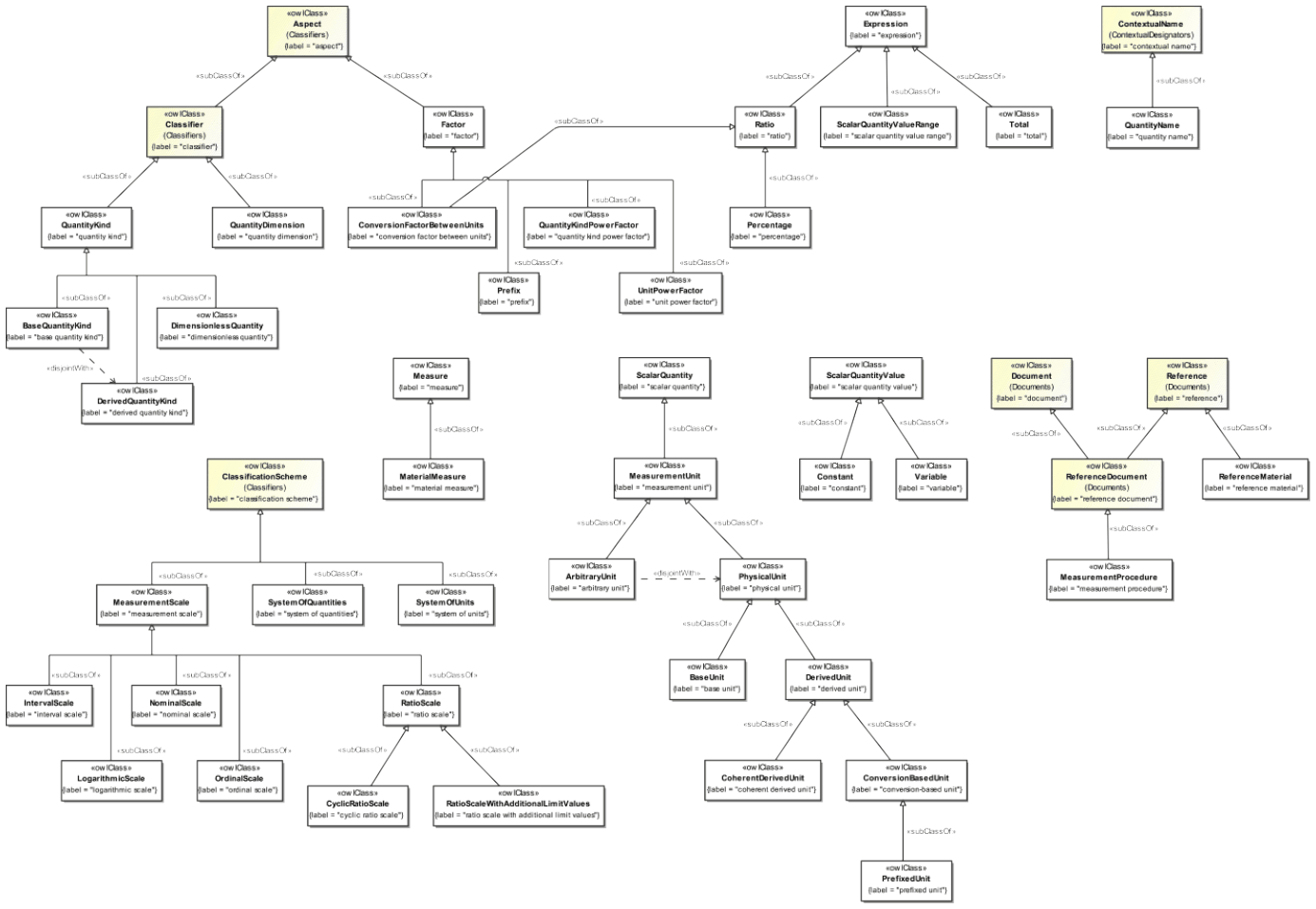
The detailed annotations and axioms that comprise the Commons Quantities and Units Ontology are provided in Commons Quantities and Units Ontology Details, below.
Classes
| Name | Annotations | Class Expressions |
|---|---|---|
|
ArbitraryUnit (arbitrary unit) |
Definition: arbitrarily defined unit of measurement, where a relation of the unit to a physical unit of the SI does not exist or is unknown Note: Arbitrary units represent references to materials or procedures that are defined outside of the SI system. A quantity value is arbitrarily assigned to the reference preparation or the result of a measurement procedure, usually specific for a particular substance. This generally precludes comparability of quantity values across different systems and components for this type of units. Source: ISO 11240 Health informatics - Identification of medicinal products - Data elements and structures for the unique identification and exchange of units of measurement, clause 3.1.1 |
Parent Class: MeasurementUnit Property Restriction: ≥ 0 cmns-doc:refersTo.MaterialMeasure Property Restriction: ≥ 0 cmns-doc:refersTo.ReferenceMaterial Property Restriction: ≥ 0 cmns-doc:refersTo.MeasurementProcedure Class Axiom: ¬ PhysicalUnit |
|
BaseQuantityKind (base quantity kind) |
Definition: quantity in a conventionally chosen subset of a given system of quantities, where no quantity in the subset can be expressed in terms of the other quantities within that subset Synonym: base quantity Synonym: simple quantity kind Example: The International System of Quantities (ISQ) comprises these base quantities (with their SI base measurement units): length (meter), mass (kilogram), duration (second), electric current (ampere), thermodynamic temperature (kelvin), amount of substance (mole), and luminous intensity (candela). These base quantities are not mutually comparable. All quantities of any one of these kinds are, however, mutually comparable. Note: The subset mentioned in the definition is termed the 'set of base quantities'. Base quantities are referred to as being mutually independent since a base quantity cannot be expressed as a product of powers of the other base quantities. Source: ISO 11240 Health informatics - Identification of medicinal products - Data elements and structures for the unique identification and exchange of units of measurement, clause 3.1.2 Source: ISO 80000-1:2009 Quantities and units - Part 1: General, clause 3.4 Source: https://www.omg.org/spec/SysML/ |
Parent Class: QuantityKind Property Restriction: = 1 cmns-dsg:isDefinedIn.SystemOfQuantities |
|
BaseUnit (base unit) |
Definition: measurement unit that is defined by a system of units to be the reference measurement unit for a base quantity Synonym: simple unit Example: In the SI, the meter is the base unit of length. In the CGS systems, the centimeter is the base unit of length. Note: In each coherent system of units, there is only one base unit for each base quantity. A base unit may also serve for a derived quantity of the same quantity dimension. Source: ISO 11240 Health informatics - Identification of medicinal products - Data elements and structures for the unique identification and exchange of units of measurement, clause 3.1.3 Source: ISO 80000-1:2009 Quantities and units - Part 1: General, clause 3.10 Source: https://www.omg.org/spec/SysML/ |
Parent Class: PhysicalUnit |
|
CoherentDerivedUnit (coherent derived unit) |
Definition: derived unit that, for a given system of quantities and for a chosen set of base units, is a product of powers of base units with no other proportionality factor than one Example: If the meter, the second, and the mole are base units, the mole per cubic meter is the coherent derived unit of amount-of-substance concentration when amount-of-substance concentration is defined by the quantity equation c = n/V. The kilometer per hour and the knot, given as examples of derived units, are not coherent derived units in such a system of quantities. Note: A power of a base unit is the base unit raised to an exponent. Coherence can be determined only with respect to a particular system of quantities and a given set of base units. Source: ISO 11240 Health informatics - Identification of medicinal products - Data elements and structures for the unique identification and exchange of units of measurement, clause 3.1.4 Source: ISO 80000-1:2009 Quantities and units - Part 1: General, clause 3.12 |
Parent Class: DerivedUnit |
|
Constant (constant) |
Definition: symbol that represents a value that does not change (i.e., is fixed) with respect to a formula or expression |
Parent Class: ScalarQuantityValue |
|
ConversionBasedUnit (conversion-based unit) |
Definition: derived unit that is defined with respect to another reference unit through an explicit conversion relationship Source: https://www.omg.org/spec/SysML/ |
Parent Class: DerivedUnit Property Restriction: ≥ 0 hasExpression.Expression |
|
ConversionFactorBetweenUnits (conversion factor between units) |
Definition: ratio of two measurement units for quantities of the same kind Source: ISO 11240 Health informatics - Identification of medicinal products - Data elements and structures for the unique identification and exchange of units of measurement, clause 3.1.6 Source: ISO 80000-1:2009 Quantities and units - Part 1: General, clause 3.24 |
Property Restriction: = 1 hasQuantityKind.QuantityKind |
|
CyclicRatioScale (cyclic ratio scale) |
Definition: measurement scale that represents a ratio scale with a periodic cycle Example: 'cyclic degree' (to express planar angular measures) with modulus = 360 and unit 'degree' Example: 'hour of day' with modulus = 24 and unit 'hour' Source: https://www.omg.org/spec/SysML/ |
Parent Class: RatioScale |
|
DerivedQuantityKind (derived quantity kind) |
Definition: quantity, in a system of quantities, defined in terms of the base quantities of that system Example: In a system of quantities having the base quantities length and mass, mass density is a derived quantity defined as the quotient of mass and volume (length to the power three). Source: ISO 11240 Health informatics - Identification of medicinal products - Data elements and structures for the unique identification and exchange of units of measurement, clause 3.1.7 Source: ISO 80000-1:2009 Quantities and units - Part 1: General, clause 3.5 Source: https://www.omg.org/spec/SysML/ |
Parent Class: QuantityKind Property Restriction: ∃ isDerivedFrom.QuantityKind Property Restriction: ≥ 0 hasFactor.QuantityKindPowerFactor Class Axiom: ¬ BaseQuantityKind |
|
DerivedUnit (derived unit) |
Definition: measurement unit for a derived quantity, i.e., one that is defined with respect to one or more base units, such as as a product of powers of one or more other measurement units Example: The meter per second, symbol m/s, and the centimeter per second, symbol cm/s, are derived units of speed in the SI. The kilometer per hour, symbol km/h, is a measurement unit of speed outside the SI but accepted for use with the SI. The knot, equal to one nautical mile per hour, is a measurement unit of speed outside the SI. Source: ISO 11240 Health informatics - Identification of medicinal products - Data elements and structures for the unique identification and exchange of units of measurement, clause 3.1.8 Source: ISO 80000-1:2009 Quantities and units - Part 1: General, clause 3.11 Source: https://www.omg.org/spec/SysML/ |
Parent Class: PhysicalUnit Property Restriction: ∃ isDerivedFrom.BaseUnit Property Restriction: ≥ 0 hasFactor.UnitPowerFactor |
|
DimensionlessQuantity (dimensionless quantity) |
Definition: quantity for which all the exponents of the factors corresponding to the base quantities in its quantity dimension are zero Synonym: quantity of dimension one Example: Plane angle, solid angle, refractive index, relative permeability, mass fraction, friction factor, Mach number Note: Some quantities of dimension one are defined as the ratios of two quantities of the same kind. The coherent derived unit is the number one, symbol 1. Note: The measurement units and values of quantities of dimension one are numbers, but such quantities convey more information than a number. Note: The term 'dimensionless quantity' is commonly used and is included for historical reasons. It stems from the fact that all exponents are zero in the symbolic representation of the dimension for such quantities. The term 'quantity of dimension one' reflects the convention in which the symbolic representation of the dimension for such quantities is the symbol 1. This dimension is not a number, but the neutral element for multiplication of dimensions. Source: ISO 11240 Health informatics - Identification of medicinal products - Data elements and structures for the unique identification and exchange of units of measurement, clause 3.1.10 Source: ISO 80000-1:2009 Quantities and units - Part 1: General, clause 3.8 Source: https://www.omg.org/spec/SysML/ |
Parent Class: QuantityKind |
|
Expression (expression) |
Definition: finite combination of symbols that are well-formed according to applicable rules |
Property Restriction: ≥ 0 hasArgument.Variable Property Restriction: ≥ 0 hasArgument.Constant |
|
Factor (factor) |
Definition: number or quantity that when multiplied with another produces a given number or expression |
Parent Class: cmns-cls:Aspect |
|
IntervalScale (interval scale) |
Definition: measurement scale that represents quantitative values and for which mode, median and mean can be calculated Example: Celsius and Fahrenheit are examples of interval scales: they represent equality or inequality among intervals of temperature, but not ratios of temperature, because their zero points are arbitrary. Rating scales, where it is assumed that the distances between the single expressions of evaluation (score) are equal, are also interval scales with no natural zero point. Note: Linear interval scales allow both multiplication by a positive number and a constant shift, e.g., the conversion from Celsius to Fahrenheit. Source: https://plato.stanford.edu/entries/measurement-science/ Source: https://www.omg.org/spec/SysML/ Source: https://www.statista.com/statistics-glossary/definition/320/interval_scale/ |
Parent Class: MeasurementScale |
|
LogarithmicScale (logarithmic scale) |
Definition: measurement scale on which the actual distance of a point from the scale's zero is proportional to the logarithm of the corresponding scale number rather than to the number itself Example: A logarithmic scale (or log scale) is a way of displaying numerical data over a very wide range of values in a compact way - typically the largest numbers in the data are hundreds or even thousands of times larger than the smallest numbers. Such a scale is nonlinear: the numbers 10 and 20, and 60 and 70, are not the same distance apart on a log scale. Rather, the numbers 10 and 100, and 60 and 600 are equally spaced. Thus moving a unit of distance along the scale means the number has been multiplied by 10 (or some other fixed factor). Source: https://en.wikipedia.org/wiki/Logarithmic_scale/ Source: https://plato.stanford.edu/entries/measurement-science/ Source: https://www.omg.org/spec/SysML/ |
Parent Class: MeasurementScale |
|
MaterialMeasure (material measure) |
Definition: something that reproduces or supplies one or more quantities, each with an assigned quantity value Example: Ruler, standard weight, volume measure Source: ISO 11240 Health informatics - Identification of medicinal products - Data elements and structures for the unique identification and exchange of units of measurement, clause 3.1.14 |
Parent Class: Measure |
|
Measure (measure) |
Definition: amount or degree of something; the dimensions, capacity, or amount of something ascertained by measuring Note: Measure refers to the phenomenon or phenomena to be measured in a data set. In a data set, the instance of a measure is often called an observation. Source: https://stats.oecd.org/glossary/detail.asp?ID=7062 |
|
|
MeasurementProcedure (measurement procedure) |
Definition: procedure of a measurement according to one or more measurement principles (i.e. phenomena, observables) and a given measurement method, based on a measurement model and including any calculation to obtain a measurement result Abbreviation: SOP Synonym: standard operating procedure Example: Lowering of the concentration of glucose in blood in a fasting rabbit is an observable that can be applied to the measurement of insulin concentration in a preparation. Together with a description of the measurement method this can be used to define a measurement procedure. Note: A measurement procedure can include a statement concerning a target measurement uncertainty. Note: A measurement procedure is usually documented in sufficient detail to enable an operator to perform a measurement. Adapted from: ISO 11240 Health informatics - Identification of medicinal products - Data elements and structures for the unique identification and exchange of units of measurement, clause 3.1.16 |
Parent Class: MeasurementReference |
|
MeasurementReference (measurement reference) |
Definition: measurement unit, measurement procedure, reference material, or a combination of such Note: Note that the concept of a measurement reference is currently not defined in terms and definitions in the VIM standard, but rather in Note 2 on quantity. Adapted from: International Vocabulary of Metrology - Basic and General Concepts and Associated Terms (VIM), Third Edition, JCGM 200:2012, available at https://www.bipm.org/documents/20126/2071204/JCGM_200_2012.pdf |
Parent Class: cmns-doc:Reference Parent Class: MeasurementProcedure ⊔ MeasurementUnit ⊔ ReferenceMaterial ⊔ MeasurementScale |
|
MeasurementScale (measurement scale) |
Definition: ordered set of quantity values of quantities of a given kind of quantity used in ranking, according to magnitude, quantities of that kind Synonym: quantity-value scale Note: Note that the majority of scalar quantities can be expressed by just using a MeasurementUnit directly as its measurement reference. This implies expression of a scalar quantity value on a ratio scale. However, for full coverage of all quantity value expressions, additional explicit measurement scales with additional semantics are needed, such as ordinal scale, interval scale, ratio scale with additional limit values, cyclic ratio scale and logarithmic scale. Source: ISO 80000-1:2009 Quantities and units - Part 1: General, clause 3.27 Source: https://plato.stanford.edu/entries/measurement-science/ Source: https://www.omg.org/spec/SysML/ |
Parent Class: cmns-cls:ClassificationScheme, MeasurementReference Property Restriction: ≥ 0 isMinimumInclusive.xsd:boolean Property Restriction: ≥ 0 hasMinimumPermissiveValue.ScalarQuantityValue Property Restriction: ≥ 0 isMaximumInclusive.xsd:boolean Property Restriction: ∃ cmns-cls:classifies.MeasurementUnit Property Restriction: ≥ 0 hasMaximumPermissiveValue.ScalarQuantityValue |
|
MeasurementUnit (measurement unit) |
Definition: real scalar quantity, defined and adopted by convention, with which any other quantity of the same kind can be compared to express the ratio of the second quantity to the first one as a number Synonym: unit of measurement Example: week, day, hour, minute, second, kilogram, joule, meter Note: A Unit is a quantity in terms of which the magnitudes of other quantities that have the same quantity kind can be stated. A unit often relies on precise and reproducible ways to measure the unit. For example, a unit of length such as meter may be specified as a multiple of a particular wavelength of light. A unit may also specify less stable or precise ways to express some value, such as a cost expressed in some currency, or a severity rating measured by a numerical scale. Note: Depending on the nature of the reference scale, the unit of measurement expression may stand either for a physical unit of measurement that is related to a system of quantities (e.g. SI units) or for an arbitrarily defined unit of measurement, which may refer to a certain reference material, a standard measurement procedure, a material measure or even to a combination of those. Note: For a given quantity, the short term 'unit' is often combined with the quantity name, such as 'mass unit' or 'unit of mass'. Note: Measurement units are designated by conventionally assigned names and symbols. Note: Measurement units of quantities of dimension one are numbers. In some cases, these measurement units are given special names, e.g. radian, steradian, and decibel, or are expressed by quotients such as millimole per mole equal to 10 to the power minus 3 and microgram per kilogram equal to 10 to the power minus 9. Note: Measurement units of quantities of the same quantity dimension may be designated by the same name and symbol even when the quantities are not of the same kind. For example, joule per kelvin and J/K are respectively the name and symbol of both a measurement unit of heat capacity and a measurement unit of entropy, which are generally not considered to be quantities of the same kind. However, in some cases special measurement unit names are restricted to be used with quantities of specific kind only. For example, the measurement unit 'second to the power minus one' (1/s) is called hertz (Hz) when used for frequencies and becquerel (Bq) when used for activities of radionuclides. As another example, the joule (J) is used as a unit of energy, but never as a unit of moment of force, i.e. the newton meter (N m). Source: ISO 11240 Health informatics - Identification of medicinal products - Data elements and structures for the unique identification and exchange of units of measurement, clause 3.1.33 Source: ISO 80000-1:2009 Quantities and units - Part 1: General, clause 3.9 Source: https://www.omg.org/spec/SysML/ |
Parent Class: MeasurementReference, ScalarQuantity Property Restriction: ≥ 0 cmns-dsg:isDefinedIn.SystemOfUnits Property Restriction: ≥ 0 hasFactor.UnitPowerFactor Property Restriction: ≥ 0 specializes.MeasurementUnit |
|
NominalScale (nominal scale) |
Definition: measurement scale that represents objects as belonging to classes that have no particular order Example: Many nominal scales are qualitative in nature. A common example of a nominal scale is that of gender identity, which is a way of describing one's persistent inner concept of their gender. While the terminology from a psychological and medical perspective continues to evolve, the scale covers individuals who self identify as male or female as well as those that have a less determinant perspective, such as transsexual or non-binary. Source: https://plato.stanford.edu/entries/measurement-science/ Source: https://www.ncbi.nlm.nih.gov/pmc/articles/PMC4589638/ |
Parent Class: MeasurementScale |
|
OrdinalScale (ordinal scale) |
Definition: quantity-value scale for ordinal quantities, i.e., one that represents order but no further algebraic structure Synonym: ordinal quantity-value scale Synonym: ordinal value scale Example: For example, the Mohs scale of mineral hardness represents minerals with numbers ranging from 1 (softest) to 10 (hardest), but there is no empirical significance to equality among intervals or ratios of those numbers. Note: An ordinal quantity-value scale may be established by measurements according to a measurement procedure. Note: Ordinal scales allow any transformation function as long as it is monotonic and increasing. Source: ISO 80000-1:2009 Quantities and units - Part 1: General, clause 3.28 Source: https://plato.stanford.edu/entries/measurement-science/ Source: https://www.omg.org/spec/SysML/ |
Parent Class: MeasurementScale |
|
Percentage (percentage) |
Definition: ratio value expressed as a fraction of 100, i.e., in which the denominator is fixed rather than variable and equal to 100 Note: The percent value is computed by multiplying the numeric value of the ratio by 100. Note: While many percentage values are between 0 and 100, there is no mathematical restriction and percentages may take on other values (positive or negative), particularly in the case of comparisons (percent change). |
Parent Class: Ratio |
|
PhysicalUnit (physical unit) |
Definition: unit of measurement that is defined using a physical quantity Synonym: physical unit of measurement Note: Its definition relates measured quantities to the base quantities through a set of well-defined equations. Note: Physical units and their related scales are defined independently of the measurement procedure and the measured components. They relate to an internationally standardized system of units and equations governing the mathematical relations between those units. Source: ISO 11240 Health informatics - Identification of medicinal products - Data elements and structures for the unique identification and exchange of units of measurement, clause 3.1.21 |
Parent Class: MeasurementUnit Property Restriction: ∃ cmns-dsg:isDefinedIn.SystemOfUnits |
|
Prefix (prefix) |
Definition: named multiple or sub-multiple multiplication factor used in the specification of a derived unit Note: A prefix is a word or symbol for attachment to the name or symbol of a unit in order to form units that are multiples or sub-multiples of that unit. Note: A system of units may specify a set of prefixes. Source: ISO 11240 Health informatics - Identification of medicinal products - Data elements and structures for the unique identification and exchange of units of measurement, clause 3.1.22 |
Parent Class: Factor Property Restriction: = 1 hasFactorValue.owl:rational |
|
PrefixedUnit (prefixed unit) |
Definition: conversion-based unit that is defined with respect to another measurement reference unit through a linear conversion relationship with a named prefix that represents a multiple or submultiple of a unit Source: https://www.omg.org/spec/SysML/ |
Parent Class: ConversionBasedUnit |
|
QuantityDimension (quantity dimension) |
Definition: expression of the dependence of a quantity on the base quantities of a system of quantities as a product of powers of factors corresponding to the base quantities, omitting any numerical factor Synonym: dimension Synonym: dimension of a quantity Note: A power of a factor is the factor raised to an exponent. Each factor is the dimension of a base quantity. Note: In a given system of quantities, - quantities of the same kind have the same quantity dimension, - quantities of different quantity dimensions are always of different kinds, and - quantities having the same quantity dimension are not necessarily of the same kind. Note: In deriving the dimension of a quantity, no account is taken of its scalar, vector, or tensor character. Note: The conventional symbolic representation of the dimension of a base quantity is a single upper case letter in roman (upright) type. The conventional symbolic representation of the dimension of a derived quantity is the product of powers of the dimensions of the base quantities according to the definition of the derived quantity. The dimension of a quantity Q is denoted by dim Q. Source: ISO 11240 Health informatics - Identification of medicinal products - Data elements and structures for the unique identification and exchange of units of measurement, clause 3.1.9 Source: ISO 80000-1:2009 Quantities and units - Part 1: General, clause 3.7 Source: https://www.omg.org/spec/SysML/ |
Parent Class: cmns-cls:Classifier Property Restriction: ≥ 0 hasFactor.QuantityKindPowerFactor |
|
QuantityKind (quantity kind) |
Definition: aspect common to mutually comparable quantities Synonym: kind of quantity Example: The quantities diameter, circumference, and wavelength are generally considered to be quantities of the same kind, namely, of the kind of quantity called length. Example: The quantities heat, kinetic energy, and potential energy are generally considered to be quantities of the same kind, namely, of the kind of quantity called energy. Example: The quantities moment of force and energy are, by convention, not regarded as being of the same kind, although they have the same dimension. Similarly for heat capacity and entropy, as well as for number of entities, relative permeability, and mass fraction. Note: Quantities of the same kind within a given system of quantities have the same quantity dimension. However, quantities of the same dimension are not necessarily of the same kind. Source: ISO 11240 Health informatics - Identification of medicinal products - Data elements and structures for the unique identification and exchange of units of measurement, clause 3.1.12 Source: ISO 80000-1:2009 Quantities and units - Part 1: General, clause 3.2 Source: https://www.omg.org/spec/SysML/ |
Parent Class: cmns-cls:Classifier Property Restriction: ≥ 0 hasMeasurementUnit.MeasurementUnit Property Restriction: ≥ 0 specializes.QuantityKind Property Restriction: ≥ 0 cmns-dsg:isDefinedIn.SystemOfQuantities Property Restriction: = 1 hasDimension.QuantityDimension |
|
QuantityKindPowerFactor (quantity kind power factor) |
Definition: factor in a product of powers that defines a derived quantity Source: https://www.omg.org/spec/SysML/ |
Parent Class: Factor Property Restriction: = 1 hasExponent.owl:rational Property Restriction: ∃ hasQuantityKind.QuantityKind |
|
QuantityName (quantity name) |
Definition: human-readable textual representation of the quantity Note: A number of systems of quantities and units encode a quantity, such as a unit of measure, via a generally accepted abbreviation. URIs representing such quantities are very useful in applications that require globally unique, machine readable names, but are less accessible to people. This concept is intended to provide the corresponding name for a given quantity in the context of a specific system of quantities and units for human consumption. |
Parent Class: cmns-cxtdsg:ContextualName Property Restriction: ∃ cmns-dsg:isNameOf.ScalarQuantity Property Restriction: ≥ 0 cmns-cxtdsg:isApplicableIn.SystemOfUnits Property Restriction: ≥ 0 cmns-cxtdsg:isApplicableIn.SystemOfQuantities |
|
Ratio (ratio) |
Definition: proportional relationship between two different quantity values that gives rise to a datum of a specific quantity kind Synonym: rate Note: A ratio is a quantity measured with respect to some other quantity, or in mathematics a quotient of two numbers or expressions, arrived at by dividing one by the other. Source: https://stats.oecd.org/glossary/detail.asp?ID=6688 Source: https://www150.statcan.gc.ca/n1/edu/power-pouvoir/glossary-glossaire/5214842-eng.htm#r |
Parent Class: Expression Property Restriction: = 1 hasDenominator.ScalarQuantityValue Property Restriction: = 1 hasNumerator.ScalarQuantityValue |
|
RatioScale (ratio scale) |
Definition: measurement scale that represents quantitative values, allows comparison of differences in values, has a fixed zero value and is invariant under multiplication by a positive number Example: The Kelvin scale is a ratio scale, as are the familiar scales representing mass in kilograms, length in meters and duration in seconds. Source: https://plato.stanford.edu/entries/measurement-science/ Source: https://www.omg.org/spec/SysML/ |
Parent Class: MeasurementScale |
|
RatioScaleWithAdditionalLimitValues (ratio scale with additional limit values) |
Definition: measurement scale that that represents a ratio scale that has additional limit values Source: https://www.omg.org/spec/SysML/ |
Parent Class: RatioScale |
|
ReferenceMaterial (reference material) |
Definition: material, sufficiently homogeneous and stable with reference to specified properties, which has been established to be fit for its intended use in measurement or in examination of nominal properties Note: Some reference materials have assigned quantity values that are metrologically traceable to a measurement unit outside a system of units. Such materials include vaccines to which International Units (IU) have been assigned by the World Health Organization (WHO). Source: ISO 11240 Health informatics - Identification of medicinal products - Data elements and structures for the unique identification and exchange of units of measurement, clause 3.1.26 |
Parent Class: MeasurementReference |
|
ScalarQuantity (scalar quantity) |
Definition: property of a phenomenon, body, or substance, where the property has a magnitude that can be expressed by means of a number and a reference Example: second, kilogram, joule, meter Note: A quantity as defined in ISO 80000 is a scalar. However, a vector or a tensor, the components of which are quantities, is also considered to be a quantity. Note: A reference can be a measurement unit, a measurement procedure, a reference material, or a combination of such. Source: ISO 11240 Health informatics - Identification of medicinal products - Data elements and structures for the unique identification and exchange of units of measurement, clause 3.1.24 Source: ISO 80000-1:2009 Quantities and units - Part 1: General, clause 3.1 Source: https://www.omg.org/spec/SysML/ |
Property Restriction: ∃ hasQuantityKind.QuantityKind Property Restriction: ≥ 0 cmns-dsg:hasName.QuantityName |
|
ScalarQuantityValue (scalar quantity value) |
Definition: number and reference together expressing the magnitude of a quantity Synonym: measurement Synonym: value of a quantity Note: According to the type of reference, a quantity value is either - a product of a number and a measurement unit; the measurement unit one is generally not indicated for quantities of dimension one, or - a number and a reference to a measurement procedure, or - a number and a reference material. Source: ISO 11240 Health informatics - Identification of medicinal products - Data elements and structures for the unique identification and exchange of units of measurement, clauses 3.1.19, 3.1.25 Source: ISO 80000-1:2009 Quantities and units - Part 1: General, clause 3.19 Source: https://www.omg.org/spec/SysML/ |
Property Restriction: ∃ hasMeasurementReference.MeasurementReference Property Restriction: = 1 hasNumericValue.xsd:decimal Property Restriction: ≥ 0 expressesTheMagnitudeOf.ScalarQuantity |
|
ScalarQuantityValueRange (scalar quantity value range) |
Definition: expression of the lowest possible value and/or highest possible value for some scalar quantity |
Parent Class: Expression Property Restriction: ≤ 1 hasUpperBound.ScalarQuantityValue Property Restriction: ≤ 1 hasLowerBound.ScalarQuantityValue |
|
SystemOfQuantities (system of quantities@en) |
Definition: set of quantities together with a set of non-contradictory equations relating those quantities Example: The International System of Quantities (ISQ) is an example of a SystemOfQuantities, defined in ISO 31 and ISO/IEC 80000. Note: Ordinal quantities, such as Rockwell C hardness, and nominal properties, such as color of light, are usually not considered to be part of a system of quantities because they are related to other quantities through empirical relations only. Source: ISO 11240 Health informatics - Identification of medicinal products - Data elements and structures for the unique identification and exchange of units of measurement, clause 3.1.29 Source: ISO 80000-1:2009 Quantities and units - Part 1: General, clause 3.3 Source: https://www.omg.org/spec/SysML/ |
Parent Class: cmns-cls:ClassificationScheme |
|
SystemOfUnits (system of units) |
Definition: set of base units and derived units, together with their multiples and submultiples, defined in accordance with given rules, for a given system of quantities Source: ISO 11240 Health informatics - Identification of medicinal products - Data elements and structures for the unique identification and exchange of units of measurement, clause 3.1.30 Source: ISO 80000-1:2009 Quantities and units - Part 1: General, clause 3.13 Source: https://www.omg.org/spec/SysML/ |
Parent Class: cmns-cls:ClassificationScheme |
|
Total (total) |
Definition: sum of the values for some characteristic of all units |
Parent Class: Expression |
|
UnitPowerFactor (unit power factor) |
Definition: factor in a product of powers that defines a derived unit Source: https://www.omg.org/spec/SysML/ |
Parent Class: Factor Property Restriction: = 1 hasExponent.owl:rational Property Restriction: = 1 hasMeasurementUnit.MeasurementUnit |
|
Variable (variable) |
Definition: symbol that represents a parameter in a formula or expression |
Parent Class: ScalarQuantityValue |
Individuals
| Name | Annotations | Individual Axioms |
|---|---|---|
|
InternationalSystemOfQuantities (International System of Quantities) |
Definition: system of quantities based on the seven base quantities: length, mass, time, electric current, thermodynamic temperature, amount of substance, and luminous intensity Abbreviation: ISQ Note: The International System of Units (SI) is based on the ISQ. Note: This system of quantities is published in the ISO 80000 and IEC 80000 series Quantities and units, Parts 3 to 14. Source: ISO 80000-1:2009 Quantities and units - Part 1: General, clause 3.6 |
Type: SystemOfQuantities |
|
InternationalSystemOfUnits (International System of Units) |
Definition: system of units, based on the International System of Quantities, their names and symbols, including a series of prefixes and their names and symbols, together with rules for their use, adopted by the General Conference on Weights and Measures (CGPM) Abbreviation: SI Note: The SI is founded on the seven base quantities of the ISQ and the names and symbols of the corresponding base units. The base units and the coherent derived units of the SI form a coherent set, designated the 'set of coherent SI units'. Source: ISO 80000-1:2009 Quantities and units - Part 1: General, clause 3.16 |
Type: SystemOfUnits |
Properties
| Name | Annotations | Property Axioms |
|---|---|---|
|
describesActualExpression (describes actual expression) |
Definition: specifies the calculation or expression used to determine the value of something Note: In cases where some expression can only be calculated in SPARQL or via rules, this property is useful for stating what that calculation should be using the input arguments to the expression. |
Parent Property: cmns-dsg:hasDescription |
|
expressesTheMagnitudeOf (expresses the magnitude of) |
Definition: specifies the quantity that some quantity value reflects |
Range: ScalarQuantity |
|
hasArgument (has argument) |
Definition: indicates a specific input to a function, formula or expression, also known as an independent variable Scope note: Note that this property and its subproperties apply in the context of quantities and units as well as statistical measures. They are not intended to support more general mathematics. |
|
|
hasDenominator (has denominator) |
Definition: specifies the quantity value that is the part of a fraction 'below the line' and signifies the value by which the numerator should be divided Note: If a fraction is considered as an ordered pair, the denominator is the second argument of the fraction. |
Parent Property: hasArgument |
|
hasDimension (has dimension) |
Definition: indicates a measurable extent associated with a given quantity kind in some system of quantities, which may be derived, depending on the choice of base quantity |
Parent Property: cmns-cls:isClassifiedBy Domain: QuantityKind Range: QuantityDimension |
|
hasExponent (has exponent) |
Definition: indicates the number of times a number should be multiplied by itself |
Range: owl:rational |
|
hasExpression (has expression) |
Definition: specifies a finite combination of symbols, including constants, variables that may be ordered via one or more operators, that is well-formed according to rules that depend on the language and context |
Range: Expression |
|
hasFactor (has factor) |
Definition: indicates a number or quantity that when multiplied with another produces a given number or expression |
Parent Property: hasArgument |
|
hasFactorValue (has factor value) |
Definition: indicates the numeric multiple or submultiple multiplication factor |
Range: owl:rational |
|
hasLowerBound (has lower bound) |
Definition: specifies the quantity value that is the lower value of a pair of values representing a range |
Parent Property: hasArgument, hasQuantityValue Range: ScalarQuantityValue |
|
hasMaximumPermissiveValue (has maximum permissive value) |
Definition: indicates the maximum allowed value for a measurement on the given scale |
Parent Property: hasQuantityValue Domain: MeasurementScale Range: ScalarQuantityValue |
|
hasMeasurementReference (has measurement reference) |
Definition: indicates the reference against which a quantity can be expressed with respect to a number |
Range: MeasurementReference |
|
hasMeasurementUnit (has measurement unit) |
Definition: indicates the unit against which a quantity can be expressed in a quantity value |
Parent Property: hasMeasurementReference Range: MeasurementUnit |
|
hasMinimumPermissiveValue (has minimum permissive value) |
Definition: indicates the minimum allowed value for a measurement on the given scale |
Parent Property: hasQuantityValue Domain: MeasurementScale Range: ScalarQuantityValue |
|
hasNumerator (has numerator) |
Definition: specifies the quantity value that is the part of a fraction 'above the line' and signifies the value to be divided by the denominator Note: If a fraction is considered as an ordered pair, the numerator is the first argument of the fraction. |
Parent Property: hasArgument |
|
hasNumericValue (has numeric value) |
Definition: indicates a particular magnitude or designation for a given observable characteristic that is a number Source: https://www.omg.org/spec/SysML/ |
Range: xsd:decimal |
|
hasQuantityKind (has quantity kind) |
Definition: indicates the class of mutually comparable quantities involved in the definition of an individual quantity or factor |
Parent Property: cmns-cls:isClassifiedBy Range: QuantityKind |
|
hasQuantityValue (has quantity value) |
Definition: relates something (an expression, formula, etc.) to its magnitude expressed as a number together with its unit of measure (if applicable) |
Range: ScalarQuantityValue |
|
hasQuantityValueRange (has quantity value range) |
Definition: relates something (an expression, formula, etc.) to its magnitude expressed as range of numbers together with their unit(s) of measure (if applicable) |
Parent Property: hasExpression Range: ScalarQuantityValueRange |
|
hasUpperBound (has upper bound) |
Definition: specifies the quantity value that is the higher value of a pair of values representing a range |
Parent Property: hasArgument, hasQuantityValue Range: ScalarQuantityValue |
|
isDerivedFrom (is derived from) |
Definition: indicates something from which the subject is obtained or determined Example: a derived quantity is derived from a base quantity; a derived unit is derived from a base unit |
|
|
isDimensionOf (is dimension of) |
Definition: indicates a measurable extent associated with a given quantity kind in some system of quantities, which may be derived, depending on the choice of base quantity |
Parent Property: cmns-cls:classifies Domain: QuantityDimension Range: QuantityKind Inverse: hasDimension |
|
isMaximumInclusive (is maximum inclusive) |
Definition: indicates whether something, such as a measurement scale, includes the absolute maximum permissive value or not |
Range: xsd:boolean |
|
isMinimumInclusive (is minimum inclusive) |
Definition: indicates whether something, such as a measurement scale, includes the absolute minimum permissive value or not |
Range: xsd:boolean |
|
isValueOf (is value of) |
Definition: is the measure that the value represents |
Parent Property: cmns-cxtdsg:appliesTo Domain: ScalarQuantityValue Inverse: hasQuantityValue |
|
specializes (specializes) |
Definition: indicates something whose nature is more general (broader than) the subject |