
Commons Organizations Ontology
OMG GraphArch rendering of the Commons 1.3 formal specification
- Copyright © 2024-2025, Adaptive Analytics, Inc.
- Copyright © 2022-2025, agnos.ai U.K. Ltd.
- Copyright © 2024-2025, Airbus Group
- Copyright © 2024-2025, Boeing
- Copyright © 2024-2025, Dassault Systèmes
- Copyright © 2024-2025, DEKonsult
- Copyright © 2022-2026, EDM Council, Inc. d/b/a EDM Association
- Copyright © 2024-2025, 88Solutions
- Copyright © 2022-2025, Federated Knowledge, LLC
- Copyright © 2024-2025, GfSE e.V.
- Copyright © 2024-2025, Mayo Clinic
- Copyright © 2022-2025, OntoAge
- Copyright © 2024-2025, Ontogenesis Solutions, LLC
- Copyright © 2023-2025, Pistoia Alliance
- Copyright © 2024-2025, ProSTEP iViP Association
- Copyright © 2024-2025, Raytheon Technologies
- Copyright © 2022, QuoteWell, Inc.
- Copyright © 2024-2025, Sparx Systems Pty Ltd
- Copyright © 2022-2025, Stardog Union
- Copyright © 2022-2025, Thematix Partners LLC
- Copyright © 2022-2025, University of North Florida
- Copyright © 2022-2025, Working Ontologist
- Copyright © 2022-2026, Object Management Group, Inc.
USE OF SPECIFICATION – TERMS, CONDITIONS & NOTICES
The material in this document details an Object Management Group specification in accordance with the terms, conditions and notices set forth below. This document does not represent a commitment to implement any portion of this specification in any company's products. The information contained in this document is subject to change without notice.
LICENSES
The companies listed above have granted to the Object Management Group, Inc. (OMG) a nonexclusive, royalty-free, paid up, worldwide license to copy and distribute this document and to modify this document and distribute copies of the modified version. Each of the copyright holders listed above has agreed that no person shall be deemed to have infringed the copyright in the included material of any such copyright holder by reason of having used the specification set forth herein or having conformed any computer software to the specification.
Subject to all of the terms and conditions below, the owners of the copyright in this specification hereby grant you a fully-paid up, non-exclusive, nontransferable, perpetual, worldwide license (without the right to sublicense), to use this specification to create and distribute software and special purpose specifications that are based upon this specification, and to use, copy, and distribute this specification as provided under the Copyright Act; provided that: (1) both the copyright notice identified above and this permission notice appear on any copies of this specification; (2) the use of the specifications is for informational purposes and will not be copied or posted on any network computer or broadcast in any media and will not be otherwise resold or transferred for commercial purposes; and (3) no modifications are made to this specification. This limited permission automatically terminates without notice if you breach any of these terms or conditions. Upon termination, you will destroy immediately any copies of the specifications in your possession or control.
PATENTS
The attention of adopters is directed to the possibility that compliance with or adoption of OMG specifications may require use of an invention covered by patent rights. OMG shall not be responsible for identifying patents for which a license may be required by any OMG specification, or for conducting legal inquiries into the legal validity or scope of those patents that are brought to its attention. OMG specifications are prospective and advisory only. Prospective users are responsible for protecting themselves against liability for infringement of patents.
GENERAL USE RESTRICTIONS
Any unauthorized use of this specification may violate copyright laws, trademark laws, and communications regulations and statutes. This document contains information which is protected by copyright. All Rights Reserved. No part of this work covered by copyright herein may be reproduced or used in any form or by any means--graphic, electronic, or mechanical, including photocopying, recording, taping, or information storage and retrieval systems--without permission of the copyright owner.
DISCLAIMER OF WARRANTY
WHILE THIS PUBLICATION IS BELIEVED TO BE ACCURATE, IT IS PROVIDED "AS IS" AND MAY CONTAIN ERRORS OR MISPRINTS. THE OBJECT MANAGEMENT GROUP AND THE COMPANIES LISTED ABOVE MAKE NO WARRANTY OF ANY KIND, EXPRESS OR IMPLIED, WITH REGARD TO THIS PUBLICATION, INCLUDING BUT NOT LIMITED TO ANY WARRANTY OF TITLE OR OWNERSHIP, IMPLIED WARRANTY OF MERCHANTABILITY OR WARRANTY OF FITNESS FOR A PARTICULAR PURPOSE OR USE. IN NO EVENT SHALL THE OBJECT MANAGEMENT GROUP OR ANY OF THE COMPANIES LISTED ABOVE BE LIABLE FOR ERRORS CONTAINED HEREIN OR FOR DIRECT, INDIRECT, INCIDENTAL, SPECIAL, CONSEQUENTIAL, RELIANCE OR COVER DAMAGES, INCLUDING LOSS OF PROFITS, REVENUE, DATA OR USE, INCURRED BY ANY USER OR ANY THIRD PARTY IN CONNECTION WITH THE FURNISHING, PERFORMANCE, OR USE OF THIS MATERIAL, EVEN IF ADVISED OF THE POSSIBILITY OF SUCH DAMAGES.
The entire risk as to the quality and performance of software developed using this specification is borne by you. This disclaimer of warranty constitutes an essential part of the license granted to you to use this specification.
RESTRICTED RIGHTS LEGEND
Use, duplication or disclosure by the U.S. Government is subject to the restrictions set forth in subparagraph (c) (1) (ii) of The Rights in Technical Data and Computer Software Clause at DFARS 252.227-7013 or in subparagraph (c)(1) and (2) of the Commercial Computer Software - Restricted Rights clauses at 48 C.F.R. 52.227-19 or as specified in 48 C.F.R. 227-7202-2 of the DoD F.A.R. Supplement and its successors, or as specified in 48 C.F.R. 12.212 of the Federal Acquisition Regulations and its successors, as applicable. The specification copyright owners are as indicated above and may be contacted through the Object Management Group, 9C Medway Road, PMB 274, Milford, MA 01757, U.S.A.
TRADEMARKS
CORBA®, CORBA logos®, FIBO®, Financial Industry Business Ontology®, FINANCIAL INSTRUMENT GLOBAL IDENTIFIER®, IIOP®, IMM®, Model Driven Architecture®, MDA®, Object Management Group®, OMG®, OMG Logo®, SoaML®, SOAML®, SysML®, UAF®, Unified Modeling Language®, UML®, UML Cube Logo®, VSIPL®, and XMI® are registered trademarks of the Object Management Group, Inc.
For a complete list of trademarks, see: https://www.omg.org/legal/tm_list.htm. All other products or company names mentioned are used for identification purposes only, and may be trademarks of their respective owners.
COMPLIANCE
The copyright holders listed above acknowledge that the Object Management Group (acting itself or through its designees) is and shall at all times be the sole entity that may authorize developers, suppliers and sellers of computer software to use certification marks, trademarks or other special designations to indicate compliance with these materials.
Software developed under the terms of this license may claim compliance or conformance with this specification if and only if the software compliance is of a nature fully matching the applicable compliance points as stated in the specification. Software developed only partially matching the applicable compliance points may claim only that the software was based on this specification but may not claim compliance or conformance with this specification. In the event that testing suites are implemented or approved by Object Management Group, Inc., software developed using this specification may claim compliance or conformance with the specification only if the software satisfactorily completes the testing suites.
OMG’s Issue Reporting Procedure
All OMG specifications are subject to continuous review and improvement. As part of this process, we encourage readers to report any ambiguities, inconsistencies, or inaccuracies they may find by completing the Issue Reporting Form listed on the main web page https://www.omg.org, under Specifications, Report a Bug/Issue (https://issues.omg.org/issues/create-new-issue).
1. Commons Organizations Ontology§
This ontology defines high-level concepts for organizations, legal entities, and related terms, such as organization membership. It is purposefully underspecified to facilitate mapping to specific organization ontologies, such as the W3C organization ontology, organization from a business (BMM or BPMN) perspective, organization from a records management (RMS) and provenance (PPMN) perspective, and to other models describing organizations.
Metadata for the Commons Organizations Ontology is given in Commons Organizations Ontology Metadata.
| Metadata Term | Value |
|---|---|
|
Ontology IRI |
|
|
|
Commons Organizations Ontology |
|
|
This ontology defines high-level concepts for organizations, legal entities, and related terms, such as organization membership. It is purposefully underspecified to facilitate mapping to specific organization ontologies, such as the W3C organization ontology, organization from a business (BMM or BPMN) perspective, organization from a records management (RMS) and provenance (PPMN) perspective, and to other models describing organizations. |
|
|
Copyright (c) 2013-2025 EDM Council, Inc. |
|
|
Copyright (c) 2013-2025 Object Management Group, Inc. |
|
|
Copyright (c) 2013-2025 EDM Council, Inc. Permission is hereby granted, free of charge, to any person obtaining a copy of this software and associated documentation files (the 'Software'), to deal in the Software without restriction, including without limitation the rights to use, copy, modify, merge, publish, distribute, sublicense, and/or sell copies of the Software, and to permit persons to whom the Software is furnished to do so, subject to the following conditions: The above copyright notice and this permission notice shall be included in all copies or substantial portions of the Software. THE SOFTWARE IS PROVIDED 'AS IS', WITHOUT WARRANTY OF ANY KIND, EXPRESS OR IMPLIED, INCLUDING BUT NOT LIMITED TO THE WARRANTIES OF MERCHANTABILITY, FITNESS FOR A PARTICULAR PURPOSE AND NONINFRINGEMENT. IN NO EVENT SHALL THE AUTHORS OR COPYRIGHT HOLDERS BE LIABLE FOR ANY CLAIM, DAMAGES OR OTHER LIABILITY, WHETHER IN AN ACTION OF CONTRACT, TORT OR OTHERWISE, ARISING FROM, OUT OF OR IN CONNECTION WITH THE SOFTWARE OR THE USE OR OTHER DEALINGS IN THE SOFTWARE. See https://opensource.org/licenses/MIT. |
|
|
|
|
|
This ontology is derived, in part, from the Financial Industry Business Ontology (FIBO) Organizations, Formal Organizations, and Legal Persons ontologies. |
|
|
The https://www.omg.org/spec/Commons/20240801/Organizations.rdf version of the ontology was modified to add the concept of capacity (COMMONS13-25). |
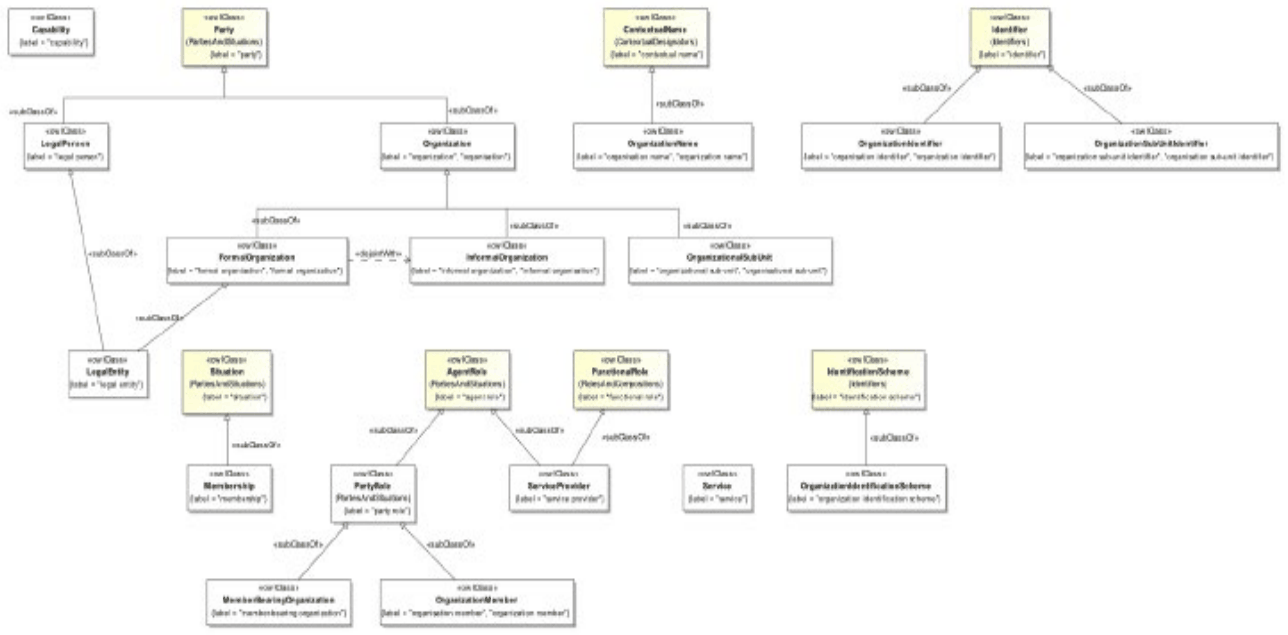
The detailed annotations and axioms that comprise the Commons Organizations Ontology are provided in Commons Organizations Ontology Details, below.
Classes
| Name | Annotations | Class Expressions |
|---|---|---|
|
Capability (capability) |
Definition: ability to perform a specific function or achieve a particular outcome Explanatory note: Capabilities are described in terms of outcomes as well as the roles involved in achieving those outcomes. The ability for an organization to perform or provide some capability may involve people with particular skills and knowledge, intellectual property, defined practices, operating facilities, tools and equipment. Adapted from: Business Architecture Core Metamodel, https://www.omg.org/spec/BACM Adapted from: The TOGAF Standard, https://pubs.opengroup.org/togaf-standard/business-architecture/business-capability-planning.html Adapted from: Value Delivery Modeling Language Specification, https://www.omg.org/spec/VDML |
Parent Class: cmns-cls:Aspect |
|
Capacity (capacity) |
Definition: maximum extent to which something or someone can perform a function or produce an output under specified conditions Explanatory note: In contrast with capability, the concept of capacity is constrained by upper limits on resources including time and within some context, in addition to having the ability to do so if circumstances allow. |
Parent Class: cmns-cls:Aspect |
|
FormalOrganization (formal organisation@en-GB, formal organization@en-US) |
Definition: organization that is recognized in some legal jurisdiction, with associated rights and responsibilities Preferred label: formal organization Example: Examples include a corporation, charity, government or church. Adapted from: https://www.w3.org/TR/vocab-org/#class-formalorganization |
Parent Class: Organization Property Restriction: ≥ 0 isDomiciledIn.cmns-loc:GeopoliticalEntity Class Axiom: ¬ InformalOrganization |
|
InformalOrganization (informal organisation@en-GB, informal organization@en-US) |
Definition: group of individuals who come together for a common purpose without forming a legal entity Preferred label: informal organization Explanatory note: A bridge club with officers and a bank account can be classified as an informal organization, but it depends on how the club is structured and whether it has taken steps to formalize its existence. If the bridge club has officers and a bank account but has not incorporated or registered as a legal entity (like a nonprofit organization or a corporation), it would be considered an informal organization. The officers manage the club's affairs, and the bank account is likely opened under the names of the officers or with the designation 'on behalf of the bridge club'. Explanatory note: There is usually no formal registration with governmental authorities, and the group operates based on mutual agreement among its members rather than a formal legal structure. |
Parent Class: Organization |
|
LegalEntity (legal entity) |
Definition: legal person that is a partnership, corporation, or other organization having the capacity to negotiate contracts, assume financial obligations, and pay off debts, organized under the laws of some jurisdiction Synonym: artificial person Synonym: juridical entity Synonym: juridical person Synonym: juristic person Scope note: The term 'legal entity' includes, but is not limited to, unique parties that are legally or financially responsible for the performance of financial transactions or have the legal right in their jurisdiction to enter independently into legal contracts, regardless of whether they are incorporated or constituted in some other way (e.g. trust, partnership, contractual). It excludes natural persons, but includes governmental organizations and supranationals. Adapted from: ISO 17442, Financial services - Legal Entity Identifier (LEI), first edition, 2012-06-01, section 3.1 |
Parent Class: FormalOrganization, LegalPerson |
|
LegalPerson (legal person@en) |
Definition: party that is recognized as having rights and obligations under the law, including but not limited to the right to sue and be sued, enter into contracts, own property, and incur financial and other obligations Explanatory note: To have legal personality means to be capable of having legal rights and duties within a certain legal system, such as to enter into contracts, sue, and be sued. Legal personality is a prerequisite to legal capacity, the ability of any legal person to amend (enter into, transfer, etc.) rights and obligations. |
Parent Class: cmns-pts:Party |
|
MemberBearingOrganization (member-bearing organization) |
Definition: role of a group or organization that has members that are people or other organizations |
Parent Class: cmns-pts:PartyRole Property Restriction: ∃ cmns-rlcmp:isPlayedBy.∃ cmns-col:hasMember.cmns-pts:Party |
|
Membership (membership@en) |
Definition: situation, corresponding to an n-ary relation, in which some group or organization has at least one member (person or organization) for some period of time |
Parent Class: cmns-pts:Situation Property Restriction: ∃ hasMembership.MemberBearingOrganization Property Restriction: ∃ hasOrganizationMember.OrganizationMember |
|
Organization (organisation@en-GB, organization@en-US) |
Definition: framework of authority within which a person, persons, or groups of people act, or are designated to act, towards some purpose, such as to meet a need or pursue collective goals Preferred label: organization Example: This may be a business entity, government, international organization, not-for-profit, academic institution, or other unincorporated and/or informal social organization. Adapted from: ISO/IEC 6523-1:1998 Information technology — Structure for the identification of organizations and organization parts — Part 1: Identification of organization identification schemes, https://www.iso.org/obp/ui/#iso:std:iso-iec:6523:-1:ed-1:v1:en |
Parent Class: cmns-pts:Party Property Restriction: ≥ 0 cmns-dsg:hasName.OrganizationName Property Restriction: ∀ cmns-col:hasPart.Organization Property Restriction: ∀ cmns-col:hasMember.cmns-pts:Party |
|
OrganizationalSubUnit (organisational sub-unit@en-GB, organizational sub-unit@en-US) |
Definition: any department or other entity within a larger organization that only has full recognition within the context of that organization, but requires identification for some purpose Preferred label: organizational sub-unit Synonym: organization part Explanatory note: In other words, it is not a legal entity in its own right. Adapted from: ISO/IEC 6523-1:1998 Information technology — Structure for the identification of organizations and organization parts — Part 1: Identification of organization identification schemes, https://www.iso.org/obp/ui/#iso:std:iso-iec:6523:-1:ed-1:v1:en See also: https://www.w3.org/TR/vocab-org/#org:OrganizationalUnit |
Parent Class: Organization Property Restriction: ∀ cmns-col:isPartOf.Organization |
|
OrganizationIdentificationScheme (organization identification scheme) |
Definition: identification scheme dedicated to the unique identification of organizations Adapted from: ISO/IEC 6523-1:1998 Information technology — Structure for the identification of organizations and organization parts — Part 1: Identification of organization identification schemes, https://www.iso.org/obp/ui/#iso:std:iso-iec:6523:-1:ed-1:v1:en |
Parent Class: cmns-id:IdentificationScheme |
|
OrganizationIdentifier (organisation identifier@en-GB, organization identifier@en-US) |
Definition: identifier assigned to an organization within an organization identification scheme, and unique within that scheme Preferred label: organization identifier Adapted from: ISO/IEC 6523-1:1998 Information technology — Structure for the identification of organizations and organization parts — Part 1: Identification of organization identification schemes, https://www.iso.org/obp/ui/#iso:std:iso-iec:6523:-1:ed-1:v1:en |
Parent Class: cmns-id:Identifier Property Restriction: ∃ cmns-id:identifies.Organization Property Restriction: = 1 cmns-col:isMemberOf.OrganizationIdentificationScheme |
|
OrganizationMember (organisation member@en-GB, organization member@en-US) |
Definition: party (person or organization) that has a membership role with respect to some organization Preferred label: organization member |
Parent Class: cmns-pts:PartyRole Property Restriction: ∃ cmns-rlcmp:isPlayedBy.∀ cmns-col:isMemberOf.Organization |
|
OrganizationName (organisation name@en-GB, organization name@en-US) |
Definition: designation by which some organization is known in some context Preferred label: organization name |
Parent Class: cmns-cxtdsg:ContextualName Property Restriction: ≥ 0 cmns-dsg:isNameOf.Organization |
|
OrganizationSubUnitIdentifier (organisation sub-unit identifier@en-GB, organization sub-unit identifier@en-US) |
Definition: identifier allocated to a particular organizational sub-unit Preferred label: organization sub-unit identifier Abbreviation: OPI Synonym: organization part identifier Adapted from: ISO/IEC 6523-1:1998 Information technology — Structure for the identification of organizations and organization parts — Part 1: Identification of organization identification schemes, https://www.iso.org/obp/ui/#iso:std:iso-iec:6523:-1:ed-1:v1:en |
Parent Class: cmns-id:Identifier Property Restriction: ∃ cmns-id:identifies.OrganizationalSubUnit |
|
Service (service) |
Definition: intangible activity performed by some party for the benefit of another party Example: Services include intangible products, such as accounting, banking, cleaning, consultancy, education, insurance, expertise, medical treatment, or transportation services. Explanatory note: Sometimes services are difficult to identify because they are closely associated with a good; such as the combination of a diagnosis with the administration of a medicine. No transfer of possession or ownership takes place when services are sold, and they (1) cannot be stored or transported, (2) are instantly perishable, and (3) come into existence at the time they are bought and consumed. Explanatory note: The OECD defines services as outputs produced to order and which cannot be traded separately from their production; ownership rights cannot be established over services and by the time their production is completed they must have been provided to the consumers. As an exception to this rule there is a group of industries, generally classified as service industries, some of whose outputs have characteristics of goods, i.e. those concerned with the provision, storage, communication and dissemination of information, advice and entertainment in the broadest sense of those terms; the products of these industries, where ownership rights can be established, may be classified either as goods or services depending on the medium by which these outputs are supplied. See also: https://unstats.un.org/unsd/nationalaccount/glossresults.asp?gID=501 |
Property Restriction: ∃ isProvidedBy.ServiceProvider Property Restriction: ≥ 0 provides.Capability |
|
ServiceProvider (service provider) |
Definition: role of an agent that provides some service, including but not limited to commercial or professional services Example: Example services may include consulting, financial, legal, real estate, education, communications, registration, regulatory, manufacturing, storage, processing, or other services. |
Parent Class: cmns-pts:AgentRole, cmns-rlcmp:FunctionalRole |
Properties
| Name | Annotations | Property Axioms |
|---|---|---|
|
designates (designates) |
Definition: appoints someone officially Explanatory note: This property is intended to cover assigning a job or role to someone, selecting or designating someone to fill an office or a position, and fixing or setting by authority or by mutual agreement. |
Parent Property: cmns-pts:hasRelatedPartyRole Domain: cmns-pts:PartyRole Range: cmns-pts:PartyRole |
|
hasMembership (has membership) |
Definition: identifies the organization acting in the role of having members in an organizational membership situation |
Parent Property: cmns-pts:hasActor Domain: Membership Range: MemberBearingOrganization Inverse: isMembershipPartyIn |
|
hasOrganizationMember (has organization member) |
Definition: indicates the party acting in the role of the member in an organizational membership situation |
Parent Property: cmns-pts:hasUndergoer Domain: Membership Range: OrganizationMember Inverse: isOrganizationMember |
|
hasSubUnit (has sub-unit) |
Definition: relates an organization to a part of that organization See also: https://www.w3.org/TR/vocab-org/#org:hasSubOrganization |
Parent Property: cmns-col:hasPart Domain: Organization Range: OrganizationalSubUnit Inverse: isSubUnitOf |
|
hasURL (has URL) |
Definition: links something to a web resource that specifies its location on a computer network and a method for retrieving it Synonym: has uniform resource locator |
Range: xsd:anyURI |
|
hasWebsite (has website) |
Definition: links something to a page or set of related web pages located under a single domain name, typically produced by a single person or organization Explanatory note: Web Design and Applications involve the standards for building and Rendering Web pages, including HTML, CSS, SVG, device APIs, and other technologies for Web Applications ('WebApps'). HTML (the Hypertext Markup Language) and CSS (Cascading Style Sheets) are two of the core technologies for building Web pages. HTML provides the structure of the page, CSS the (visual and aural) layout, for a variety of devices and services. See also: https://www.w3.org/standards/webdesign/ |
Parent Property: hasURL Range: xsd:anyURI |
|
isDesignatedBy (is designated by) |
Definition: indicates the role of the party that has assigned or appointed someone to an office or position |
Parent Property: cmns-pts:hasRelatedPartyRole Domain: cmns-pts:PartyRole Range: cmns-pts:PartyRole Inverse: designates |
|
isDomiciledIn (is domiciled in) |
Definition: indicates the principal place where an entity conducts business within some country, such as where its headquarters is located Explanatory note: Corporate domicile refers to a place where a company's affairs are discharged. It is also typically the legal home of a corporation within a country because the place is considered by law as the center of corporate affairs. In cases where a business has incorporated in one location for convenience, such as for taxation, legal, or regulatory purposes, but operates primarily in one or more other locations, domicile refers to the operational location(s) rather than legal location. Many companies in the US have incorporated in the State of Delaware, for example, but do not have operational facilities in Delaware (or only have small offices there). |
Parent Property: cmns-loc:hasRegion Domain: FormalOrganization Range: cmns-loc:GeopoliticalEntity |
|
isManagedBy (is managed by) |
Definition: indicates the role of a party that directs the affairs or administration of something or someone |
Parent Property: cmns-pts:hasPartyRole Range: cmns-pts:PartyRole |
|
isMembershipPartyIn (is membership party in) |
Definition: indicates the membership situation in which the party plays the role of having members |
Parent Property: cmns-pts:actsIn Domain: MemberBearingOrganization Range: Membership |
|
isOrganizationMember (is organization member) |
Definition: indicates the context of membership in which the party plays the role of an organization member |
Parent Property: cmns-pts:undergoes Domain: OrganizationMember Range: Membership |
|
isProvidedBy (is provided by) |
Definition: is made available by |
Inverse: provides |
|
isProvidedTo (is provided to) |
Definition: is made available to |
|
|
isSubUnitOf (is sub-unit of) |
Definition: relates a part of an organization to the larger entity See also: https://www.w3.org/TR/vocab-org/#org:subOrganizationOf |
Parent Property: cmns-col:isPartOf Domain: OrganizationalSubUnit Range: Organization |
|
manages (manages) |
Definition: relates a party role to something or someone that it directs or administers in some way |
Parent Property: cmns-rlcmp:isRoleIn Domain: cmns-pts:PartyRole Inverse: isManagedBy |
|
provides (provides) |
Definition: makes available |